. 2021 Jan 22;11(1):2106.
doi: 10.1038/s41598-021-81588-8.

Suppression of IL-23-mediated psoriasis-like inflammation by regulatory B cells

Affiliations

Suppression of IL-23-mediated psoriasis-like inflammation by regulatory B cells

Kie Mizumaki et al. Sci Rep. .

Abstract

Psoriasis is an inflammatory cutaneous disease mediated by T-cell dependent immune responses; however, B cells are also considered to play an important role its development. Regulatory B cells (Bregs) regulate immune responses negatively through interleukin-10 (IL-10) production. This study aimed to investigate the role of Bregs in IL-23-mediated psoriasis-like inflammation in mice. Psoriasis-like inflammation was induced in B cell-specific phosphatase and tensin homolog (PTEN)-deficient mice, in which Bregs were significantly expanded, and in their controls, by intradermal injection of 20 μL phosphate-buffered saline (PBS) containing 0.5 μg rmIL-23 into one ear, every other day for 16 days. IL-23-mediated psoriasis-like inflammation was suppressed in B cell-specific PTEN-deficient mice along with decreased ear thickness and epidermal thickness on day 15. Moreover, adoptive transfer of B1 B cells suppressed IL-23-mediated psoriasis-like inflammation. rmIL-23-injected B cell-specific PTEN-deficient mice showed expanded regulatory T cells (Tregs) in the spleen and draining lymph nodes along with increased Bregs. Further, T helper (Th) 17 differentiation in the rmIL-23-injected ear was suppressed in B cell-specific PTEN-deficient mice. Overall, these results indicate that increased Bregs suppress IL-23-mediated psoriasis-like inflammation through Treg expansion and inhibition of Th17 differentiation. Thus, targeting Bregs may be a feasible treatment strategy for psoriasis.


Conflict of interest statement

The authors declare no competing interests.

Figures
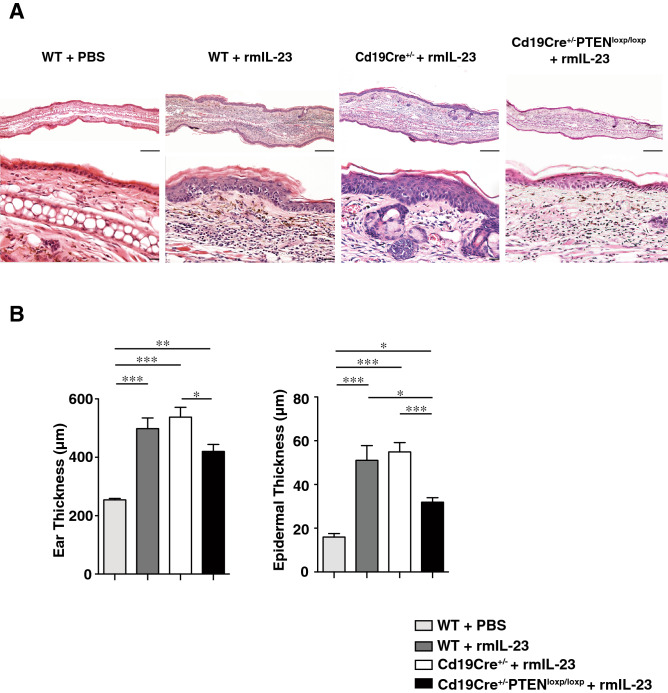
Figure 1
Figure 1
IL-23-mediated psoriasis-like inflammation was suppressed more in B cell-specific PTEN-deficient mice. (A) H&E staining of skin section from rmIL-23 or PBS-injected ears in WT mice, Cd19Cre+/− mice and Cd19Cre+/−PtenloxP/loxP mice. rmIL-23 induced hyperkeratosis, parakeratosis, acanthosis, and infiltration of mononuclear cells in the dermis (original magnification × 40, 200; bars = 200 μm and 20 μm). (B) Ear thickness and epidermal thickness were measured on day 15 in WT mice, Cd19Cre+/− or Cd19Cre+/−PtenloxP/loxP mice with intradermal injection of 20 μL PBS/0.1% BSA with or without 0.5 μg rmIL-23. Values represent means ± SEMs. Significant differences between sample means are indicated as: *P < 0.05, **P < 0.01, ***P < 0.001.
Figure 2
Figure 2
Cell infiltration of rmIL-23-injected ears was decreased in B cell-specific PTEN-deficient mice. Immunohistochemical staining of skin section from rmIL-23-injected ears in Cd19Cre+/− and Cd19Cre+/−PtenloxP/loxP mice (original magnification × 400; bars = 20 μm). The number of CD4+ T cells (A), CD8+ T cells (B), B cells (C) and F4/80+ macrophages (D) per field of view (× 400) were counted. Values represent means ± SEMs. Significant differences between samples means are indicated as: *P < 0.05, ***P < 0.001.
Figure 3
Figure 3
rmIL-23 injection increased the number of CD4+ T cells in the spleen and draining lymph nodes and B cells in the draining lymph nodes in B cell-specific PTEN-deficient mice. The number of CD4+ T cells, CD8+ T cells, and B cells in the spleen (A) and draining lymph nodes (B) of rmIL-23 injected Cd19Cre+/− and Cd19Cre+/−PtenloxP/loxP mice. Values represent means ± SEMs. Significant differences between samples means are indicated as: *P < 0.05, **P < 0.01.
Figure 4
Figure 4
Tregs in the spleen and draining lymph nodes were expanded in rmIL-23-injected B cell-specific PTEN-deficient mice along with increased Bregs. The frequencies and numbers of IL-10-producing B cells (A) and CD25+FoxP3+ T cells (B) in the spleen of rmIL-23-injected Cd19Cre+/− and Cd19Cre+/−PtenloxP/loxP mice. The frequencies and numbers of IL-10-producing B cells (C) and CD25 + FoxP3 + T cells (D) in the draining lymph node of rmIL-23-injected Cd19Cre+/− and Cd19Cre+/−PtenloxP/loxP mice. The images were created with FlowJo software (version 10.1R5; Tree Star, San Carlos, CA, USA, https://www.flowjo.com/). Significant differences between samples means are indicated as: *P < 0.05, **P < 0.01, ***P < 0.001.
Figure 5
Figure 5
Th17 differentiation in rmIL-23-injected ears was suppressed in B cell-specific PTEN-deficient mice. The number of CD4+ T cells, CD8+ T cells, and B cells in the inflamed skin of rmIL-23 injected Cd19Cre+/− and Cd19Cre+/−PtenloxP/loxP mice (A). The frequencies of CD25+FoxP3+ T cells (B) and CD4+IL-17A+ T cells in the inflamed skin of rmIL-23-injected Cd19Cre+/− and Cd19Cre+/−PtenloxP/loxP mice (C). The images were created with FlowJo software (version 10.1R5; Tree Star, San Carlos, CA, USA, https://www.flowjo.com/).
Figure 6
Figure 6
Adoptive transfer of B1 B cells suppressed IL-23-mediated psoriasis-like inflammation. (A) Splenic B cells from Cd19Cre+/−PtenloxP/loxP mice were isolated, stained for CD1d, CD5, and CD19 expression; and sorted into CD1dintCD5+ B1 B cells and CD1dintCD5- follicular B cells before stimulation with a mixture of LPS, PMA, ionomycin, and brefeldin-A for 5 h. IL-10+ B cells derived from each purified population were analyzed using flow cytometry. (B) Isolated splenic B cells (1 × 106 cells) from Cd19Cre+/−PtenloxP/loxP mice were transferred into WT mice before rmIL-23 injection. H&E staining of skin section from ears in WT mice (original magnification × 20; bars = 20 μm). (C) Effect of adoptive transfer of B1 B cells on ear thickness and epidermal thickness. The images were created with FlowJo software (version 10.1R5; Tree Star, San Carlos, CA, USA, https://www.flowjo.com/). Values represent means ± SEMs (n = 10 mice/group). Significant differences between samples means are indicated as: *P < 0.05, **P < 0.01, ***P < 0.001.

References

    1. Nestle FO, Kaplan DH, Barker J. Psoriasis. N. Engl. J. Med. 2009;361:496–509. doi: 10.1056/NEJMra0804595. - DOI - PubMed
    1. Gelfand JM, et al. Determinants of quality of life in patients with psoriasis: a study from the US population. J. Am. Acad. Dermatol. 2004;51:704–708. doi: 10.1016/j.jaad.2004.04.014. - DOI - PubMed
    1. Mueller W, Herrmann B. Cyclosporin A for psoriasis. N. Engl. J. Med. 1979;301:555. doi: 10.1056/nejm197909063011016. - DOI - PubMed
    1. Di Cesare A, Di Meglio P, Nestle FO. The IL-23/Th17 axis in the immunopathogenesis of psoriasis. J. Invest. Dermatol. 2009;129:1339–1350. doi: 10.1038/jid.2009.59. - DOI - PubMed
    1. Dass S, Vital EM, Emery P. Development of psoriasis after B cell depletion with rituximab. Arthritis Rheum. 2007;56:2715–2718. doi: 10.1002/art.22811. - DOI - PubMed

Publication types

MeSH terms

Grants and funding
