


Prolonged ketamine infusion modulates limbic connectivity and induces sustained remission of treatment-resistant depression
- PMID: 33483802
- PMCID: PMC7969576
- DOI: 10.1007/s00213-021-05762-6
Prolonged ketamine infusion modulates limbic connectivity and induces sustained remission of treatment-resistant depression
Abstract
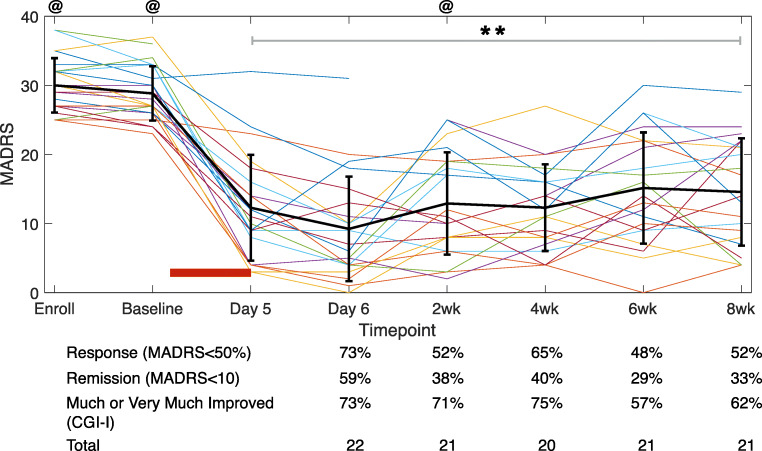
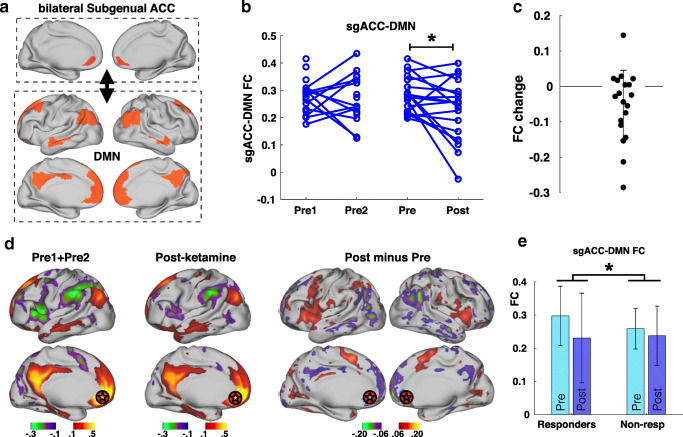
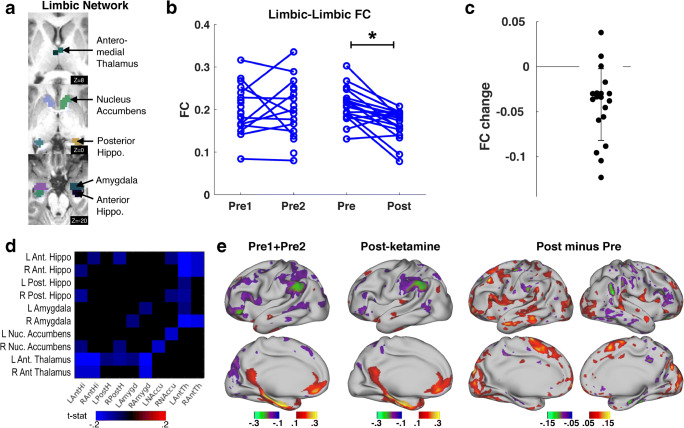
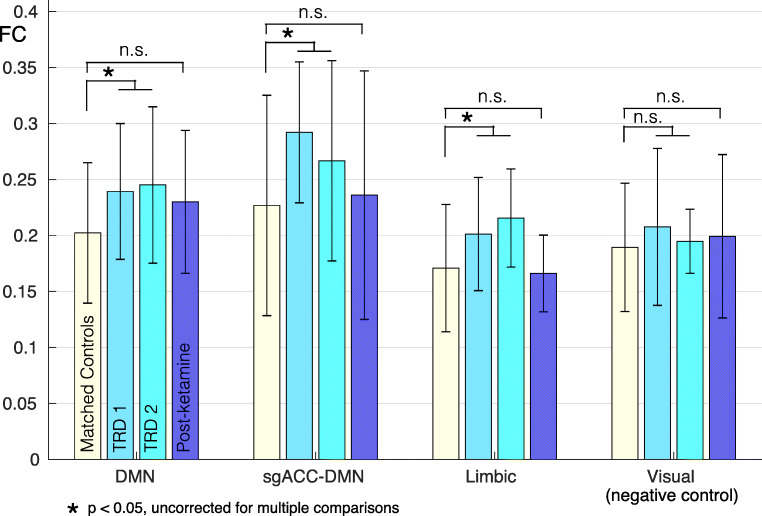
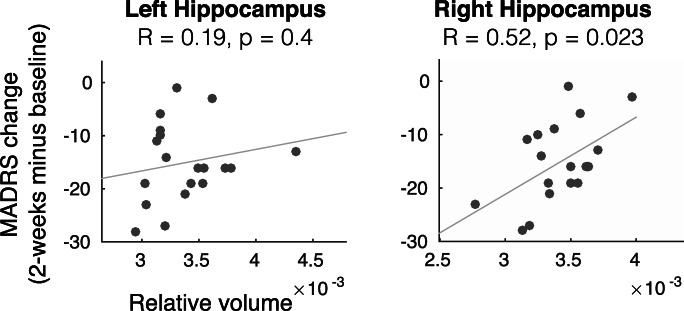
Ketamine produces a rapid antidepressant response in over 50% of adults with treatment-resistant depression. A long infusion of ketamine may provide durable remission of depressive symptoms, but the safety, efficacy, and neurobiological correlates are unknown. In this open-label, proof-of-principle study, adults with treatment-resistant depression (N = 23) underwent a 96-h infusion of intravenous ketamine (0.15 mg/kg/h titrated toward 0.6 mg/kg/h). Clonidine was co-administered to reduce psychotomimetic effects. We measured clinical response for 8 weeks post-infusion. Resting-state functional magnetic resonance imaging was used to assess functional connectivity in patients pre- and 2 weeks post-infusion and in matched non-depressed controls (N = 27). We hypothesized that responders to therapy would demonstrate response-dependent connectivity changes while all subjects would show treatment-dependent connectivity changes. Most participants completed infusion (21/23; mean final dose 0.54 mg/kg/h, SD 0.13). The infusion was well tolerated with minimal cognitive and psychotomimetic side effects. Depressive symptoms were markedly reduced (MADRS 29 ± 4 at baseline to 9 ± 8 one day post-infusion), which was sustained at 2 weeks (13 ± 8) and 8 weeks (15 ± 8). Imaging demonstrated a response-dependent decrease in hyperconnectivity of the subgenual anterior cingulate cortex to the default mode network, and a treatment-dependent decrease in hyperconnectivity within the limbic system (hippocampus, amygdala, medial thalamus, nucleus accumbens). In exploratory analyses, connectivity was increased between the limbic system and frontal areas, and smaller right hippocampus volume at baseline predicted larger MADRS change. A single prolonged infusion of ketamine provides a tolerated, rapid, and sustained response in treatment-resistant depression and normalizes depression-related hyperconnectivity in the limbic system and frontal lobe. ClinicalTrials.gov : Treatment Resistant Depression (Pilot), NCT01179009.
Keywords: Depression; Functional connectivity; Hippocampus; Ketamine; Limbic system; Subgenual anterior cingulate cortex.
Conflict of interest statement
Author GEN has received research support from NIMH, The Barnes Jewish Hospital Foundation, the Center for Brain Research in Depression, Center for Diabetes Translational Research, Institute for Clinical Translational Science and the McDonnell Center for Systems Neuroscience at Washington University School of Medicine, and has consulted for Alkermes. Author NBF receives research support from the BJH Foundation and holds patents on the use of clonidine to improve the tolerability of ketamine. Author EJL receives grant/research support from NIA, NCCIH, OBSSR, FDA, PCORI, McKnight Brain Research Foundation, Takeda, Alkermes, Aptinyx, Johnson & Johnson, and Lundbeck and previously Roche and the Sidney R. Baer Foundation and he has consulted for Janssen Pharmaceuticals and Jazz Pharmaceuticals. Authors JSS, BJP, BMA, EDK, JAS, AZS, and MDY all report no relevant financial disclosures.
Figures
References
MeSH terms
Substances
Associated data
Grants and funding
LinkOut - more resources
Full Text Sources
Other Literature Sources
Medical
