


Plant-feeding may explain why the generalist predator Euseius stipulatus does better on less defended citrus plants but Tetranychus-specialists Neoseiulus californicus and Phytoseiulus persimilis do not
- PMID: 33483836
- PMCID: PMC7851013
- DOI: 10.1007/s10493-020-00588-x
Plant-feeding may explain why the generalist predator Euseius stipulatus does better on less defended citrus plants but Tetranychus-specialists Neoseiulus californicus and Phytoseiulus persimilis do not
Abstract
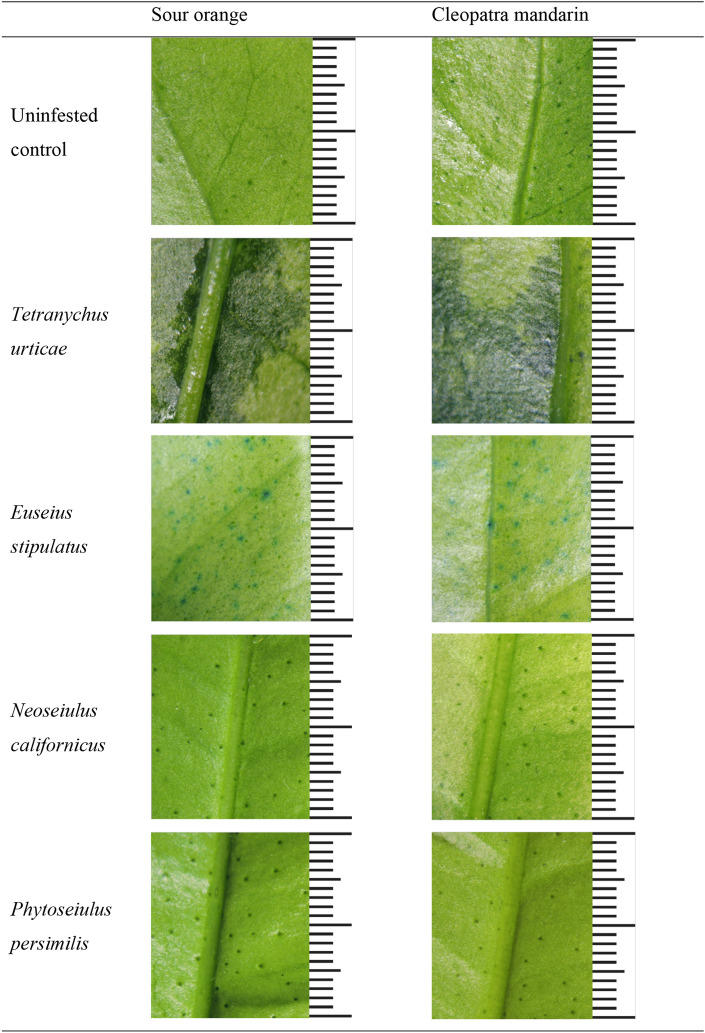
The generalist predator Euseius stipulatus (Athias-Henriot) and the Tetranychidae-specialist predators Neoseiulus californicus (McGregor) and Phytoseiulus persimilis Athias-Henriot play a key role in the regulation of Tetranychus urticae Koch in Spanish citrus orchards. Previous studies have shown that sour orange (Citrus aurantium L.) and Cleopatra mandarin (Citrus reshni hort. ex Tan.) display extreme resistance and susceptibility to T. urticae, respectively. When offered a choice between these two genotypes infested by T. urticae, E. stipulatus preferred Cleopatra mandarin, whereas the specialists did not show any preference. The present study was undertaken to check whether these preferences could be related to the feeding of E. stipulatus on the host plant and/or to differences in prey feeding on the two plants. Our results demonstrate that E. stipulatus is a zoophytophagous mite, which can engage in direct plant feeding in sour orange and Cleopatra mandarin, whereas neither N. californicus nor P. persimilis do so. Whereas Cleopatra mandarin provided a higher-quality prey/feeding substrate for E. stipulatus, which may be related to its phytophagy, no differences were observed for the two specialists. As higher constitutive and faster inducible defense against T. urticae in sour orange relative to Cleopatra mandarin plants result in sour orange supporting lower T. urticae densities and plant damage, our results demonstrate that pest regulation by specialist natural enemies may be more effective when prey feed on better defended plants.
Keywords: Cleopatra mandarin; Phytoseiidae; Plant defense; Sour orange; Zoophytophagy.
Conflict of interest statement
The authors declare that they have no conflict of interest.
Figures
References
-
- Abad-Moyano R, Pina T, Ferragut F, Urbaneja A. Comparative life-history traits of three phytoseiids mites associated with Tetranychus urticae (Acari: Tetranychidae) colonies in clementine orchards in eastern Spain: implications for biological control. Exp Appl Acarol. 2009;47:121–132. doi: 10.1007/s10493-008-9197-z. - DOI - PubMed
-
- Aguilar-Fenollosa E, Ibáñez-Gual MV, Pascual-Ruiz S, Hurtado M, Jacas JA. Effect of ground-cover management on spider mites and their phytoseiid natural enemies in clementine mandarin orchards (I): bottom-up regulation mechanisms. Biol Control. 2011;59(2):158–170. doi: 10.1016/j.biocontrol.2011.06.013. - DOI
MeSH terms
Grants and funding
LinkOut - more resources
Full Text Sources
Other Literature Sources
Research Materials
