


Maternal Intake of Lutein and Zeaxanthin during Pregnancy Is Positively Associated with Offspring Verbal Intelligence and Behavior Regulation in Mid-Childhood in the Project Viva Cohort
- PMID: 33484136
- PMCID: PMC7948203
- DOI: 10.1093/jn/nxaa348
Maternal Intake of Lutein and Zeaxanthin during Pregnancy Is Positively Associated with Offspring Verbal Intelligence and Behavior Regulation in Mid-Childhood in the Project Viva Cohort
Abstract
Background: Lutein and zeaxanthin are carotenoids associated with better cognition at older age. To our knowledge, no previous study has evaluated their cognitive implications in the prenatal period, when the brain undergoes its most rapid development.
Objective: The objective of this study was to examine associations of maternal lutein and zeaxanthin (L/Z) intake during pregnancy with child cognition.
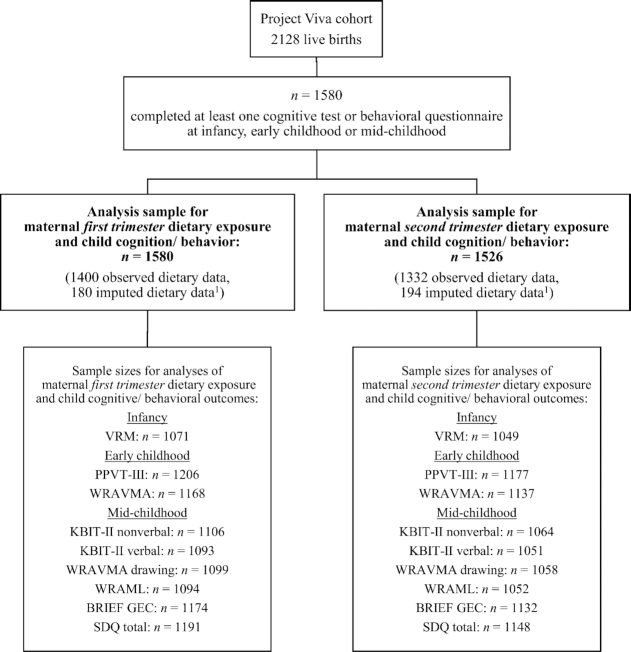
Design: Among 1580 mother-child pairs in Project Viva, a prospective cohort, we assessed maternal intake of L/Z during pregnancy using food frequency questionnaires and offspring cognition by the Visual Recognition Memory paradigm in infancy, the Peabody Picture Vocabulary Test and the Wide Range Assessment of Visual Motor Abilities (WRAVMA) in early childhood, and the Kaufman Brief Intelligence Test (KBIT-II), the WRAVMA drawing subtest, and the Wide Range Assessment of Memory and Learning in mid-childhood. Parents completed the Behavior Rating Inventory of Executive Function (BRIEF) and Strengths and Difficulties Questionnaire.
Results: Mothers consumed a daily mean (SD) of 2.6 (2.0) mg L/Z in the first and second trimesters of pregnancy. Mean mid-childhood KBIT-II verbal scores were higher with greater maternal L/Z intake [difference of Q4-Q1 means for first trimester: 2.67 (95% CI: 0.13, 5.20) and for second trimester: 3.55 (95% CI: 0.81, 6.28)], indicating better verbal intelligence. Secondary analyses on cognitive subtests showed that mean mid-childhood BRIEF Behavioral Regulation Index scores were lower with greater maternal L/Z intake [difference of Q4-Q1 means for first trimester: -1.63 (95% CI: -3.22, -0.04) and for second trimester: -1.89 (95% CI: -3.58, -0.21)], indicating better behavior regulation ability.
Conclusions: Higher maternal L/Z intake during pregnancy was associated with better offspring verbal intelligence and behavior regulation ability in mid-childhood, suggesting a potential benefit during prenatal development. We did not find a benefit of higher maternal L/Z intake on other child cognitive or behavioral outcomes. Project Viva is registered at clinicaltrials.gov as NCT02820402.
Keywords: birth cohort; childhood cognition; cognitive development; early development; early life nutrition; lutein and zeaxanthin; maternal diet during pregnancy; prenatal nutrition; programming.
© The Author(s) 2021. Published by Oxford University Press on behalf of the American Society for Nutrition.
Figures
References
-
- Johnson EJ. A possible role for lutein and zeaxanthin in cognitive function in the elderly. Am J Clin Nutr. 2012;96:1161S. - PubMed
-
- Johnson EJ. Role of lutein and zeaxanthin in visual and cognitive function throughout the lifespan. Nutr Rev. 2014;72:605–12. - PubMed
-
- Vishwanathan R, Kuchan MJ, Sen S, Johnson EJ. Lutein and preterm infants with decreased concentrations of brain carotenoids. J Pediatr Gastroenterol Nutr. 2014;59:659–65. - PubMed
-
- Renzi LM, Johnson EJ. Lutein and age-related ocular disorders in the older adult. J Nutr Elder. 2008;26:139–57. - PubMed
Publication types
MeSH terms
Substances
Associated data
Grants and funding
LinkOut - more resources
Full Text Sources
Other Literature Sources
Medical
