


Trends in the utilization of marginal donors for orthotopic heart transplantation
- PMID: 33484206
- PMCID: PMC9122040
- DOI: 10.1111/jocs.15359
Trends in the utilization of marginal donors for orthotopic heart transplantation
Abstract
Background: This study explored trends in utilization of marginal donors for orthotopic heart transplantation (OHT) in the United States.
Methods: Using the United Network for Organ Sharing database, adults (≥18 years) undergoing OHT between 2009 and 2019 were identified. Marginal donors were defined as having ≥2 of the following: age ≥50 years, ejection fraction less than 50%, ischemic time greater than 240 min, donor-to-recipient body mass index ratio less than 0.8, or donor inotrope use. Kaplan-Meier analysis was utilized to model survival with multivariable Cox regression analysis used for risk-adjustment.
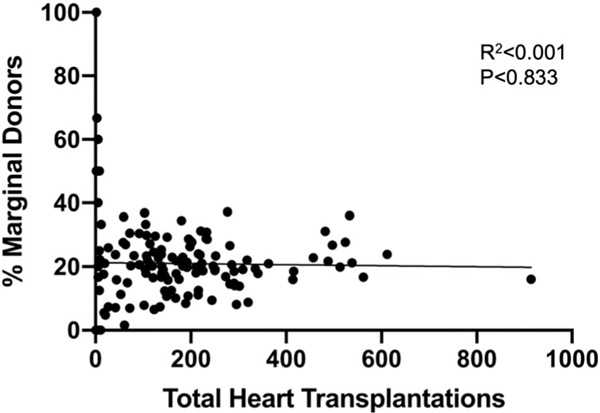
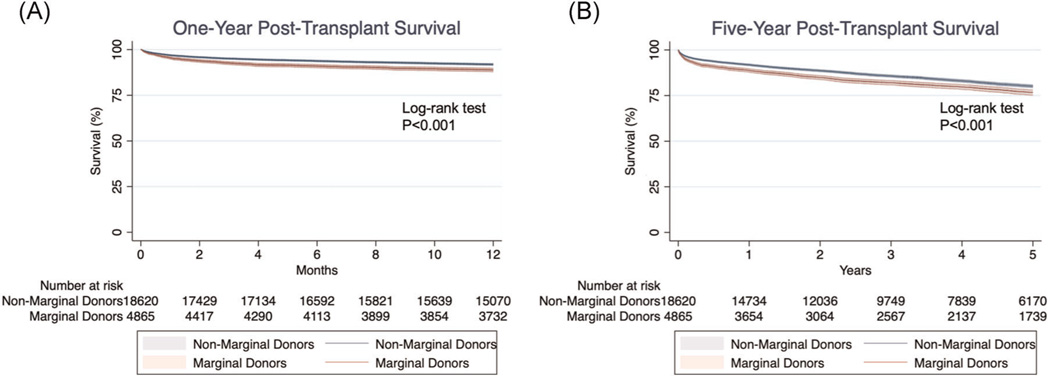
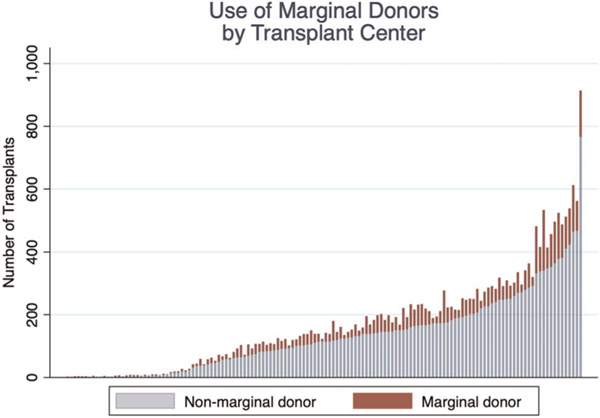
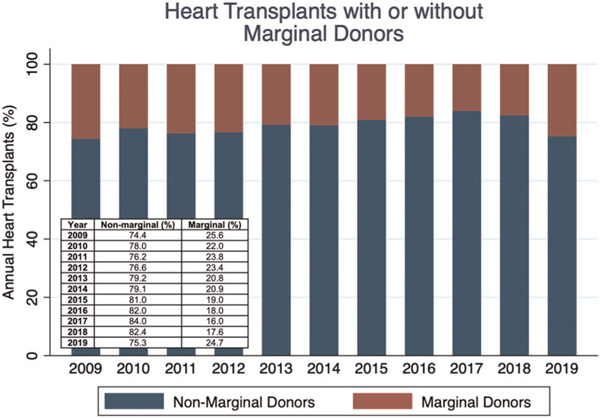
Results: A total of 23,580 recipients underwent OHT with 4896 (20.76%) receiving organs from marginal donors. The use of marginal donors decreased from 25.6% in 2009 to 16.0% in 2017 but accounted for 24.7% of OHTs in 2019. This recent increase in marginal donor use was largely attributable to increased use of donors with ischemic time greater than 240 min, whereas other marginal donor criteria remained stable. Among 140 centers, median marginal donor use was 20.07% (interquartile range, 14.17%-26.51%). An increasing proportion of marginal donors was not associated with increased center-level OHT volume (R2 < 0.001, p = .833). Marginal donor use was associated with reduced 1- (88.75% vs. 91.87%) and 5-year survival (76.73% vs. 80.08%, p < .001). Following adjustment, marginal donor use remained a significant predictor of post-OHT mortality (hazard ratio, 1.17; p < .001).
Conclusion: Marginal donors account for approximately 20% of OHTs performed in the United States. Despite a reduction in utilization over the past decade, the 2018 allocation change has resulted in a significant increase in use, largely attributable to longer ischemic times.
Keywords: cardiovascular pathology; transplant.
© 2021 Wiley Periodicals LLC.
Figures
References
MeSH terms
Grants and funding
LinkOut - more resources
Full Text Sources
Other Literature Sources
Medical
Miscellaneous
