


The combined effects of obesity and ageing on skeletal muscle function and tendon properties in vivo in men
- PMID: 33484409
- PMCID: PMC8128745
- DOI: 10.1007/s12020-020-02601-0
The combined effects of obesity and ageing on skeletal muscle function and tendon properties in vivo in men
Abstract
Purpose: We investigated the combined impact of ageing and obesity on Achilles tendon (AT) properties in vivo in men, utilizing three classification methods of obesity.
Method: Forty healthy, untrained men were categorised by age (young (18-49 years); older (50-80 years)), body mass index (BMI; normal weight (≥18.5-<25); overweight (≥25-<30); obese (≥30)), body fat% (normal adipose (<28%); high adiposity (≥28%)) and fat mass index (FMI; normal (3-6); excess fat (>6-9); high fat (>9). Assessment of body composition used dual-energy X-ray absorptiometry, gastrocnemius medialis (GM)/AT properties used dynamometry and ultrasonography and endocrine profiling used multiplex luminometry.
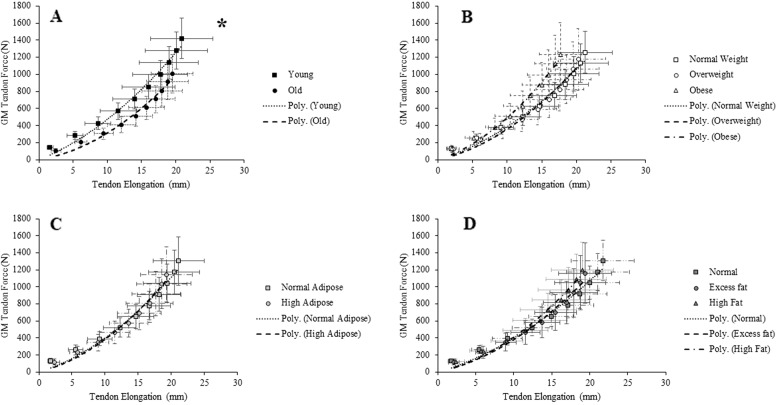
Results: Older men had lower total range of motion (ROM; -11%; P = 0.020), GM AT force (-29%; P < 0.001), stiffness (-18%; P = 0.041), Young's modulus (-22%; P = 0.011) and AT stress (-28%; P < 0.001). All three methods of classifying obesity revealed obesity to be associated with lower total ROM (P = 0.014-0.039). AT cross sectional area (CSA) was larger with higher BMI (P = 0.030). However, after controlling for age, higher BMI only tended to be associated with greater tendon stiffness (P = 0.074). Interestingly, both AT CSA and stiffness were positively correlated with body mass (r = 0.644 and r = 0.520) and BMI (r = 0.541 and r = 0.493) in the young but not older adults. Finally, negative relationships were observed between AT CSA and pro-inflammatory cytokines TNF-α, IL-6 and IL-1β.
Conclusions: This is the first study to provide evidence of positive adaptations in tendon stiffness and size in vivo resulting from increased mass and BMI in young but not older men, irrespective of obesity classification.
Keywords: Adiposity; Aging; Body fat percentage; Body mass index; Obesity; Tendon.
Conflict of interest statement
The authors declare that they have no conflict of interest.
Figures

References
-
- Collins KH, Herzog W, MacDonald GZ, Reimer RA, Rios JL, Smith IC, Zernicke RF, Hart DA. Obesity, metabolic syndrome, and musculoskeletal disease: common inflammatory pathways suggest a central role for loss of muscle integrity. Front. Physiol. 2018;9:112. doi: 10.3389/fphys.2018.00112. - DOI - PMC - PubMed
-
- de Carvalho DHT, Scholes S, Santos JLF, de Oliveira C, Alexandre TDS. Does abdominal obesity accelerate muscle strength decline in older adults? Evidence from the english longitudinal study of ageing. J. Gerontol. A Biol. Sci. Med. Sci. 2019;74(7):1105–1111. doi: 10.1093/gerona/gly178. - DOI - PMC - PubMed
Publication types
MeSH terms
LinkOut - more resources
Full Text Sources
Other Literature Sources
Medical
