. 2021 Mar:182:177-184.
doi: 10.1016/j.biochi.2021.01.010. Epub 2021 Jan 20.

Protein structural heterogeneity: A hypothesis for the basis of proteolytic recognition by the main protease of SARS-CoV and SARS-CoV-2

Affiliations

Protein structural heterogeneity: A hypothesis for the basis of proteolytic recognition by the main protease of SARS-CoV and SARS-CoV-2

Mira A M Behnam. Biochimie. 2021 Mar.

Abstract

The main protease (Mpro) of SARS-CoV and SARS-CoV-2 is a key enzyme in viral replication and a promising target for the development of antiviral therapeutics. The understanding of this protein is based on a number of observations derived from earlier x-ray structures, which mostly consider substrates or ligands as the main reason behind modulation of the active site. This lead to the concept of substrate-induced subsite cooperativity as an initial attempt to explain the dual binding specificity of this enzyme in recognizing the cleavage sequences at its N- and C-termini, which are important processing steps in obtaining the mature protease. The presented hypothesis proposes that structural heterogeneity is a property of the enzyme, independent of the presence of a substrate or ligand. Indeed, the analysis of Mpro structures of SARS-CoV and SARS-CoV-2 reveals a conformational diversity for the catalytically competent state in ligand-free structures. Variation in the binding site appears to result from flexibility at residues lining the S1 subpocket and segments incorporating methionine 49 and glutamine 189. The structural evidence introduces "structure-based recognition" as a new paradigm in substrate proteolysis by Mpro. In this concept, the binding space in subpockets of the enzyme varies in a non-cooperative manner, causing distinct conformations, which recognize and process different cleavage sites, as the N- and C-termini. Insights into the recognition basis of the protease provide explanation to the ordered processing of cleavage sites. The hypothesis expands the conformational space of the enzyme and consequently opportunities for drug development and repurposing efforts.

Keywords: Antiviral drugs; Conformational selection; SARS-CoV; SARS-CoV-2; Viral protease.


Conflict of interest statement

Declaration of competing interest The author declares no competing financial interest.

Figures
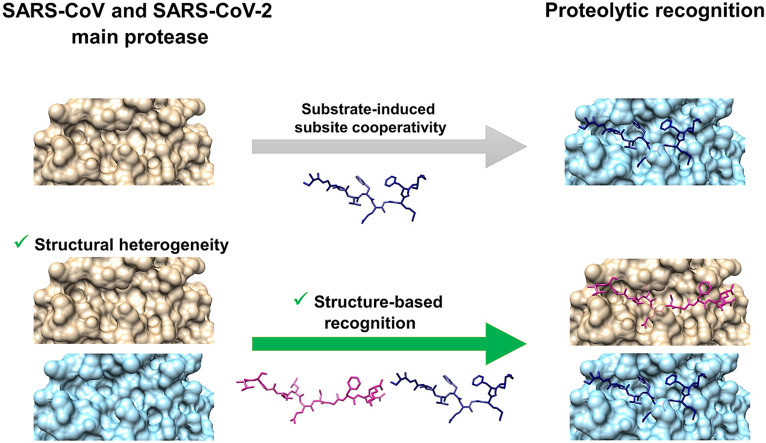
Image 1
Graphical abstract
Fig. 1
Fig. 1
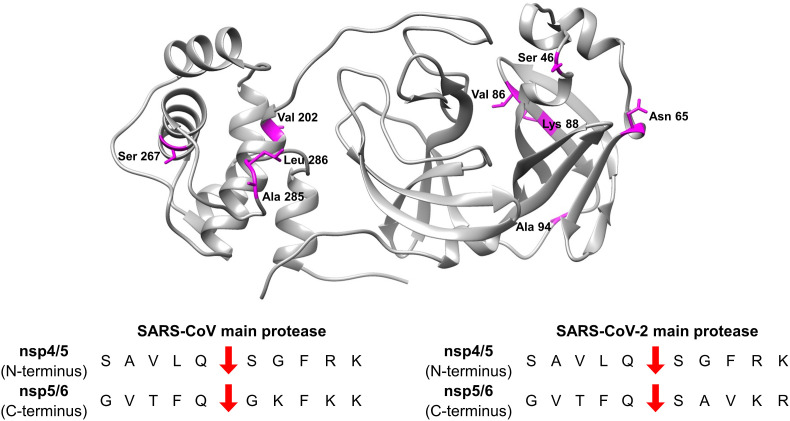
Mapping of residues of the main protease of SARS-CoV-2, which differ from SARS-CoV. Structure 6Y2E is depicted in ribbon form in grey, non-conserved residues are shown in stick form in magenta. Cleavage sequences at the N- and C-termini of the main protease (NSP5) are shown. (Sequence alignment and a complete list of cleavage sites are provided in the Supporting Information, as Fig. S1 and Table S1, respectively).
Fig. 2
Fig. 2
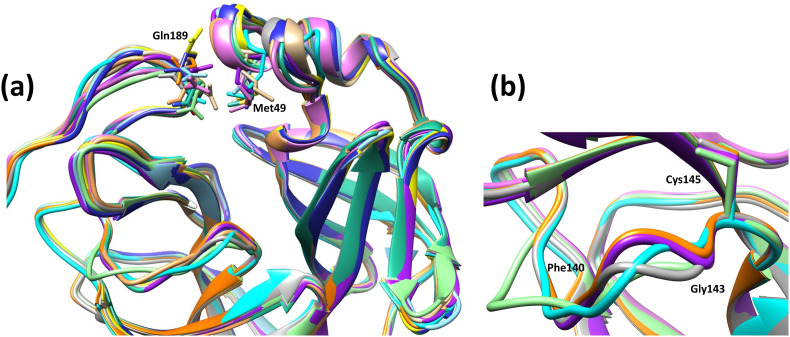
Structural heterogeneity of the main protease of SARS-CoV and SARS-CoV-2. (a) Overlay of representative ligand-free structures and complexes of SARS-CoV and SARS-CoV-2 main protease in ribbon form to show variation in the segments containing Met49 and Gln189. Color code: 6Y2E in light purple, 6Y2F in light blue, 6Y2G in purple, 6M0K in blue, 7BRO in dark cyan, 1UK3 in cyan, 2C3S in light orange, 2GT7 in orange, 2GTB in tan, 4MDS in yellow, 2VJ1 in grey, 2DUC in light green. Structures 6Y2E, 7BRO, 2C3S, 1UK3, 2GT7, and 2DUC are ligand-free structures. (b) Zoomed-in view of the backbone flexibility in Gly143 at the oxyanion loop. Same color code is used as in section (a).
Fig. 3
Fig. 3
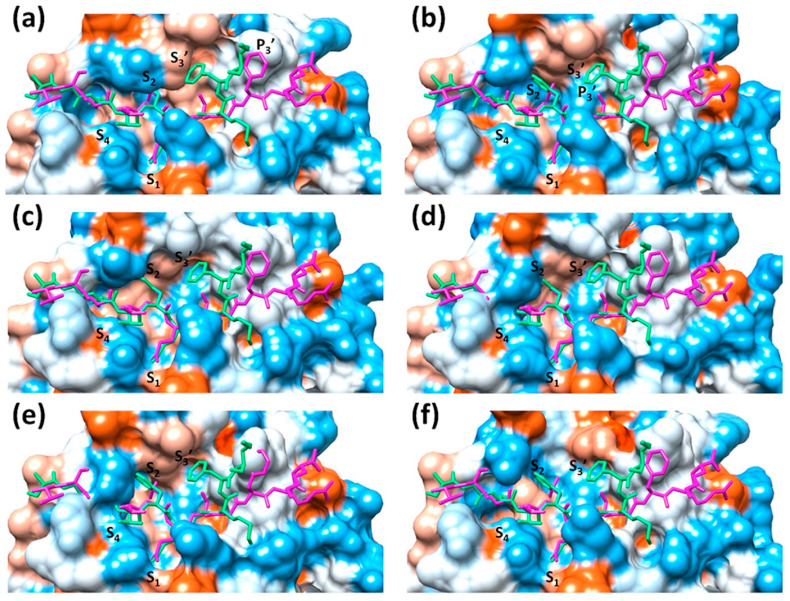
Proteolytic recognition based on substrate-induced subsite cooperativity, or structural heterogeneity and structure-based recognition. (a–f) Overlay of the N-terminal processing site in magenta and the C-terminal processing site in green in stick form to the solvent accessible surface of different structures: (a) 2Q6G, SARS-CoV, H41A mutant cocrystallized with the N-terminal site; (b) 5B6O, SARS-CoV C145A cocrystallized with the C-terminal site; (c) 6Y2E, SARS-CoV-2, ligand-free structure; (d) 7BRO, SARS-CoV-2, ligand-free structure; (e) 2C3S, SARS-CoV, ligand-free structure; (f) 2GT7, SARS-CoV, ligand-free structure. (a) and (b) represent the basis behind the concept of substrate-induced subsite cooperativity between S2 and S3’, while (c–f) oppose this mechanism by showing that variations in the active site occur in the absence of a ligand due to conformational heterogeneity and thus substrate processing depends on structure-based recognition. The binding spaces in S2 and S3’ does not vary in an exclusively cooperative manner. The solvent accessible surface is colored according to hydrophobicity, where blue is hydrophilic and orange is hydrophobic.

References

    1. Ziebuhr J., Herold J., Siddell S.G. Characterization of a human coronavirus (strain 229E) 3C-like proteinase activity. J. Virol. 1995;69:4331–4338. - PMC - PubMed
    1. Zhang L., et al. Crystal structure of SARS-CoV-2 main protease provides a basis for design of improved α-ketoamide inhibitors. Science. 2020;368:409–412. - PMC - PubMed
    1. Schechter I., Berger A. On the size of the active site in proteases. I. Papain. Biochem. Biophys. Res. Commun. 1967;27:157–162. - PubMed
    1. Muramatsu T., et al. SARS-CoV 3CL protease cleaves its C-terminal autoprocessing site by novel subsite cooperativity. Proc. Natl. Acad. Sci. U.S.A. 2016;113:12997–13002. - PMC - PubMed
    1. Behnam M.A.M., Klein C.D.P. Conformational selection in the flaviviral NS2B-NS3 protease. Biochimie. 2020;174:117–125. - PubMed

MeSH terms