Review
. 2021 Aug:69:51-57.
doi: 10.1016/j.conb.2021.01.002. Epub 2021 Jan 21.

Ankyrins and neurological disease

Affiliations
Review

Ankyrins and neurological disease

Sharon R Stevens et al. Curr Opin Neurobiol. 2021 Aug.

Abstract

Ankyrins are scaffolding proteins widely expressed throughout the nervous system. Ankyrins recruit diverse membrane proteins, including ion channels and cell adhesion molecules, into specialized subcellular membrane domains. These domains are stabilized by ankyrins interacting with the spectrin cytoskeleton. Ankyrin genes are highly associated with a number of neurological disorders, including Alzheimer's disease, schizophrenia, autism spectrum disorders, and bipolar disorder. Here, we discuss ankyrin function and their role in neurological disease. We propose mutations in ankyrins contribute to disease through two primary mechanisms: 1) altered neuronal excitability by disrupting ion channel clustering at key excitable domains, and 2) altered neuronal connectivity via impaired stabilization of membrane proteins.


Conflict of interest statement

Competing Financial Interests

The authors declare no competing financial interests

Declaration of interests

The authors declare that they have no known competing financial interests or personal relationships that could have appeared to influence the work reported in this paper.

Figures
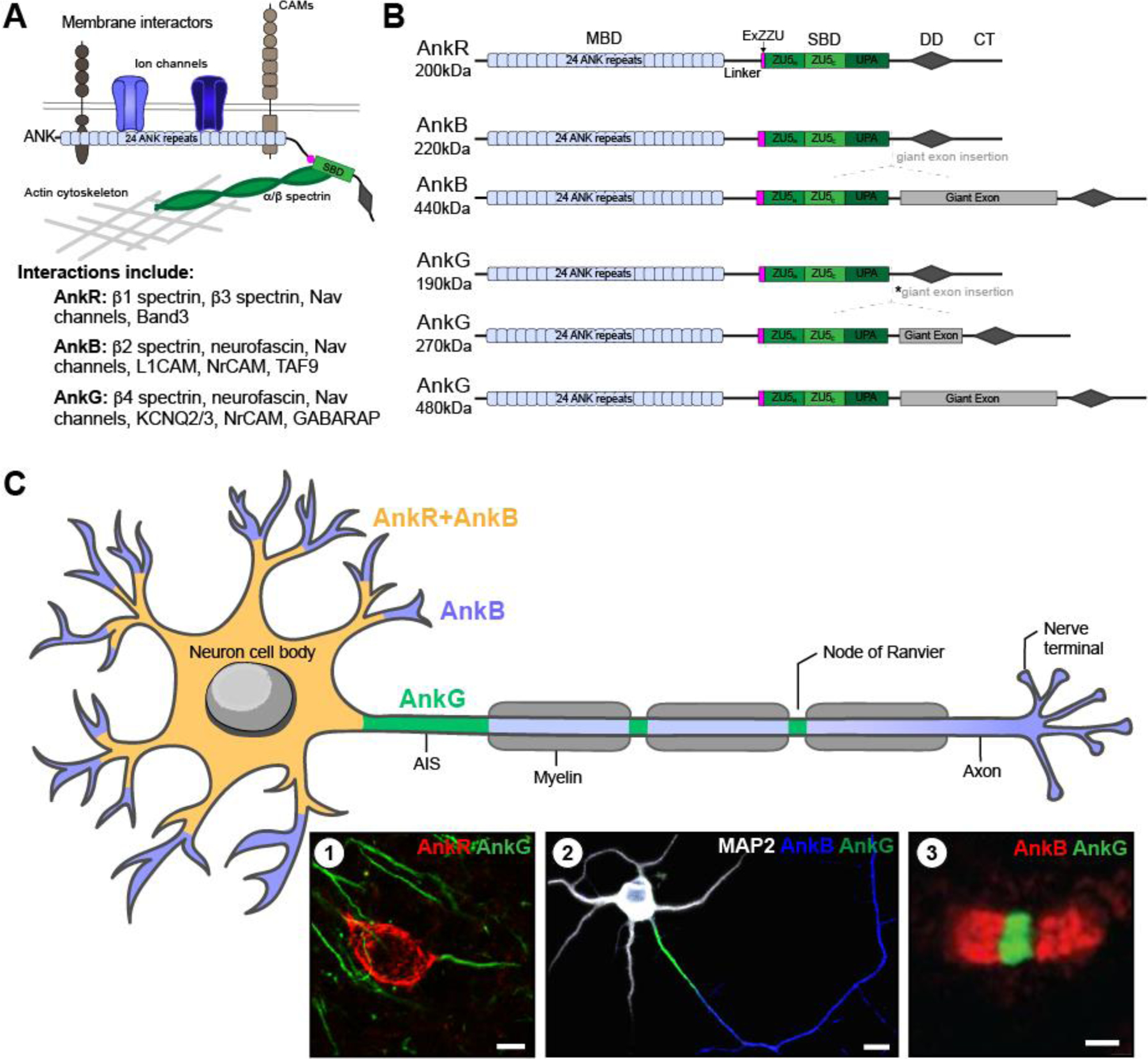
Figure 1.
Figure 1.
(A) Schematic of subcellular ankyrins with domains and interactions; and list of key interactors for each ankyrin. (B) Primary ankyrin isoforms. AnkR has one main isoform, 200kDa. However, alternative splicing of AnkB results in two main isoforms: 220kDa, and 440kDa. Similarly, alternative splicing of AnkG results in three main isoforms: 190kDa, 270kDa, and 480kDa. The 270kDa isoform results from an in-frame splicing of the giant exon eliminating 1,900 amino acids (*asterisk). Apart from the giant exon present in some isoforms, all three ankyrins have a similar structure. A N-terminal membrane binding domain (MBD) consisting of 24 ANK repeats, a linker domain, a recently discovered extension of the spectrin binding domain (SBD) termed ExZZU thought to enhance ankyrin-spectrin binding affinities, the SBD also known as the ZZU domain due to its three parts (ZU5N, ZU5C, and UPA), the DEATH domain (DD), and a regulatory C-terminal tail. (C) Schematic of ankyrin localization in neurons. All three ankyrins are expressed in neurons; however, each one has a unique pattern of localization. AnkB (blue) is expressed throughout neurons, however in some, AnkR is co-localized with AnkB at the soma and proximal dendrites (yellow). Whereas AnkG (green) is found at the AIS and nodes of Ranvier. Insets show (1) immunolabeling of AnkR and AnkG in adult mouse cortical neurons; scale bar, 10µm; (2) MAP2 (white) labeling the somatodendritic domain, AnkB (blue) co-localized with MAP2 in the somatodendritic domain but is also present in the distal axon, and AnkG (green) labeling the AIS in vitro rat hippocampal neurons at DIV10 [modified from 12]; scale bar, 10µm; and (3) Schwann cell derived paranodal AnkB (red), and AnkG (green) at a node of Ranvier in mouse sciatic nerve [modified from 11]; scale bar, 1µm.

References

    1. Michaely P, Bennett V: Mechanism for Binding Site Diversity on Ankyrin: J Biol Chem 1995, 270:31298–31302. - PubMed
    1. Sedgwick SG, Smerdon SJ: The ankyrin repeat: A diversity of interactions on a common structural framework. Trends Biochem Sci 1999, 24:311–316. - PubMed
    1. Bennett V, Healy J: Organizing the fluid membrane bilayer: diseases linked to spectrin and ankyrin. Trends Mol Med 2008, 14:28–36. - PubMed
    1. Ho TSY, Zollinger DR, Chang KJ, Xu M, Cooper EC, Stankewich MC, Bennett V, Rasband MN: A hierarchy of ankyrin-spectrin complexes clusters sodium channels at nodes of Ranvier. Nat Neurosci 2014, 17:1664–1672. - PMC - PubMed
    1. Liu CH, Seo R, Ho TSY, Stankewich M, Mohler PJ, Hund TJ, Noebels JL, Rasband MN: β spectrin-dependent and domain specific mechanisms for Na+ channel clustering. Elife 2020, 9:1–16. - PMC - PubMed

Publication types
