. 2020 Dec 5:2020:3498549.
doi: 10.1155/2020/3498549. eCollection 2020.

Survey of Paediatric Oncologists and Pathologists regarding Their Views and Experiences with Variant Translocations in Ewing and Ewing-Like Sarcoma: A Report of the Children's Oncology Group

Affiliations

Survey of Paediatric Oncologists and Pathologists regarding Their Views and Experiences with Variant Translocations in Ewing and Ewing-Like Sarcoma: A Report of the Children's Oncology Group

Michael D Kinnaman et al. Sarcoma. .

Abstract

Advances in molecular diagnostics have identified subsets of Ewing and Ewing-like sarcomas driven by variant translocations with unique biology. It is likely that patients with these tumours will have different clinical features and therapeutic outcomes. Nevertheless, the management of these patients both locally and within cooperative group trials depends on the local pathological diagnosis. It is not known what molecular diagnostic approaches are employed by local pathologists or if the exact translocation is commonly determined. In addition, it is not known what therapeutic approaches are employed for these patients or what cooperative trials are deemed appropriate for these patients by expert consensus. To answer these questions, we performed an international survey of oncologists and pathologists to better understand the diagnostic approaches used to identify variant translocations and the influence the findings have on therapy and clinical trial eligibility. An online survey was distributed to oncologists and pathologists primarily in North America. A total of 141 surveys were completed, representing a 28% response rate. The majority of respondents considered EWSR1-ETS gene family translocations (range 61-96%) to be Ewing sarcoma and would include them on the primary arm of a Ewing sarcoma clinical trial. There was a lack of consensus on how to classify and stratify BCOR-CCNB3, CIC-DUX4, and EWSR1+ with non-ETS partner fusions. Most respondents were either unsure how their institution tested, or their institution did not perform the test. In cases with atypical Ewing morphology, most respondents favoured additional fusion transcript testing. There is a lack of consensus regarding the classification and stratification of rare molecular subtypes in Ewing sarcoma. It is not clear how these alternative translocations have impacted outcomes for past clinical studies. This suggests a need for molecular confirmation of diagnoses and centralized or minimum standardization of testing for future trial enrolment.


Conflict of interest statement

K.A. Janeway has received consulting fees from Bayer. S.L. Lessnick is a scientific advisor for Salarius Pharmaceuticals and has patents related to NKX2.2 and GSTM4 in Ewing sarcoma.

Figures
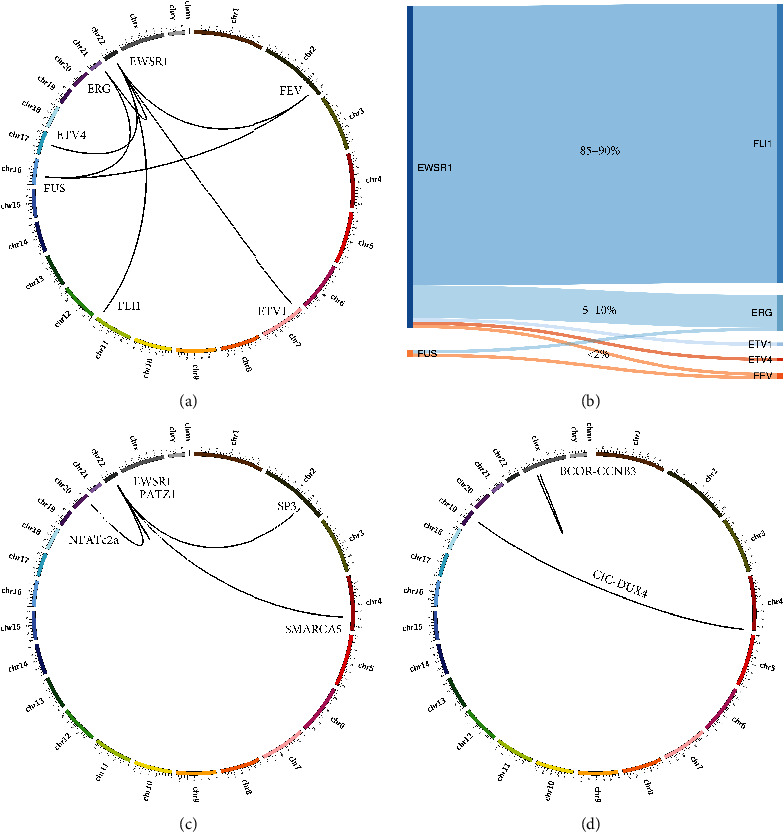
Figure 1
Figure 1
Proposed WHO Classification of Tumours of Soft Tissue and Bone for Ewing and Ewing-like sarcoma: (a) Circos plot of Ewing sarcoma with all FET-ETS variants. (b) Sankey plot of FET-ETS translocation Ewing sarcoma scaled to represent the percentage of total cases. (c) Circos plot of select EWSR1 round cell sarcomas with non-ETS partners. (d) Circos plot of two most common CIC and BCOR translocation sarcomas.
Figure 2
Figure 2
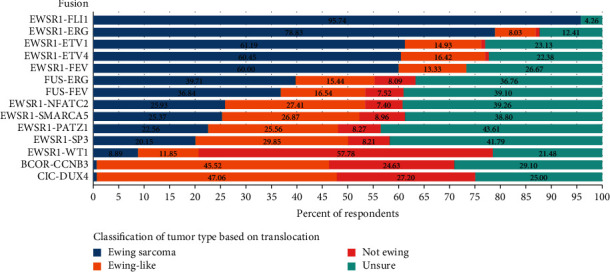
Classification of variant chromosomal translocations by percentage of respondents. The data represent the percentage of respondents who believed a given translocation in the column on the left represents Ewing sarcoma (blue bar and percentage), Ewing-like sarcoma (orange bar and percentage), not Ewing sarcoma (red bar and percentage), or unsure of the classification (teal bar and percentage).
Figure 3
Figure 3
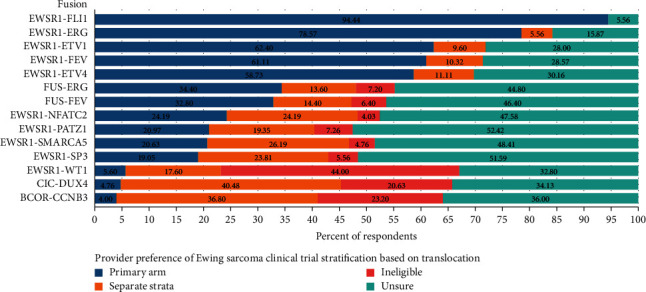
Perceptions of respondents on the optimal stratification of variant chromosomal translocations on future Ewing sarcoma clinical trials. The data represent the percentage of respondents who believed that a given translocation in the column on the left should result in inclusion in a Ewing sarcoma clinical trial in the primary stratum (blue bar and percentage), in a separate stratum (orange bar and percentage) or if the translocation makes a patient ineligible (red bar and percentage) for a Ewing sarcoma study. The teal bar and percentage indicate the number of respondents who were unsure of how the translocation should influence inclusion criteria.
Figure 4
Figure 4
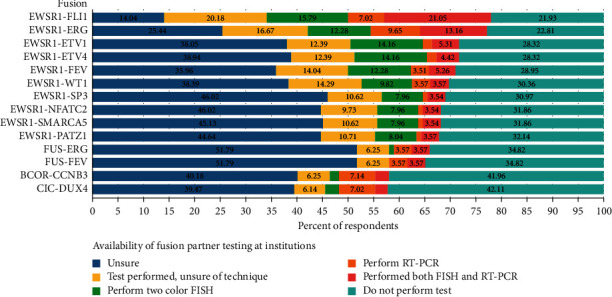
Available variant translocation fusion partner testing at respondent institutions. Data represent the respondent's impression of the type of testing that is done at the local institution to determine fusion partner identity by two-color fish (green bar and percentage), RT-PCR (orange bar and percentage), or both (green bar and percentage). Other investigators were either unsure if testing is performed (blue bar and percentage), unsure of the type of testing (yellow bar and percentage), or do not perform testing (green bar and percentage).
Figure 5
Figure 5
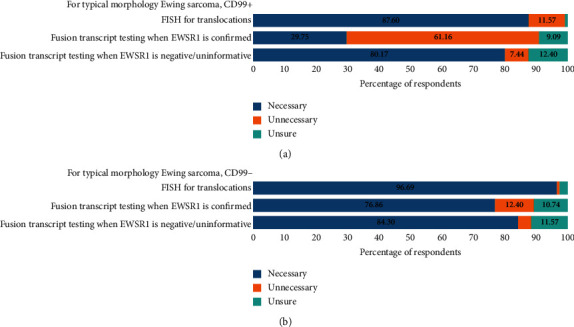
Summary of suggested workup for patients with defined diagnostic features: (a) respondents' opinions regarding the necessary diagnostic workup for a case of a CD99+, typical Ewing morphology tumour. (b) Respondents' opinions regarding the necessary diagnostic workup for a case of a CD99−, atypical Ewing morphology tumour.

References

    1. Delattre O., Zucman J., Melot T., et al. The Ewing family of tumors—a subgroup of small-round-cell tumors defined by specific chimeric transcripts. New England Journal of Medicine. 1994;331(5):294–299. doi: 10.1056/NEJM199408043310503. - DOI - PubMed
    1. Sorensen P. H. B., Lessnick S. L., Lopez-Terrada D., Liu X. F., Triche T. J., Denny C. T. A second Ewing’s sarcoma translocation, t(21;22), fuses the EWS gene to another ETS–family transcription factor, ERG. Nature Genetics. 1994;6(2):146–151. doi: 10.1038/ng0294-146. - DOI - PubMed
    1. Jeon I. S., Davis J. N., Braun B. S., et al. A variant Ewing’s sarcoma translocation (7;22) fuses the EWS gene to the ETS gene ETV1. Oncogene. 1995;10(6):1229–1234. - PubMed
    1. Ishida S., Yoshida K., Kaneko Y., et al. The genomic breakpoint and chimeric transcripts in the EWSR1-ETV4/E1AF gene fusion in Ewing sarcoma. Cytogenetic and Genome Research. 1998;82(3-4):278–283. doi: 10.1159/000015119. - DOI - PubMed
    1. Peter M., Couturier J., Pacquement H., et al. A new member of the ETS family fused to EWS in Ewing tumors. Oncogene. 1997;14(10):1159–1164. doi: 10.1038/sj.onc.1200933. - DOI - PubMed

LinkOut - more resources