Review
. 2021 Jan 8:11:531571.
doi: 10.3389/fpsyt.2020.531571. eCollection 2020.

Premature Birth and Developmental Programming: Mechanisms of Resilience and Vulnerability

Affiliations
Review

Premature Birth and Developmental Programming: Mechanisms of Resilience and Vulnerability

Femke Lammertink et al. Front Psychiatry. .

Abstract

The third trimester of pregnancy represents a sensitive phase for infant brain plasticity when a series of fast-developing cellular events (synaptogenesis, neuronal migration, and myelination) regulates the development of neural circuits. Throughout this dynamic period of growth and development, the human brain is susceptible to stress. Preterm infants are born with an immature brain and are, while admitted to the neonatal intensive care unit, precociously exposed to stressful procedures. Postnatal stress may contribute to altered programming of the brain, including key systems such as the hypothalamic-pituitary-adrenal axis and the autonomic nervous system. These neurobiological systems are promising markers for the etiology of several affective and social psychopathologies. As preterm birth interferes with early development of stress-regulatory systems, early interventions might strengthen resilience factors and might help reduce the detrimental effects of chronic stress exposure. Here we will review the impact of stress following premature birth on the programming of neurobiological systems and discuss possible stress-related neural circuits and pathways involved in resilience and vulnerability. Finally, we discuss opportunities for early intervention and future studies.

Keywords: autonomic nervous system; epigenetics; hypothalamus-pituitary-adrenal axis; large-scale brain networks; prematurity; resilience; stress.


Conflict of interest statement

The authors declare that the research was conducted in the absence of any commercial or financial relationships that could be construed as a potential conflict of interest.

Figures
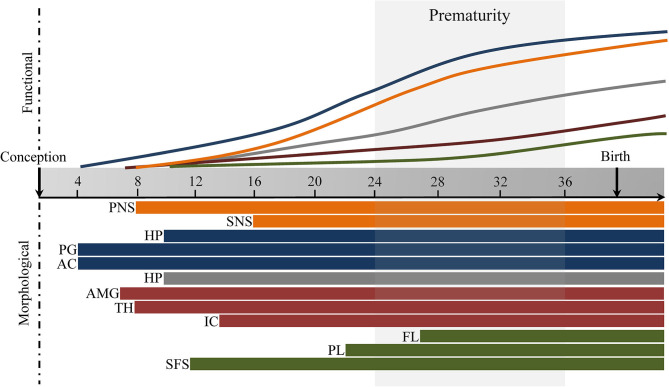
Figure 1
Figure 1
Fetal development of stress-response and stress-regulatory brain networks for illustration purposes. Autonomic Nervous System (orange), Hypothalamic-Pituitary-Adrenal axis (blue), Salience Network (red), Executive Control Network (green). PNS, parasympathetic nervous system, SNS, sympathetic nervous system, HPT, hypothalamus, PG, pituitary gland; AC, adrenal gland; HP, hippocampus; AMG, amygdala; TH, thalamus; IC, insular cortex; FL, frontal lobe; PL, parietal lobe; SFS, superior frontal sulcus. Timing based on literature reviewed under section Pre- and Post-natal Brain Development of Stress Systems and Brain Networks. Default Mode Network (gray).
Figure 2
Figure 2
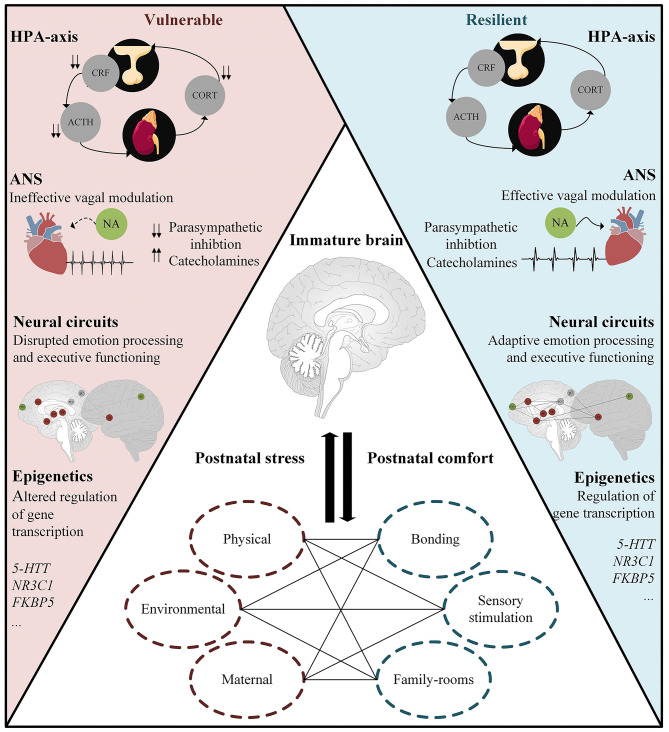
Resilient functioning in preterm born individuals exposed to chronic postnatal stress might be facilitated by; the ability to regulate and dampen stress responsivity; effective vagal modulation; homeostasis in large-scale neural networks underlying emotion processing and executive functioning; and adaptive regulation of gene transcription. Middle panel: Postnatal factors influencing brain maturation and, in turn, the onset/development of stress-related disorders such as anxiety and depression. ACTH, adrenocorticotropic hormone; Cort, cortisol; CRF, corticotropin-releasing factor; HPA-axis, hypothalamus–pituitary–adrenal axis; ANS, autonomic nervous system; NA, Nucleus Ambiguus; 5-HTT, serotonin transporter; NR3C1, glucocorticoid receptor; FKBP5, FK506 binding protein 5 and acts as a co-chaperone that modulates glucocorticoid receptor activity.

References

    1. Tau GZ, Peterson BS. Normal development of brain circuits. Neuropsychopharmacology. (2010) 35:147–68. 10.1038/npp.2009.115 - DOI - PMC - PubMed
    1. McEwen BS. Physiology and neurobiology of stress and adaptation: central role of the brain. Physiol Rev. (2007) 87:873–904. 10.1152/physrev.00041.2006 - DOI - PubMed
    1. Doom JR, Gunnar MR. Stress physiology and developmental psychopathology: past, present, and future. Dev Psychopathol. (2013) 25(4 Part 2):1359–73. 10.1017/S0954579413000667 - DOI - PMC - PubMed
    1. McEwen BS. Allostasis and allostatic load: implications for neuropsychopharmacology. Neuropsychopharmacology. (2000) 22:108–24. 10.1016/S0893-133X(99)00129-3 - DOI - PubMed
    1. de Waal CG, Weisglas-Kuperus N, van Goudoever JB, Walther FJ. Mortality, neonatal morbidity and two year follow-up of extremely preterm infants born in the netherlands in 2007. PLoS ONE. (2012) 7:e41302. 10.1371/journal.pone.0041302 - DOI - PMC - PubMed