


The Michelangelo Effect: Art Improves the Performance in a Virtual Reality Task Developed for Upper Limb Neurorehabilitation
- PMID: 33488478
- PMCID: PMC7817887
- DOI: 10.3389/fpsyg.2020.611956
The Michelangelo Effect: Art Improves the Performance in a Virtual Reality Task Developed for Upper Limb Neurorehabilitation
Abstract
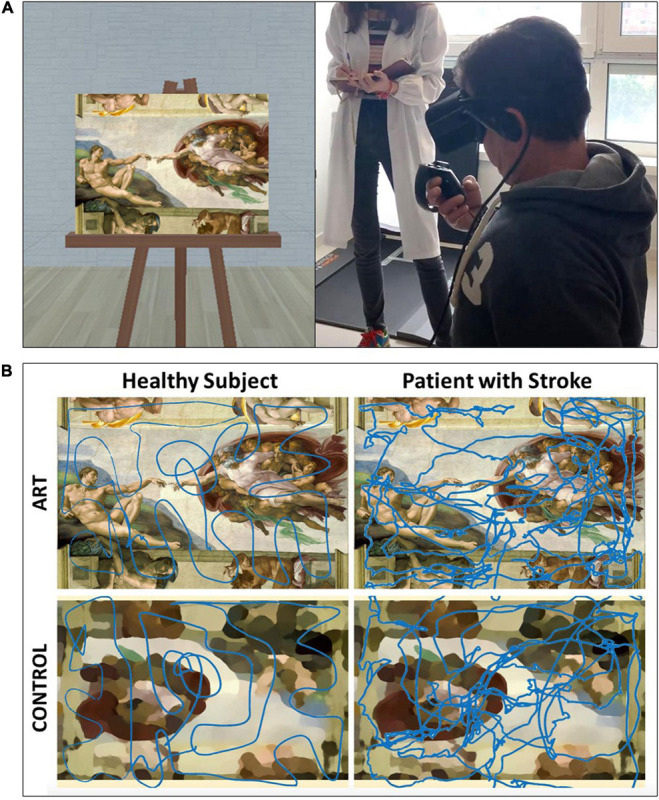
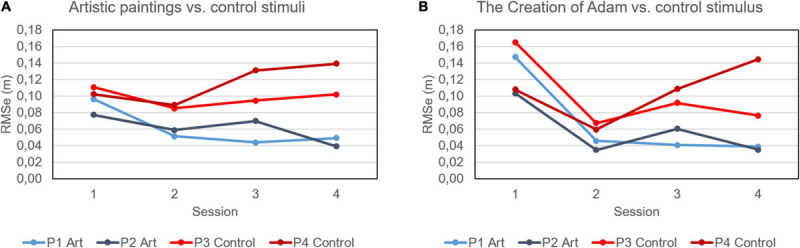
The vision of an art masterpiece is associated with brain arousal by neural processes occurring quite spontaneously in the viewer. This aesthetic experience may even elicit a response in the motor areas of the observers. In the neurorehabilitation of patients with stroke, art observation has been used for reducing psychological disorders, and creative art therapy for enhancing physical functions and cognitive abilities. Here, we developed a virtual reality task which allows patients, by moving their hand on a virtual canvas, to have the illusion of painting some art masterpieces, such as The Creation of Adam of Michelangelo or The birth of Venus of Botticelli. Twenty healthy subjects (experiment 1) and four patients with stroke (experiment 2) performed this task and a control one in which they simply colored the virtual canvas. Results from User Satisfaction Evaluation Questionnaire and the NASA Task Load Index highlighted an appropriate level of usability. Moreover, despite the motor task was the same for art and control stimuli, the art condition was performed by healthy subjects with shorter trajectories (p = 0.001) and with a lower perception of physical demand (p = 0.049). In experiment 2, only the patients treated with artistic stimuli showed a reduction in the erroneous movements performed orthogonally to the canvas (p < 0.05). This finding reminds the so-called Mozart effect that improves the performance of subjects when they listen to classic music. Thus, we called this improvement in the performance when interacting with an artistic stimulus as Michelangelo effect.
Keywords: aesthetics; art; cognition; neuroscience; psychophysics; rehabilitation; stroke; virtual reality.
Copyright © 2021 Iosa, Aydin, Candelise, Coda, Morone, Antonucci, Marinozzi, Bini, Paolucci and Tieri.
Conflict of interest statement
The authors declare that the research was conducted in the absence of any commercial or financial relationships that could be construed as a potential conflict of interest.
Figures
References
-
- Calabró R. S., Russo M., Naro A., Luca R. D., Leo A., Tomasello P., et al. (2017). Robotic gait training in multiple sclerosis rehabilitation: can virtual reality make the difference? Findings from a randomized controlled trial. J. Neurol. Sci. 377 25–30. - PubMed
-
- Cho S., Ku J., Cho Y. K., Kim I. Y., Kang Y. J., Jang D. P., et al. (2013). Development of virtual reality proprioceptive rehabilitation system for stroke patients. Comp. Methods Programs Biomed. 113 258–265. - PubMed
-
- De Bartolo D., Morone G., Giordani G., Antonucci G., Russo V., Fusco A., et al. (2020a). Effect of different music genres on gait patterns in Parkinson’s disease. Neurol. Sci. 41 575–582. - PubMed
-
- De Bartolo D., Morone G., Giordani G., Antonucci G., Russo V., Fusco A., et al. (2020b). Effect of different music genres on gait patterns in Parkinson’s disease. Neurol. Sci. 41 575–582. - PubMed
LinkOut - more resources
Full Text Sources
Other Literature Sources
