. 2020 Dec 23;12(1):99-106.
doi: 10.1021/acsmedchemlett.0c00551. eCollection 2021 Jan 14.

Discovery of an Anion-Dependent Farnesyltransferase Inhibitor from a Phenotypic Screen

Affiliations

Discovery of an Anion-Dependent Farnesyltransferase Inhibitor from a Phenotypic Screen

Marina Bukhtiyarova et al. ACS Med Chem Lett. .

Abstract

By employing a phenotypic screen, a set of compounds, exemplified by 1, were identified which potentiate the ability of histone deacetylase inhibitor vorinostat to reverse HIV latency. Proteome enrichment followed by quantitative mass spectrometric analysis employing a modified analogue of 1 as affinity bait identified farnesyl transferase (FTase) as the primary interacting protein in cell lysates. This ligand-FTase binding interaction was confirmed via X-ray crystallography and temperature dependent fluorescence studies, despite 1 lacking structural and binding similarity to known FTase inhibitors. Although multiple lines of evidence established the binding interaction, these ligands exhibited minimal inhibitory activity in a cell-free biochemical FTase inhibition assay. Subsequent modification of the biochemical assay by increasing anion concentration demonstrated FTase inhibitory activity in this novel class. We propose 1 binds together with the anion in the active site to inhibit farnesyl transferase. Implications for phenotypic screening deconvolution and HIV reactivation are discussed.


Conflict of interest statement

The authors declare no competing financial interest.

Figures

Figure 1
Figure 1
Phenotypic screen used to identify compound 1. 2.9 million compounds were screened against a cell infected with latent HIV in the presence of an EC10 of known latency reactivation agent vorinostat with the goal of finding new molecules which could act in synergy with vorinostat. Hits from this screen which reverse HIV latency result in the expression of luciferase reporter protein (illustrated with stars).
Figure 2
Figure 2
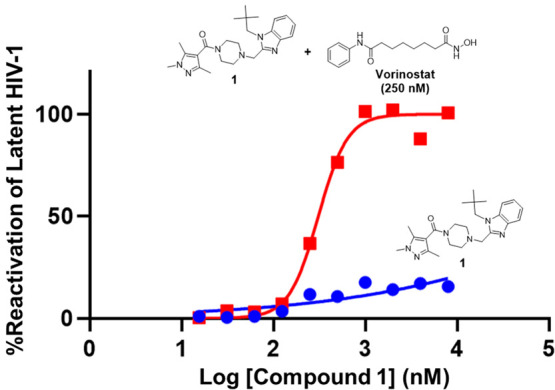
Compound 1 was identified in a phenotypic screen. Compounds 24 were used to elucidate mechanism of action. For the EC50’s reported, 100% stimulatory activity was observed; 100% activity defined as max activity observed with vorinostat; EC10 vorinostat = 250 nM.
Figure 3
Figure 3
Representative example of latent HIV activation by 1 (blue circles) and [1 + vorinostat] (red squares) in Jurkat 2C4 cells.
Figure 4
Figure 4
Farnesyltransferase mediated farnesyl addition to a cysteine of the Ras protein.
Figure 5
Figure 5
Anions used in cocrystallization studies with farnesyl transferase and compound 1.
Figure 6
Figure 6
(a) X-ray crystal structure of FTase/DMA-PP/compound 1 complex. (b) X-ray crystal structure of FTase/PPV/compound 1 complex overlaid with structure of FTase/DMA-PP/compound 1.
Figure 7
Figure 7
(a) Overlay of farnesyltransferase structures of compound 1 (this work), F-PP (from PDB1O5M), and the CaaX peptide Cys-Val-Iso-Met (from PDB 1QBQ). (b) Schematic highlighting role of t-butyl and piperidine moieties in this interaction.
Figure 8
Figure 8
Impact of dimethylallylphosphate (DMA-PP) on farnesyl transferase inhibition by compound 1 and compound 5 (known FTase inhibitor). Note that anion alone does not inhibit FTase activity.
Figure 9
Figure 9
Impact of 5 mM salt on enzymatic farnesyltransferase activity in the presence of 1, 2, and 5. Note that anion alone does not inhibit FTase activity.

References

    1. Swinney D. C.; Anthony J. How were new medicines discovered?. Nat. Rev. Drug Discovery 2011, 10, 507–519. 10.1038/nrd3480. - DOI - PubMed
    1. Lee O. W.; Austin S.; Gamma M.; Cheff D. M.; Lee T. D.; Wilson K. M.; Johnson J.; Travers J.; Braisted J. C.; Guha R.; Klumpp-Thomas C.; Shen M.; Hall M. D. Cytotoxic Profiling of Annotated and Diverse Chemical Libraries Using Quantitative High-Throughput Screening. SLAS Discov 2020, 25, 9–20. 10.1177/2472555219873068. - DOI - PMC - PubMed
    1. Childers W. E.; Elokely K. M.; Abou-Gharbia M. The Resurrection of Phenotypic Drug Discovery. ACS Med. Chem. Lett. 2020, 11, 1820–1828. 10.1021/acsmedchemlett.0c00006. - DOI - PMC - PubMed
    1. Swinney D. C. Phenotypic vs. target-based drug discovery for first-in-class medicines. Clin. Pharmacol. Ther. 2013, 93, 299–301. 10.1038/clpt.2012.236. - DOI - PubMed
    1. Rasmussen T. A.; Lewin S. R. Shocking HIV out of hiding: where are we with clinical trials of latency reversing agents?. Curr. Opin. HIV AIDS 2016, 11, 394–401. 10.1097/COH.0000000000000279. - DOI - PubMed

LinkOut - more resources