


Nutritional Status and Anthropometric Indices in relation to Menstrual Disorders: A Cross-Sectional Study
- PMID: 33489364
- PMCID: PMC7803165
- DOI: 10.1155/2020/5980685
Nutritional Status and Anthropometric Indices in relation to Menstrual Disorders: A Cross-Sectional Study
Abstract
Purpose: Dietary habit and body composition can develop risk of menstrual disorders. The objective of this study was to assess the relationship between macronutrient intake, anthropometric indices, and menstrual disorders.
Methods: This cross-sectional study was conducted on 217 women with an average age of 28.8 ± 7.9 years. Anthropometric indices including body mass index (BMI), waist circumference (WC), waist-to-hip ratio (WHR), and skinfold thickness from all participants were measured. Menstrual cycle characteristics were self-reported. The dietary habits were assessed by using a modified, semiquantitative 147 items Food Frequency Questionnaire (FFQ) by two trained dietitians. Chi-square and independent T-test were used to assess bivariate associations and logistic regression was implemented in SPSS 21.
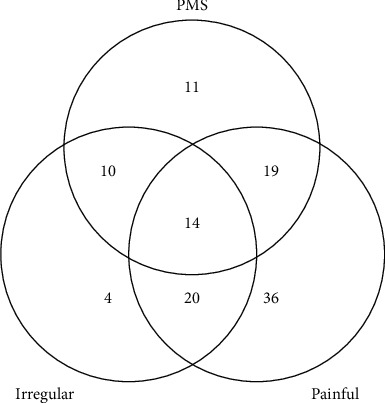
Results: Most of the participants (52.5%) suffered from at least one of the menstrual disorders including painful menstruation (41%), premenstrual syndrome (PMS) (24.9%), and irregular menstruation (22.1%). The mean of waist circumference in women with no complication was 76.0 ± 11.8 and in women with at least one disorder was 86.7 ± 14.0 (P < 0.001). Our results suggest that women with no disorder consumed less calorie, carbohydrate, protein, and fat in comparison to women with at least one disorder (P < 0.001). Furthermore, the proportion of all kinds of disorders among women, who had overweight or obesity, was significantly higher than women with normal BMI (P < 0.001).
Conclusion: Irregular menstruation, painful menstruation, and PMS were significantly associated with high intake of calories, proteins, carbohydrates, and total fat. Furthermore, menstruation-related complications were worsened by obesity.
Copyright © 2020 Reihaneh Taheri et al.
Conflict of interest statement
The authors declare no conflicts of interest.
Figures
References
-
- Geetha P., Sathyavathi R. B., Bharathi T., Reddy T., Reddy K. S., Re K. K. Prevalence of dysmenorrhea and its correlates among the rural women of Andhra Pradesh, India. Global Journal of Medical Research. 2016;16:42–51.
-
- Bale P., Doust J., Dawson D. Gymnasts, distance runners, anorexics body composition and menstrual status. The Journal of Sports Medicine and Physical Fitness. 1996;36(1):49–53. - PubMed
-
- Malhotra N., Malhotra J., Saxena R., Bora M. N. Jeffcoate's Principles of Gynaecology: Jaypee Brothers. Chennai, Tamilnadu: Medical Publishers Pvt. Limited; 2008.
LinkOut - more resources
Full Text Sources
