


Hereditary angioedema patients would prefer newer-generation oral prophylaxis
- PMID: 33489436
- PMCID: PMC7801100
- DOI: 10.1080/21556660.2020.1863699
Hereditary angioedema patients would prefer newer-generation oral prophylaxis
Abstract
Objective: To explore treatment preferences of patients with Hereditary Angioedema (HAE), a debilitating disorder characterized by potentially life-threatening, recurrent episodes of swelling, resulting in significant physical, emotional, and economic burden. With newer oral prophylactic treatments on the horizon, it is important to understand patients' preferences.
Methods: An online survey was conducted in 2018 among United States (US) adult patients diagnosed with Type I or II HAE. Respondents were recruited anonymously from online panels and social media.
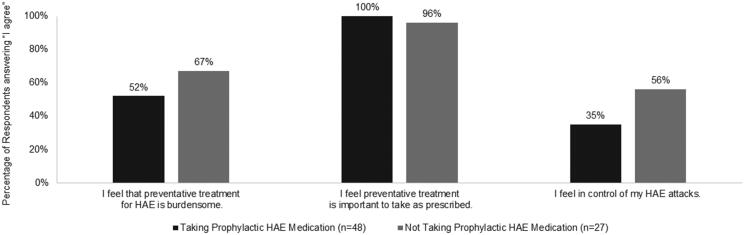
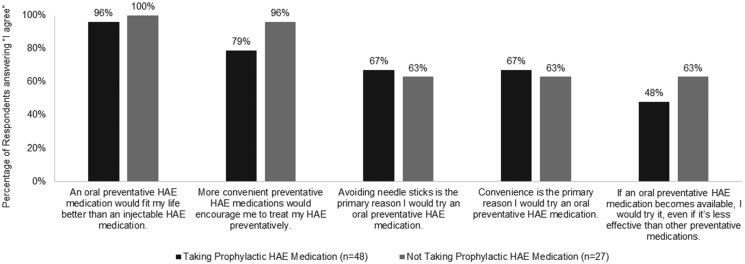
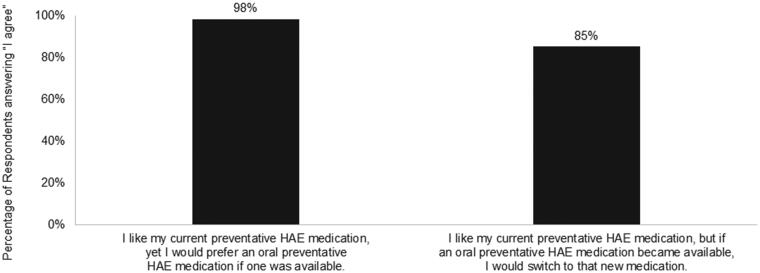
Results: Online surveys were completed by 75 patients diagnosed with HAE by a healthcare provider, with a mean of 16.7 years since diagnosis. Most patients (64%) report taking at least one medication for prophylaxis of HAE attacks. While almost all patients surveyed agree it is important to take preventative medication as prescribed, over half (52%) of patients report HAE prophylactic treatment to be burdensome. Despite stating that they like their current medications, 98% of the prophylactic HAE medication users would prefer an oral treatment if available; almost all (96%) prophylaxis users agree that oral preventative medication would fit their life better than an injectable medication, with 67% of users citing convenience as the primary reason to try an oral preventative HAE medication. If a more convenient option were available, nearly all (96%) patients currently not treating their HAE prophylactically would feel encouraged to do so.
Conclusions: Most patients with HAE would prefer a newer generation oral prophylactic medication that would decrease treatment burden and allow them to live fuller lives.
Keywords: Hereditary angioedema; patient preference; prophylaxis; route of administration.
© 2021 The Author(s). Published by Informa UK Limited, trading as Taylor & Francis Group.
Figures
References
-
- Nzeako UC, Frigas E, Tremaine WJ. Hereditary angioedema: a broad review for clinicians. Arch Intern Med. 2001;161(20):2417–2429. - PubMed
-
- U.S. National Libray of Medicine . [cited 2020 Feb 5]. Available from: https://ghr.nlm.nih.gov/condition/hereditary-angioedema#statistics.
-
- Zilberberg MD, Nathanson BH, Jacobsen T, et al. . Descriptive epidemiology of hereditary angioedema emergency department visits in the United States, 2006–2007. Allergy Asthma Proc. 2011;32(5):390–394. - PubMed
-
- Zilberberg MD, Jacobsen T, Tillotson G.. The burden of hospitalizations and emergency department visits with hereditary angioedema and angioedema in the United States, 2007. Allergy Asthma Proc. 2010;31(6):511–519. - PubMed
-
- The voice of the patient: hereditary angioedema – report of the U.S. Food and Drug Administration patient-focused drug development initiative public meeting September 2017. Center for Biologics Evaluation and Research (CBER) and U.S. Food and Drug Administration (FDA); 2018.
LinkOut - more resources
Full Text Sources
Other Literature Sources