. 2021 Jan 8:10:586752.
doi: 10.3389/fonc.2020.586752. eCollection 2020.

Clinicopathological and Immunomicroenvironment Characteristics of Epstein-Barr Virus-Associated Gastric Cancer in a Chinese Population

Affiliations

Clinicopathological and Immunomicroenvironment Characteristics of Epstein-Barr Virus-Associated Gastric Cancer in a Chinese Population

Xiaoxia Jia et al. Front Oncol. .

Abstract

Background: Epstein-Barr virus-associated gastric cancer(EBVaGC)has a unique tumor immune microenvironment. We performed a comprehensive analysis of the tumor-infiltrating immune cells in a cohort of EBVaGC in a Chinese population.

Methods: Epstein-Barr encoding region (EBER) in situ hybridization was performed in 1,328 consecutive cases of surgically resected GC. Densities of immune cells, including T cells, B cells, natural killer cells, and macrophages from the patients were calculated after immunohistochemical staining with CD3, CD20, CD57, and CD68 antibodies in tissue microarrays, respectively.

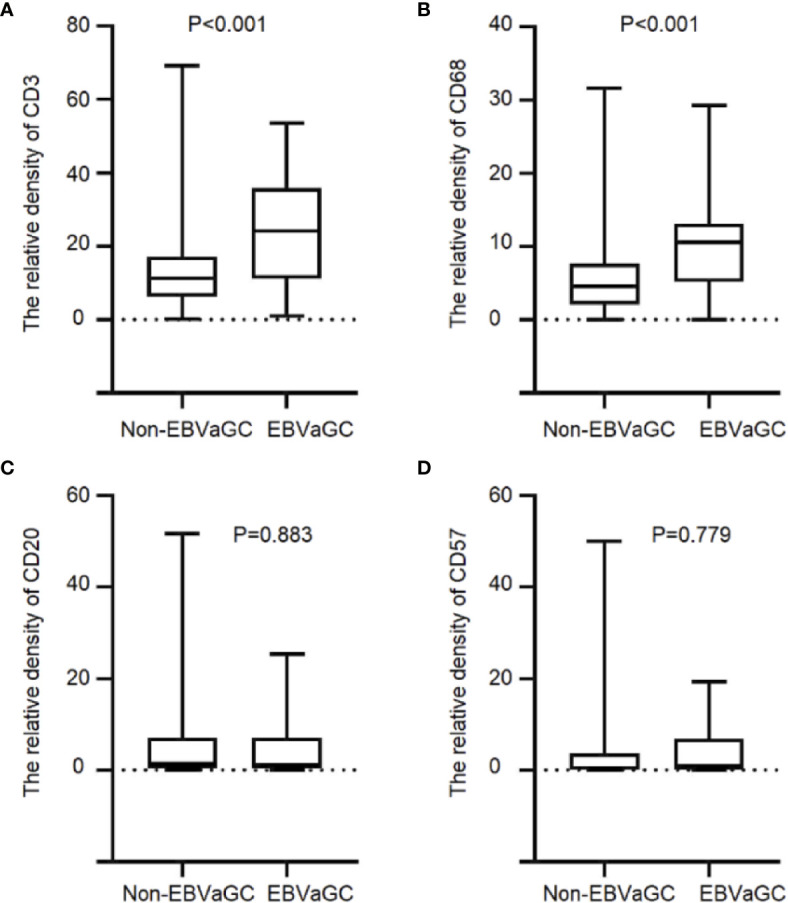
Results: EBVaGC patients accounted for 4.1% (55 of 1,328) cases in the overall population. The average age of patients with EBVaGC was lower than that of non-EBVaGC patients. Histologically, EBVaGC patients exhibited poorly differentiated adenocarcinoma (P = 0.004) and lower frequency of vascular invasion (P = 0.034). The density of CD3+ T lymphocytes (CD3, 23.84 ± 14.49 vs. 12.76 ± 8.93, P < 0.001) and CD68+ macrophages (CD68, 9.73 ± 5.25 vs. 5.44 ± 4.18, P < 0.001) was significantly higher in EBVaGC patients. CD3+ T cell density predicted better 5-year overall survival of EBVaGC patients (P = 0.022).

Conclusions: EBVaGC patients were younger with low-differentiated adenocarcinoma and less vascular invasion. Increased infiltration of multiple immune cells affected the prognosis of patients, especially EBVaGC patients with more CD3+ T lymphocytes, who survived longer.

Keywords: CD3; CD68; Epstein–Barr virus (EBV); gastric cancer; immune microenvironment.


Conflict of interest statement

The authors declare that the research was conducted in the absence of any commercial or financial relationships that could be construed as a potential conflict of interest.

Figures
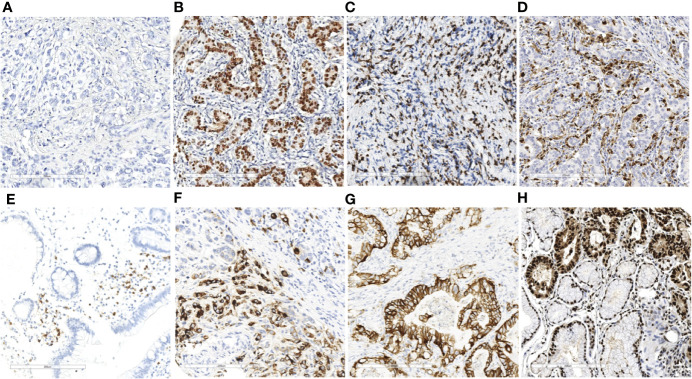
Figure 1
Figure 1
EBER ISH and immunohistochemistry results of immune markers in gastric cancer (×20). EBER ISH-negative (A) and EBER ISH-positive (B) cases. Representative images of CD3+ T lymphocytes (C) CD68+ macrophage (D) CD20+ B lymphocyte cells (E) and CD57+ NK cells (F) and expression levels of HER2 (G) and PCNA (H) in gastric cancer tissues.
Figure 2
Figure 2
Immune cell infiltration in EBVaGC and non-EBVaGC. The panels show the density of (A) CD3+T lymphocytes.(B) CD68+ macrophages, (C) CD20+ B lymphocytes, and (D) CD57+ NK cells.
Figure 3
Figure 3
Kaplan–Meier curves stratified by EBV status. Kaplan–Meier survival analysis of EBVaGC and non-EBVaGC patients without (A) and with (B) neoadjuvant chemotherapy.
Figure 4
Figure 4
Kaplan–Meier survival curves showing infiltration of immune cells in EBVaGC with or without chemotherapy. Analysis of EBVaGC patients stratified by CD3+ T lymphocyte density (A) without and with (B) neoadjuvant chemotherapy, CD68+ macrophages without (C) and with (D) neoadjuvant chemotherapy, CD20+ B lymphocytes without (E) and with (F) neoadjuvant chemotherapy, and CD57+ NK cells without (G) and with (H) neoadjuvant chemotherapy.

References

    1. Camargo MC, Kim KM, Matsuo K, Torres J, Liao LM, Morgan DR, et al. Anti-Helicobacter pylori Antibody Profiles in Epstein-Barr virus (EBV)-Positive and EBV-Negative Gastric Cancer. Helicobacter (2016) 21(2):153–7. 10.1111/hel.12249 - DOI - PMC - PubMed
    1. The Cancer Genome Atlas Research N. Bass AJ, Thorsson V, Shmulevich I, Reynolds SM, Miller M, et al. Comprehensive molecular characterization of gastric adenocarcinoma. Nature (2014) 513:202. 10.1038/nature13480 - DOI - PMC - PubMed
    1. Panda A, Mehnert JM, Hirshfield KM, Riedlinger G, Damare S, Saunders T, et al. Immune Activation and Benefit From Avelumab in EBV-Positive Gastric Cancer. J Natl Cancer Inst (2018) 110(3):316–20. 10.1093/jnci/djx213 - DOI - PMC - PubMed
    1. Kim ST, Cristescu R, Bass AJ, Kim KM, Odegaard JI, Kim K, et al. Comprehensive molecular characterization of clinical responses to PD-1 inhibition in metastatic gastric cancer. Nat Med (2018) 24(9):1449–58. 10.1038/s41591-018-0101-z - DOI - PubMed
    1. Xie T, Liu Y, Zhang Z, Zhang X, Gong J, Qi C, et al. Positive Status of Epstein-Barr Virus as a Biomarker for Gastric Cancer Immunotherapy: A Prospective Observational Study. J Immunother (Hagerstown Md 1997) (2020) 43(4):139–44. 10.1097/cji.0000000000000316 - DOI - PMC - PubMed

LinkOut - more resources