


Platelet Membrane Receptor Proteolysis: Implications for Platelet Function
- PMID: 33490118
- PMCID: PMC7820117
- DOI: 10.3389/fcvm.2020.608391
Platelet Membrane Receptor Proteolysis: Implications for Platelet Function
Abstract
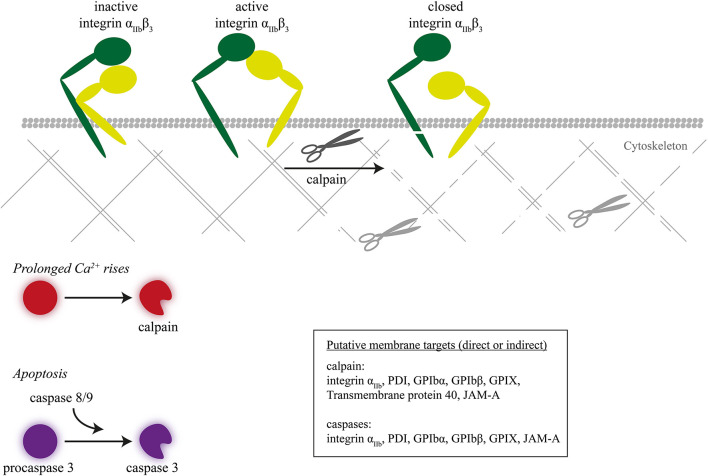
The activities of adhesion and signaling receptors in platelets are controlled by several mechanisms. An important way of regulation is provided by proteolytic cleavage of several of these receptors, leading to either a gain or a loss of platelet function. The proteases involved are of different origins and types: (i) present as precursor in plasma, (ii) secreted into the plasma by activated platelets or other blood cells, or (iii) intracellularly activated and cleaving cytosolic receptor domains. We provide a comprehensive overview of the proteases acting on the platelet membrane. We describe how these are activated, which are their target proteins, and how their proteolytic activity modulates platelet functions. The review focuses on coagulation-related proteases, plasmin, matrix metalloproteinases, ADAM(TS) isoforms, cathepsins, caspases, and calpains. We also describe how the proteolytic activities are determined by different platelet populations in a thrombus and conversely how proteolysis contributes to the formation of such populations.
Keywords: ADAM; MMP; calpain; caspase; coagulation factors; platelets; receptor proteolysis.
Copyright © 2021 Wu, Heemskerk and Baaten.
Conflict of interest statement
JH is a shareholder and cofounder of FlowChamber. The remaining authors declare that the research was conducted in the absence of any commercial or financial relationships that could be construed as a potential conflict of interest.
Figures


References
Publication types
LinkOut - more resources
Full Text Sources
Other Literature Sources
