. 2021 Jan;1(1):e19.
doi: 10.1002/cpz1.19.

Targeted Genetic Changes in Candida albicans Using Transient CRISPR-Cas9 Expression

Affiliations

Targeted Genetic Changes in Candida albicans Using Transient CRISPR-Cas9 Expression

Manning Y Huang et al. Curr Protoc. 2021 Jan.

Erratum in

Abstract

Candida albicans is an opportunistic fungal pathogen responsible for significant disease and mortality. Absent complete mating and other convenient methods, dissection of its virulence factors relies on robust tools to delete, complement, and otherwise modify genes of interest in this diploid organism. Here we describe the design principles and use of CRISPR associated nuclease 9 (Cas9) and single-guide RNAs transiently expressed from PCR cassettes to modify genes of interest, generating homozygous mutants in a single transformation step. © 2021 Wiley Periodicals LLC. Basic Protocol 1: PCR amplification of CRISPR components Basic Protocol 2: Transformation of Candida albicans Basic Protocol 3: Selecting and genotyping transformants Alternate Protocol 1: Deletion with recyclable markers by CRISPR induced marker excision (CRIME) Alternate Protocol 2: Knock-in and combining multiple cassettes with overlapping homology.

Keywords: CRISPR-Cas9; Candida albicans; gene deletion; gene editing; transient CRISPR-Cas9 expression.


Figures

Figure 1:
Figure 1:
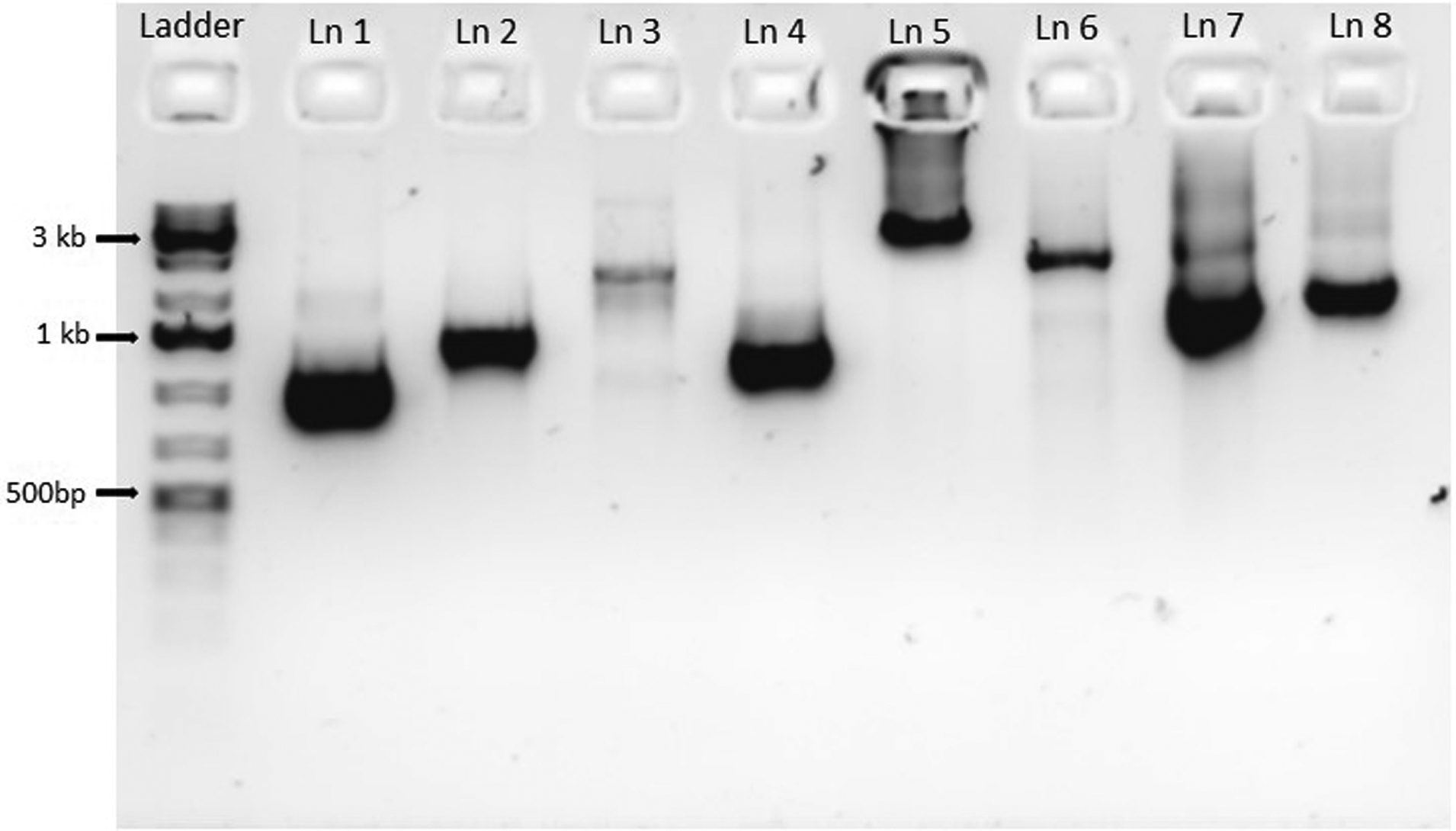
Typical products from CRISPR component PCR reactions (Basic Protocol 1 and Alternate Protocol: Deletion with recyclable markers). Ln 1: sgRNA expression cassette Round 1 product generated from pV1090 with primers YFG1_sgRNA/F and sgRNA/r (1015 bp). Ln 2: sgRNA expression cassette Round 1 product generated from pV1093 with primers SNR52/F and YFG1_SNR52/R (1459 bp). Ln 3: sgRNA expression cassette Round 2 fusion PCR product comprised of both Round 1 products (~2474 bp). Ln 4: sgRNA expression cassette Round 3 product made by amplifying unpurified Round 2 product with sgRNA/N and SNR52/N (1307 bp). Ln 5: CaCas9 expression cassette amplified from pV1093 with primers CaCas9/F and CaCas9/R (5575 bp). Ln 6: Example single piece NAT1 deletion cassette with 80bp flanking homology to YFG1 5` and 3` regions (1603 bp). Ln 7: CRIME HIS1 split marker deletion cassette amplified from pMH01 with Upstream+Adapter/F and HIS1_CRIME/R (1966 bp). Ln 8: CRIME HIS1 split marker deletion cassette amplified from pMH02 with HIS1_CRIME/F and Downstream+Adapter/R (2058 bp). Size of single piece deletion cassettes as well as split marker CRIME deletion cassettes will vary depending upon the marker used and the amount of homology to the target locus included.
Figure 2.
Figure 2.
Typical plates after CRISPR transformation (Basic Protocol 2). This transformation was performed as per Basic Protocol 2 and cells were plated on CSM-His solid media and incubated at 30°C for 48 hours. Panel A is the CRISPR Control Plate where cells have integrated a single copy of the deletion cassette. This can show up to ~50 colonies, but is highly variable. Panel B is the CRISPR plate which contains a mix of heterozygous and homozygous mutants. The increase in colony number relative to the CRISPR control plate is due to the inclusion of the sgRNA and CaCas9 expression cassettes making homozygous integration of the deletion cassette possible. Typically, around 100–300 colonies arise on this plate. Note that the tiny (<0.5mm) colonies are not transformants and most likely were able to grow for a short period before running out of histidine left over from growing in rich media prior to transformation.
Figure 3:
Figure 3:
Primer arrangement for genotyping transformant colonies via gDNA PCR and/or colony PCR. Panel A shows the schematic for genotyping PCR reaction 1 where Primer 1 is ~300bp upstream of the YFG1 and Primer 2 is ~300bp downstream of the 5` end of YFG1. This reaction serves to check for the presence of the gene being deleted. Panel B shows the schematic for genotyping PCR reaction 2 which again uses Primer 1, but instead pairs it with Primer 3 which binds ~300bp from the 5` end of the Marker being inserted at the YFG1 locus. This reaction serves to check for the successful integration of the deletion cassette/marker.
Figure 4:
Figure 4:
Schematic of homologous recombination events for knock-in of YFG1 at a desired target locus. Black triangles depict a Cas9 induced DSB in the target locus. Panel A. Integration of a cassette containing 80 bp of homology to the target locus (blue). Panel B. Segments to be integrated may be divided as is most convenient. Homologous recombination between segments using 80–160 bp of shared homology (purple) and 80 bp of homology to the target locus (blue) results in the desired construct. Panel C. The presence of additional shared homology (gray) may result in unintended recombinational events and should be avoided.

References

    1. Amberg DC, Botstein D, & Beasley EM (1995). Precise gene disruption in Saccharomyces cerevisiae by double fusion polymerase chain reaction. Yeast (Chichester, England), 11(13), 1275–1280. 10.1002/yea.320111307 - DOI - PubMed
    1. Bae S, Park J, & Kim JS (2014). Cas-OFFinder: A fast and versatile algorithm that searches for potential off-target sites of Cas9 RNA-guided endonucleases. Bioinformatics, 30(10), 1473–1475. 10.1093/bioinformatics/btu048 - DOI - PMC - PubMed
    1. Gerami-Nejad M, Zacchi LF, McClellan M, Matter K, & Berman J (2013). Shuttle vectors for facile gap repair cloning and integration into a neutral locus in Candida albicans. Microbiology (Reading, England), 159(Pt 3), 565–579. 10.1099/mic.0.064097-0 - DOI - PMC - PubMed
    1. Glazier VE, Murante T, Koselny K, Murante D, Esqueda M, Wall GA, … Krysan DJ (2018). Systematic Complex Haploinsufficiency-Based Genetic Analysis of Candida albicans Transcription Factors: Tools and Applications to Virulence-Associated Phenotypes. G3 (Bethesda, Md.), 8(4), 1299–1314. 10.1534/g3.117.300515 - DOI - PMC - PubMed
    1. Hoffman CS (2001). Preparation of yeast DNA. Current Protocols in Molecular Biology, Chapter 13, Unit13.11. 10.1002/0471142727.mb1311s39 - DOI - PubMed

MeSH terms

Substances

LinkOut - more resources