. 2021;82(s1):S379-S394.
doi: 10.3233/JAD-201384.

The Latin America and the Caribbean Consortium on Dementia (LAC-CD): From Networking to Research to Implementation Science

Affiliations

The Latin America and the Caribbean Consortium on Dementia (LAC-CD): From Networking to Research to Implementation Science

Agustin Ibanez et al. J Alzheimers Dis. 2021.

Abstract

In comparison with other regions, dementia prevalence in Latin America is growing rapidly, along with the consequent clinical, social, and economic burden upon patients and their families. The combination of fragile health care systems, large social inequalities, and isolated clinical and research initiatives makes the coordination of efforts imperative. The Latin America and the Caribbean Consortium on Dementia (LAC-CD) is a regional organization overseeing and promoting clinical and research activities on dementia. Here, we first provide an overview of the consortium, highlighting the antecedents and current mission. Then, we present the consortium's regional research, including the multi-partner consortium to expand dementia research in Latin America (ReDLat), which aims to identify the unique genetic, social, and economic factors that drive Alzheimer's and frontotemporal dementia presentation in LAC relative to the US. We describe an extension of ReDLat which aims to develop affordable markers of disease subtype and severity using high density EEG. We introduce current initiatives promoting regional diagnosis, visibility, and capacity, including the forthcoming launch of the Latin American Brain Health Institute (BrainLat). We discuss LAC-CD-led advances in brain health diplomacy, including an assessment of responses to the impact of COVID-19 on people with dementia and examining the knowledge of public policies among experts in the region. Finally, we present the current knowledge-to-action framework, which paves the way for a future regional action plan. Coordinated actions are crucial to forging strong regional bonds, supporting the implementation of regional dementia plans, improving health systems, and expanding research collaborations across Latin America.

Keywords: Dementia; LAC-CD; Latin America; genetics; implementation science; neurodegeneration; neuroimaging; regional health; social determinants of health; socioeconomic status.


Conflict of interest statement

Authors’ disclosures available online (https://www.j-alz.com/manuscript-disclosures/20-1384r1).

Figures

Fig. 1
Fig. 1
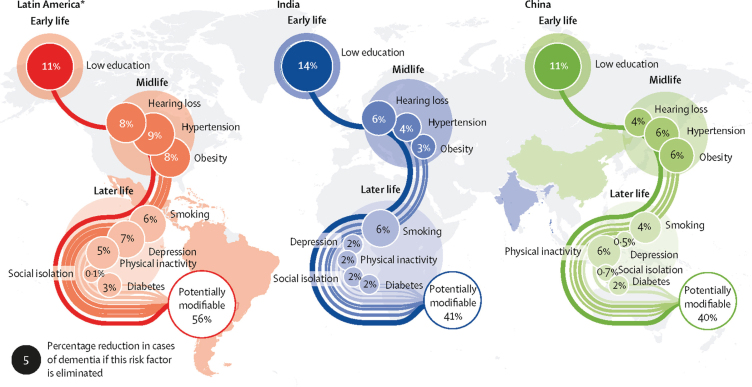
Population attributable fractions for potentially modifiable risk factors in low-income and middle-income countries. Data for Latin America include the data for Cuba, Dominican Republic, Mexico, Peru, Puerto Rico, and Venezuela. Reproduced with permission from [15].
Fig. 2
Fig. 2
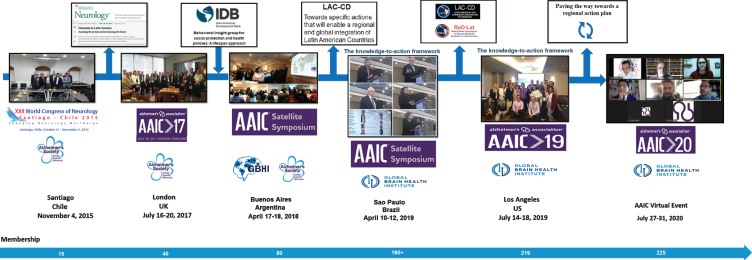
The LAC-CD timeline illustrates the growth of the consortium over the last five years. The consortium membership, regional representativeness, and its appeal to international organizations (i.e., GBHI, Alzheimer’s Association) have all grown steadily from its outset. Its evidence-based agenda started by characterizing challenges and opportunities in the region. Such knowledge has supported successful large grant applications and has informed a new action framework that aims to transform the dementia landscape in LAC. Modified and reproduced with permission from [1].
Fig. 3
Fig. 3
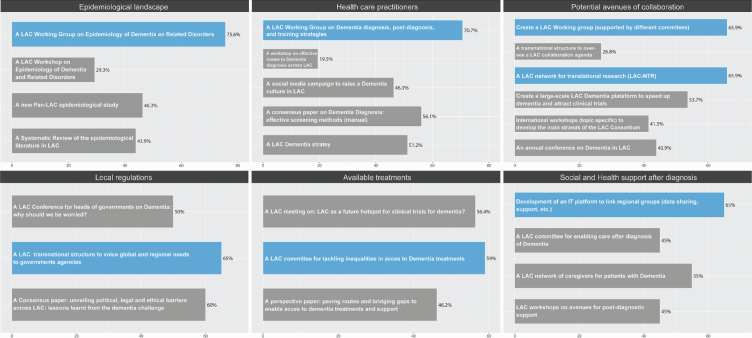
Outcomes from an online survey completed by members of the LAC-CD (N = 230 experts). Members voted on specific actions to fulfill the objectives set by six topics: epidemiological landscape, health-care practitioners and dementia diagnosis, potential avenues for collaboration, local regulations, currently available treatments and views on social and health support after diagnosis. The members were able to select more than one option per topic and suggest other actions. Values show the percentage of voters endorsing each action. Blue indicates the option attracting the highest proportion of votes under each topic. LACs, Latin American and Caribbean countries; IT, information technology; LAC-NTR, LAC Network for Translational Research. Reproduced with permission from [1].
Fig. 4
Fig. 4
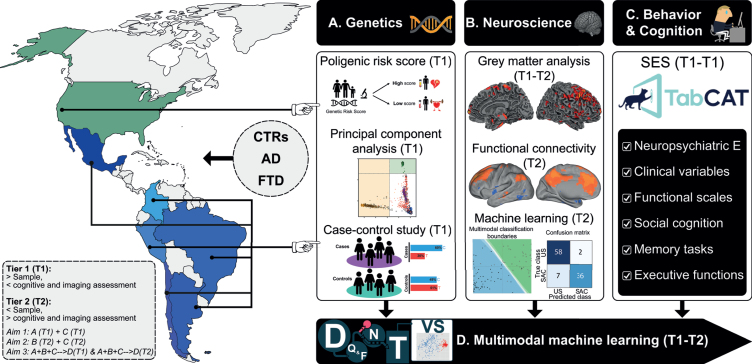
The ReDLat initiative. Systematic comparisons between LAC and US samples of AD and FTD via a novel, multimodal approach. The multimodal patterns will be assessed with different measures of (A) genetic risk (Aim 1), (B) imaging markers boosted by computational approaches, and (C) harmonized and novel measures of cognitive profiles and SES/SDH (Aim 2). These data sources will be (D) integrated and compared across countries through machine learning (Aim 3) to unveil the main commonalities and differences between US and LAC samples. Tier 1 (T1): Larger study (Aim 1 &3). Tier 2 (T2, smaller study with deep neurocognitive investigation (Aim 2 & 3). D, data; Q&F, quality & feature extraction; N, normalization; T, test; VS, visualization.
Fig. 5
Fig. 5
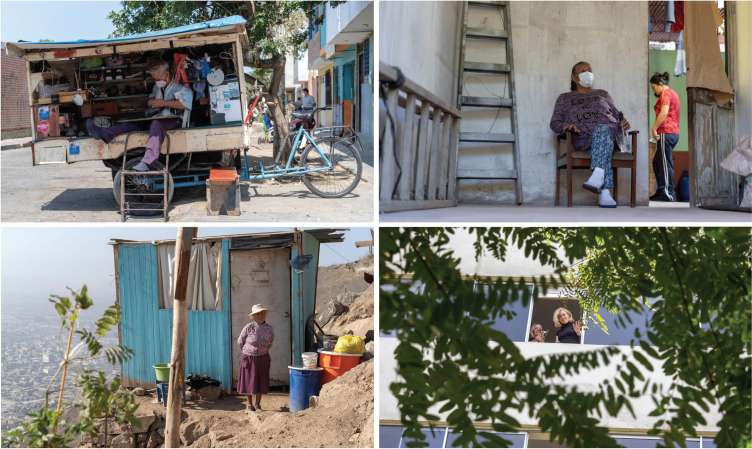
Testimonies from Peru highlighting different dimensions of the coronavirus outbreak and their impact on older people, and patients with cognitive decline and their families. The pictures above illustrate the people’s vulnerabilities and the unpreparedness of the health system. Top left inset: Enrique (64 years old, Trujillo) suffers from diabetes mellitus but has been unable to get medication for two months. He is a shoe repairer with a small mobile stall and, after months of quarantine, he has to go out to work. Top right inset: Juana (64 years old, Trujillo) is a merchant diagnosed with coronavirus three months ago, which led to her needing supplemental oxygen and intravenous medications. Given the collapse of the hospitals, she was treated at home by her daughter. She thought she might lose her life, unable to perform simple activities (such as walking and eating) without great effort. Now she is recovering. Bottom left inset: Enedina (65 years old, Lima) lives with her youngest son who lost his job due to the pandemic restrictions. They live in a precarious room, without electricity, water or drainage. Bottom right Inset: On the other side of Lima, 83-year-old Mrs. Rosita lives with her family in a wealthy district. Her daughter has noted typical dementia symptoms, which have exacerbated since the quarantine. She doesn’t understand the isolation, needs constant monitoring and urgently requires a neurological evaluation, but there are no services available due to the pandemic. Photos and testimonies from Peru documented by Alexander Kornhuber and Maritza Pintado Caipa. Individuals and relatives portrayed in the photos have provided written consent for reproduction. Reproduced with authorization from [98].
Fig. 6
Fig. 6
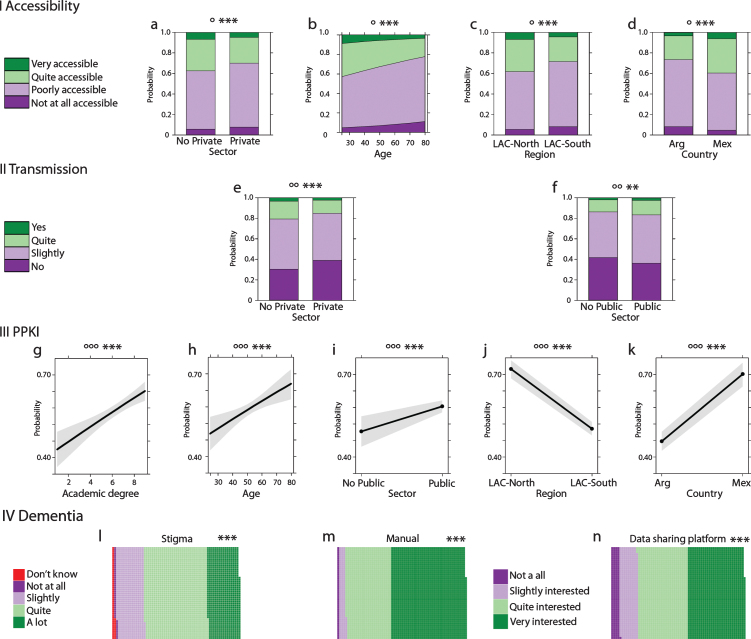
Dementia public policies in Latin America. I. Public Policies Accessibility. A) Probability of response frequency regarding accessibility by sector. B) Probability of response frequency regarding accessibility by age. C) Probability of response frequency regarding accessibility by region. D) Interaction of probability of response frequency of accessibility by country. II. Public Policies Transmission. E) Probability of response frequency regarding transmission by private sector. F) Probability of response frequency regarding transmission by the public sector. III. PPKI (Public Policy Knowledge Index). G) Probability of response frequency regarding high PPKI by academic degree. H) Probability of response frequency regarding high PPKI index by age. I) Probability of response frequency regarding high PPKI by the public sector. J) Probability of response frequency regarding PPKI by public region. K) Probability of response frequency regarding PPKI by country. IV. Aging. L) Proportion of responses about aging stigma. M) Proportion of responses about interest in aging and dementia manual. N) Proportion of responses about interest in a data-sharing platform. Significance (p values): effects significance (*p≤0.1, **p≤0.05, ***p≤0.01), model significance (°p≤0.1, °°p≤0.05, °°°p ≤ 0.01). Academic degree: 1: No reported education, 2: Technicians, 3: Tertiaries, 4; Certificates, 5: Undergrads, 6: Hospital Interns, 7: Post-graduate Specialization, 8: Master’s Degree, 9: Ph.D. Reproduced with authorization from [99].
Fig. 7
Fig. 7
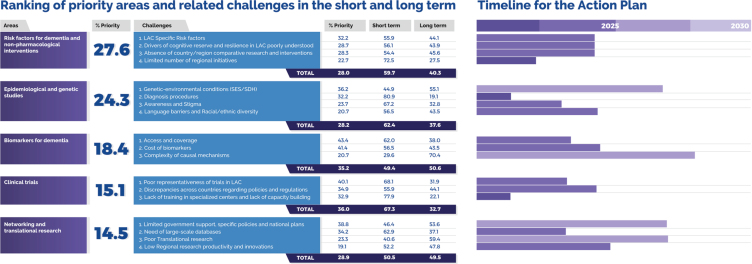
Priority levels assigned to core areas and challenges via a knowledge inquiry and related actions timelines. LAC-CD regional experts (N = 220) were presented with a survey and were asked to rank the 5 areas and associated challenges in order of priority. We calculated the percentage of respondents who rated these within the top two priorities and used these to rank both areas and challenges. The right inset shows the timeline for the proposed actions. Experts were also asked to deliver their views about a feasible timeline to address these challenges and actions (0-5 or 5-10 years) (% = Mean %of responses). Reproduced with authorization from [1].
Fig. 8
Fig. 8
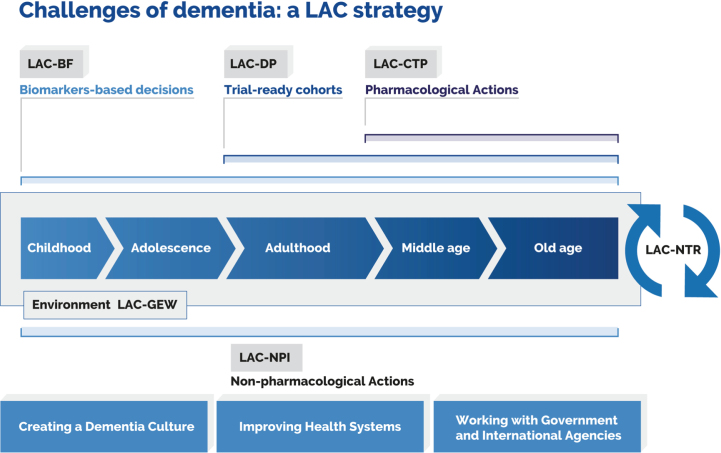
Knowledge-to-action framework. The diagram captures challenges posed by dementia and the related mapping of key actions. Such actions may be linked to specific working groups that have been included in the framework. This approach comprises a biomarker framework (LAC-BF), genetics and epidemiology workgroup (LAC-GEW), dementia platform (LAC-DP), clinical trial program (LAC-CTP), nonpharmacological interventions (LAC-NPI), and an LAC network for translational research (LAC-NTR). Reproduced with authorization from [1].

References

    1. Parra MA, Baez S, Sedeño L, Gonzalez Campo C, Santamaría-García H, Aprahamian I, Bertolucci PHF, Bustin J, Bicalho MAC, Cano-Gutierrez C, et al.. (2020) Dementia in Latin America: Paving the way towards a regional action plan. Alzheimers Dement, doi: 10.1002/alz.12202 - DOI - PMC - PubMed
    1. Parra MA, Baez S, Allegri R, Nitrini R, Lopera F, Slachevsky A, Custodio N, Lira D, Piguet O, Kumfor F, Huepe D, Cogram P, Bak T, Manes F, Ibanez A (2018) Dementia in Latin America: Assessing the present and envisioning the future. Neurology 90, 222–231. - PMC - PubMed
    1. (2014) Addressing global dementia. Lancet 383, 2185. - PubMed
    1. Alladi S, Hachinski V (2018) World dementia: One approach does not fit all. Neurology 91, 264–270. - PubMed
    1. Dartigues JF (2009) Alzheimer’s disease: A global challenge for the 21st century. Lancet Neurol 8, 1082–1083. - PubMed

Publication types

MeSH terms