


Evaluation of Seasonal Respiratory Virus Activity Before and After the Statewide COVID-19 Shelter-in-Place Order in Northern California
- PMID: 33492377
- PMCID: PMC7835714
- DOI: 10.1001/jamanetworkopen.2020.35281
Evaluation of Seasonal Respiratory Virus Activity Before and After the Statewide COVID-19 Shelter-in-Place Order in Northern California
Abstract
Importance: Public health initiatives that include shelter-in-place orders are expensive and unpopular. Demonstrating the success of these initiatives is essential to justify their systemic or individual cost.
Objective: To examine the association of a shelter-in-place order with lower rates of seasonal respiratory viral activity.
Design, setting, and participants: This cohort study with interrupted time series analysis obtained monthly counts of respiratory virus testing results at UC Davis Health from August 1, 2014, to July 31, 2020. Patients of all ages underwent testing conducted by the laboratory at UC Davis Health, a referral center for a 65 000-square-mile area that includes 33 counties and more than 6 million Northern California residents.
Exposures: A statewide shelter-in-place order was instituted on March 19, 2020, restricting residents to their homes except for traveling for essential activities. Large social gatherings were prohibited, schools were closed, and nonessential personnel worked remotely. Those who had to leave their homes were mandated to wear face masks, engage in frequent handwashing, and maintain physical distancing.
Main outcomes and measures: Positivity rates of common respiratory viruses within the community served by UC Davis Health.
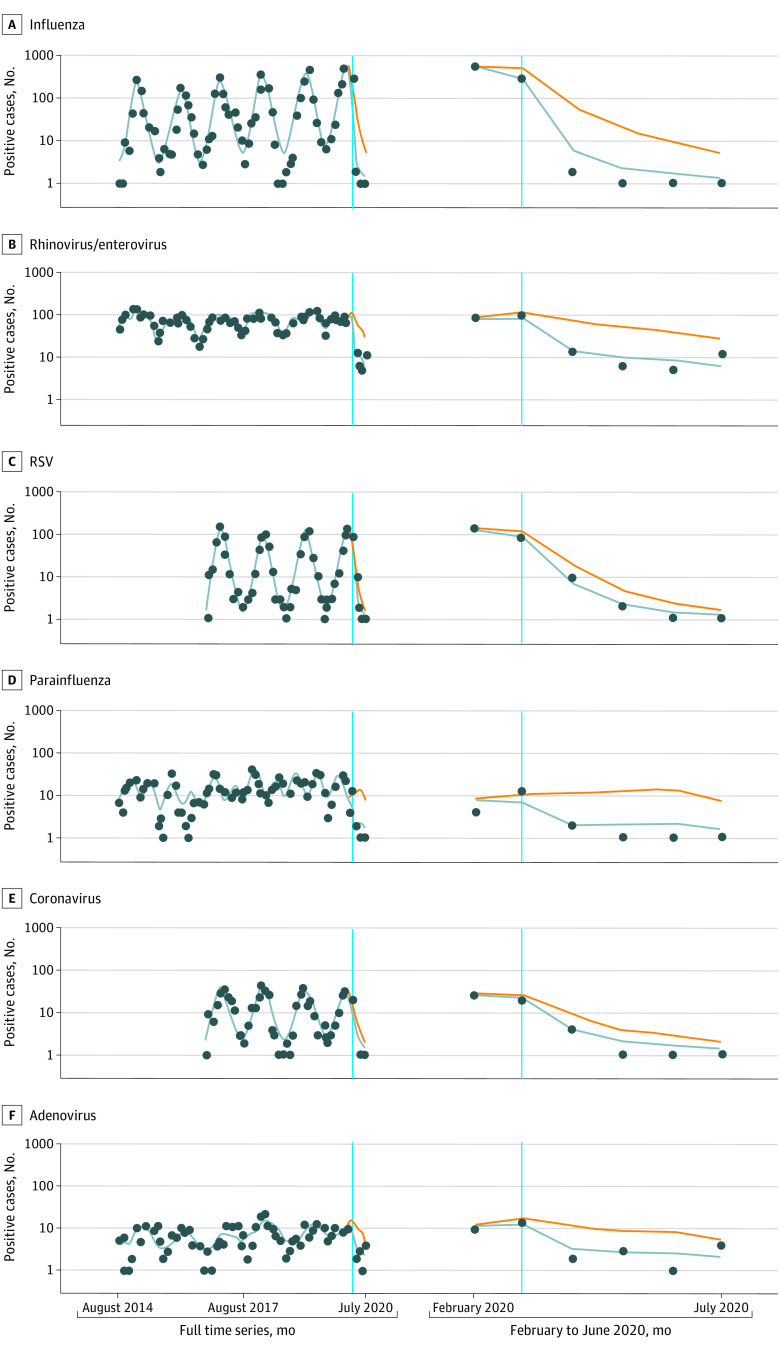
Results: A total of 46 128 tests for viral respiratory pathogens over a 6-year period were included in the analysis. For the postexposure period (March 25-July 31), approximately 168 positive test results occurred for the studied organisms in the 2020 virus year, a positivity rate of 9.88 positive results per 100 tests that was much lower than the positivity rate of 29.90 positive results per 100 tests observed for this date range in the previous 5 virus years. In contrast, the positivity rates were similar for the preexposure time frame (August 1-March 24) in the 2020 virus year and for the same time periods in the 5 previous years (30.40 vs 33.68 positive results per 100 tests). In the regression analyses, statistically significant decreases in viral activity were observed in the postexposure period for influenza (93% decrease; incidence rate ratio [IRR], 0.07; 95% CI, 0.02-0.33) and for rhinovirus or enterovirus (81% decrease; IRR, 0.19; 95% CI, 0.09-0.39) infections. Lower rates of postexposure viral activity were seen for respiratory syncytial virus, parainfluenzavirus, coronaviruses, and adenoviruses; however, these associations were not statistically significant.
Conclusions and relevance: Using interrupted time series analysis of testing for viral respiratory pathogens, this study found that statistically significant lower rates of common community respiratory viruses appeared to be associated with a shelter-in-place order during the coronavirus disease 2019 pandemic.
Conflict of interest statement
Figures
References
-
- Newsom G. Executive order N-33-20. Accessed March 19, 2020. https://www.gov.ca.gov/wp-content/uploads/2020/03/3.19.20-attested-EO-N-...
-
- SAS Institute SAS System for Windows. 9.4 ed. SAS Institute; 2012.
-
- Barnett AG, Dobson AJ. Analysing Seasonal Health Data. Springer; 2010. doi:10.1007/978-3-642-10748-1 - DOI
-
- Ten Eyck P, Cavanaugh JE. An alternate approach to pseudo-likelihood model selection in the generalized linear mixed modeling framework. Sankhya B. 2018;80:98-122. doi:10.1007/s13571-017-0130-5 - DOI
Publication types
MeSH terms
Grants and funding
LinkOut - more resources
Full Text Sources
Other Literature Sources
Medical
