


Organoid technology for personalized pancreatic cancer therapy
- PMID: 33492660
- PMCID: PMC7985124
- DOI: 10.1007/s13402-021-00585-1
Organoid technology for personalized pancreatic cancer therapy
Abstract
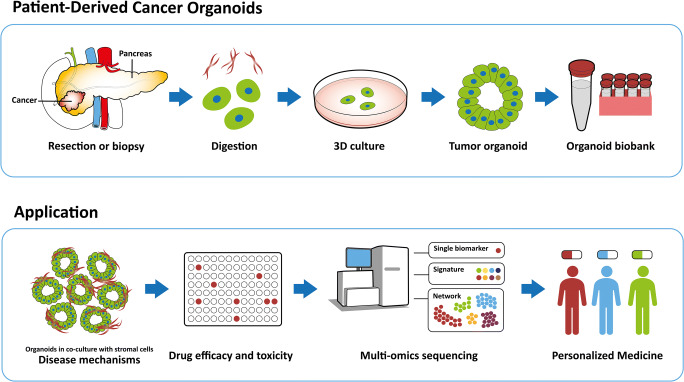
Background: Pancreatic ductal adenocarcinoma has the lowest survival rate among all major cancers and is the third leading cause of cancer-related mortality. The stagnant survival statistics and dismal response rates to current therapeutics highlight the need for more efficient preclinical models. Patient-derived organoids (PDOs) offer new possibilities as powerful preclinical models able to account for interpatient variability. Organoid development can be divided into four different key phases: establishment, propagation, drug screening and response prediction. Establishment entails tailored tissue extraction and growth protocols, propagation requires consistent multiplication and passaging, while drug screening and response prediction will benefit from shorter and more precise assays, and clear decision-making tools.
Conclusions: This review attempts to outline the most important challenges that remain in exploiting organoid platforms for drug discovery and clinical applications. Some of these challenges may be overcome by novel methods that are under investigation, such as 3D bioprinting systems, microfluidic systems, optical metabolic imaging and liquid handling robotics. We also propose an optimized organoid workflow inspired by all technical solutions we have presented.
Keywords: Drug screening; Organoids; Pancreatic cancer; Personalized medicine.
Conflict of interest statement
The authors declare no competing interests.
Figures

References
-
- Siegel RL, Miller KD, Jemal A. Cancer statistics, 2020. CA Cancer J. Clin. 2020;70:7–30. - PubMed
-
- Rahib L, Smith BD, Aizenberg R, Rosenzweig AB, Fleshman JM, Matrisian LM. Projecting cancer incidence and deaths to 2030: the unexpected burden of thyroid, liver, and pancreas cancers in the United States. Cancer Res. 2014;74:2913–2921. - PubMed
Publication types
MeSH terms
LinkOut - more resources
Full Text Sources
Other Literature Sources
Medical
