


Deficits in attentional modulation of auditory N100 in first-episode schizophrenia
- PMID: 33492765
- PMCID: PMC9491094
- DOI: 10.1111/ejn.15128
Deficits in attentional modulation of auditory N100 in first-episode schizophrenia
Abstract
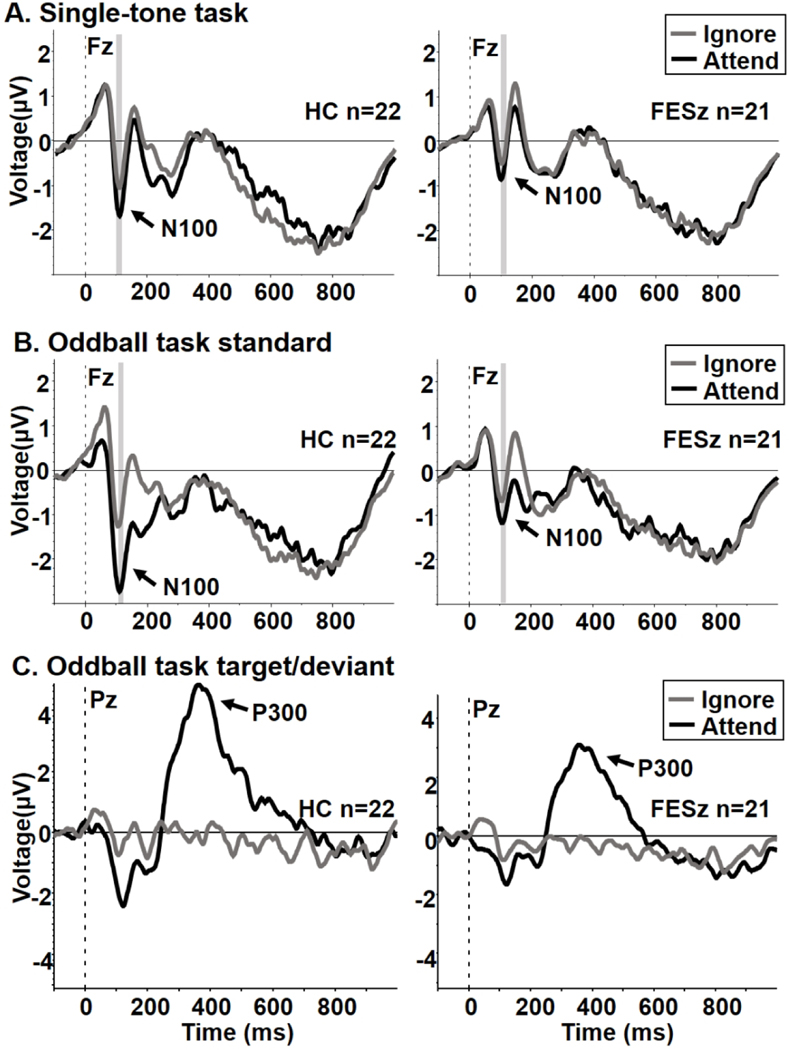
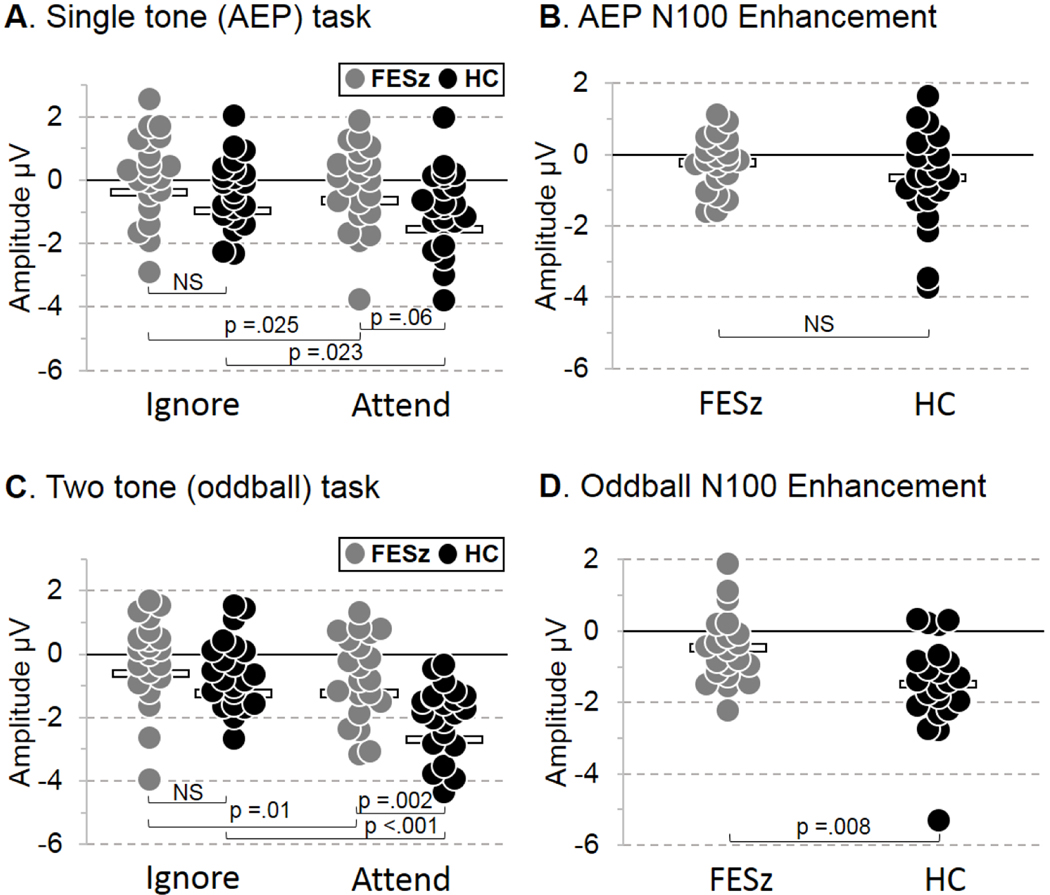
Reductions of the auditory N100 are present in schizophrenia, even at the first episode (FESz). Because most studies examine auditory N100 on active target detection oddball tasks, it remains unclear if the abnormality in FESz results from sensory deficits or impaired enhancement of N100 by selective attention, or both. N100 was recorded from 21 FESz and 22 matched healthy controls (HC) on a single-tone task and a two-tone oddball task. Overall, N100 was smaller in FESz (p = .036). Attention enhanced N100 amplitude (p < .001), but this differed between groups, with FESz impaired in N100 modulation (group x attention, p = .012). The oddball task showed greater N100 enhancement than the single-tone task (p < .001) in both groups. Group differences in N100 enhancement in the oddball task were large (Cohen's d = 0.85). Exploratory correlations showed that better N100 enhancement on the oddball task in FESz was associated with better MATRICS Overall Composite scores (cognitive tasks highly sensitive to psychosis), lower PANNS Negative factor and SANS scores, and better interpersonal (social) and role functioning in the last year. N100 during ignore conditions showed no significant difference between groups, albeit smaller in FESz, with small to medium effect sizes. Although sensory deficits in N100 are likely present, they are compounded by a failure to enhance N100 with attention. The failure of N100 enhancement by attentional gain control in FESz suggests functional dysconnection between cognitive control areas and the sensory cortex. N100 amplitude on active attention tasks may be a useful outcome biomarker for targeted enhancement of the cognitive control system.
Keywords: N100; attention; enhancement; first episode psychosis; gain; schizophrenia.
© 2021 Federation of European Neuroscience Societies and John Wiley & Sons Ltd.
Conflict of interest statement
Competing Interests
None.
Figures
References
-
- Ahveninen J, Jääskeläinen IP, Osipova D, Huttunen MO, Ilmoniemi RJ, Kaprio J, Lönnqvist J, Manninen M, Pakarinen S, Therman S and Näätänen R, 2006. Inherited auditory-cortical dysfunction in twin pairs discordant for schizophrenia. Biological psychiatry, 60(6), pp.612–620. - PubMed
-
- Bleuler E, 1950. Dementia praecox or the group of schizophrenias. - PubMed
-
- Boutros NN, Korzyukov O, Jansen B, Feingold A & Bell M Sensory gating deficits during the mid-latency phase of information processing in medicated schizophrenia patients. Psychiatry Res. 126, 203–215 (2004). - PubMed
-
- Brockhaus-Dumke A, Schultze-Lutter F, Mueller R, Tendolkar I, Bechdolf A, Pukrop R, Klosterkoetter J and Ruhrmann S, 2008. Sensory gating in schizophrenia: P50 and N100 gating in antipsychotic-free subjects at risk, first-episode, and chronic patients. Biological psychiatry, 64(5), pp.376–384. - PubMed
Publication types
MeSH terms
Grants and funding
LinkOut - more resources
Full Text Sources
Other Literature Sources
Medical
