Multicenter Study
. 2021 Aug 16;73(4):631-641.
doi: 10.1093/cid/ciab051.

Characteristics of Salmonella Recovered From Stools of Children Enrolled in the Global Enteric Multicenter Study

Affiliations
Multicenter Study

Characteristics of Salmonella Recovered From Stools of Children Enrolled in the Global Enteric Multicenter Study

Irene N Kasumba et al. Clin Infect Dis. .

Abstract

Background: The Global Enteric Multicenter Study (GEMS) determined the etiologic agents of moderate-to-severe diarrhea (MSD) in children under 5 years old in Africa and Asia. Here, we describe the prevalence and antimicrobial susceptibility of nontyphoidal Salmonella (NTS) serovars in GEMS and examine the phylogenetics of Salmonella Typhimurium ST313 isolates.

Methods: Salmonella isolated from children with MSD or diarrhea-free controls were identified by classical clinical microbiology and serotyped using antisera and/or whole-genome sequence data. We evaluated antimicrobial susceptibility using the Kirby-Bauer disk-diffusion method. Salmonella Typhimurium sequence types were determined using multi-locus sequence typing, and whole-genome sequencing was performed to assess the phylogeny of ST313.

Results: Of 370 Salmonella-positive individuals, 190 (51.4%) were MSD cases and 180 (48.6%) were diarrhea-free controls. The most frequent Salmonella serovars identified were Salmonella Typhimurium, serogroup O:8 (C2-C3), serogroup O:6,7 (C1), Salmonella Paratyphi B Java, and serogroup O:4 (B). The prevalence of NTS was low but similar across sites, regardless of age, and was similar among both cases and controls except in Kenya, where Salmonella Typhimurium was more commonly associated with cases than controls. Phylogenetic analysis showed that these Salmonella Typhimurium isolates, all ST313, were highly genetically related to isolates from controls. Generally, Salmonella isolates from Asia were resistant to ciprofloxacin and ceftriaxone, but African isolates were susceptible to these antibiotics.

Conclusions: Our data confirm that NTS is prevalent, albeit at low levels, in Africa and South Asia. Our findings provide further evidence that multidrug-resistant Salmonella Typhimurium ST313 can be carried asymptomatically by humans in sub-Saharan Africa.

Keywords: Salmonella; antibiotic susceptibility; gastroenteritis; moderate-to-severe-diarrhea (MSD); serovars.


Figures

Figure 1.
Figure 1.
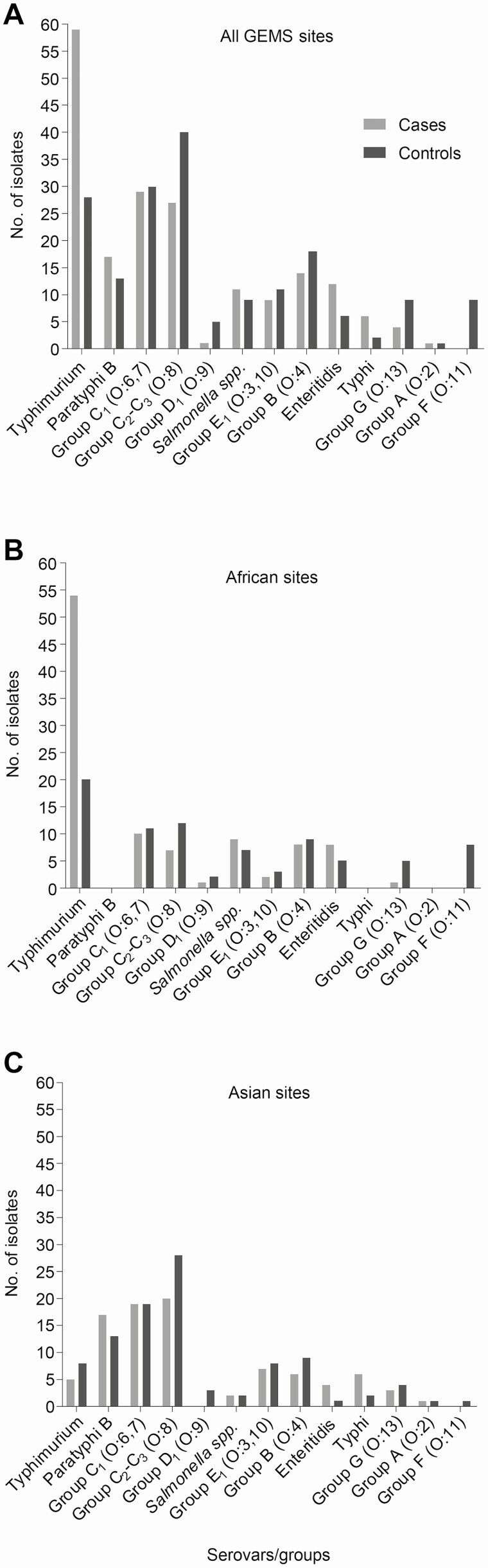
Distribution of Salmonella serogroups and serovars isolated from MSD cases and diarrhea-free asymptomatic controls. Salmonella spp. isolated from stools at (A) all 7 GEMS sites, (B) Africa, and (C) Asia. Abbreviations: GEMS, Global Enteric Multicenter Study; MSD, moderate-to-severe diarrhea.
Figure 2.
Figure 2.
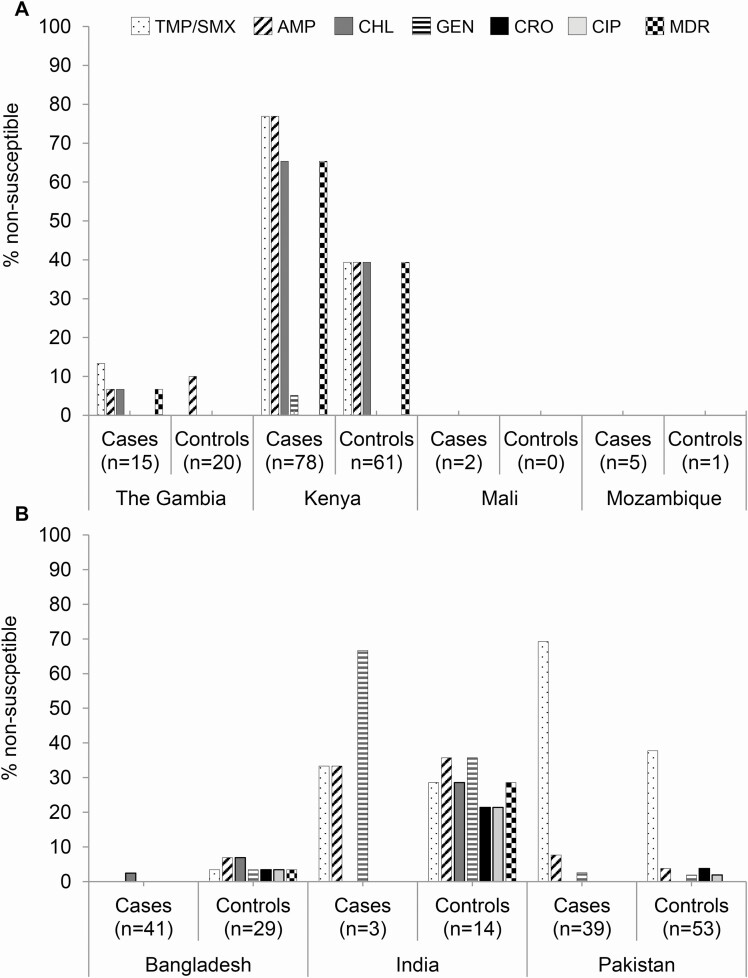
Percentage of NTS nonsusceptible to any of 6 commonly used antimicrobial agents. NTS isolated from (A) Africa and (B) Asia. Abbreviations: AMP, ampicillin; CHL, chloramphenicol; CIP, ciprofloxacin; CRO, ceftriaxone; GEN, gentamicin; MDR, multidrug resistant; NTS, nontyphoidal Salmonella; TMP/SMX, trimethoprim/sulfamethoxazole.
Figure 3.
Figure 3.
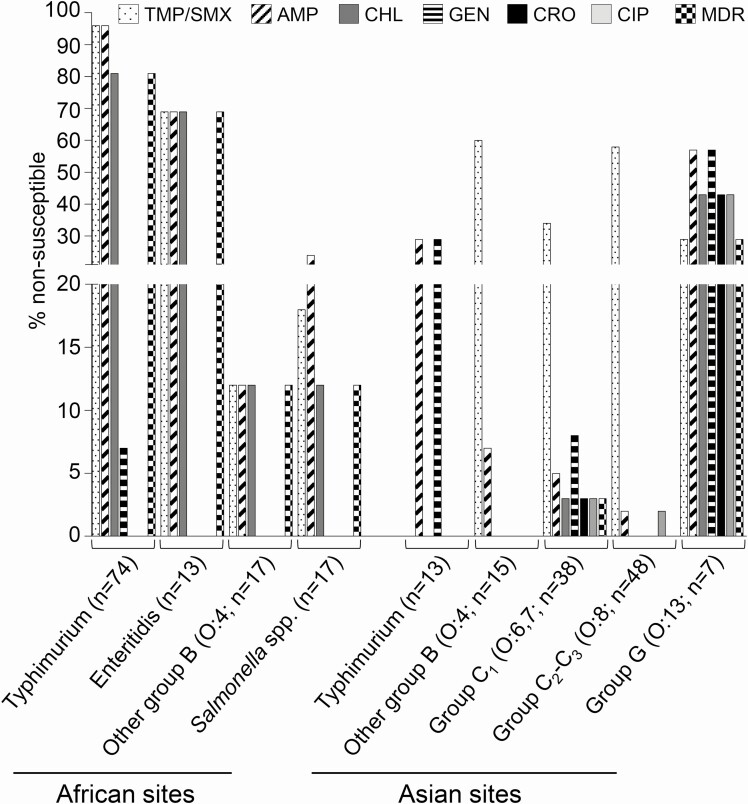
Percentage of NTS that were nonsusceptible to 6 antibiotics by serotype or serogroup. Only serotypes or serogroups that showed nonsusceptibility to antibiotics are shown. Abbreviations: AMP, ampicillin; CHL, chloramphenicol; CIP, ciprofloxacin; CRO, ceftriaxone; GEN, gentamicin; MDR, multidrug resistant; NTS, nontyphoidal Salmonella; TMP/SMX, trimethoprim/sulfamethoxazole.
Figure 4.
Figure 4.
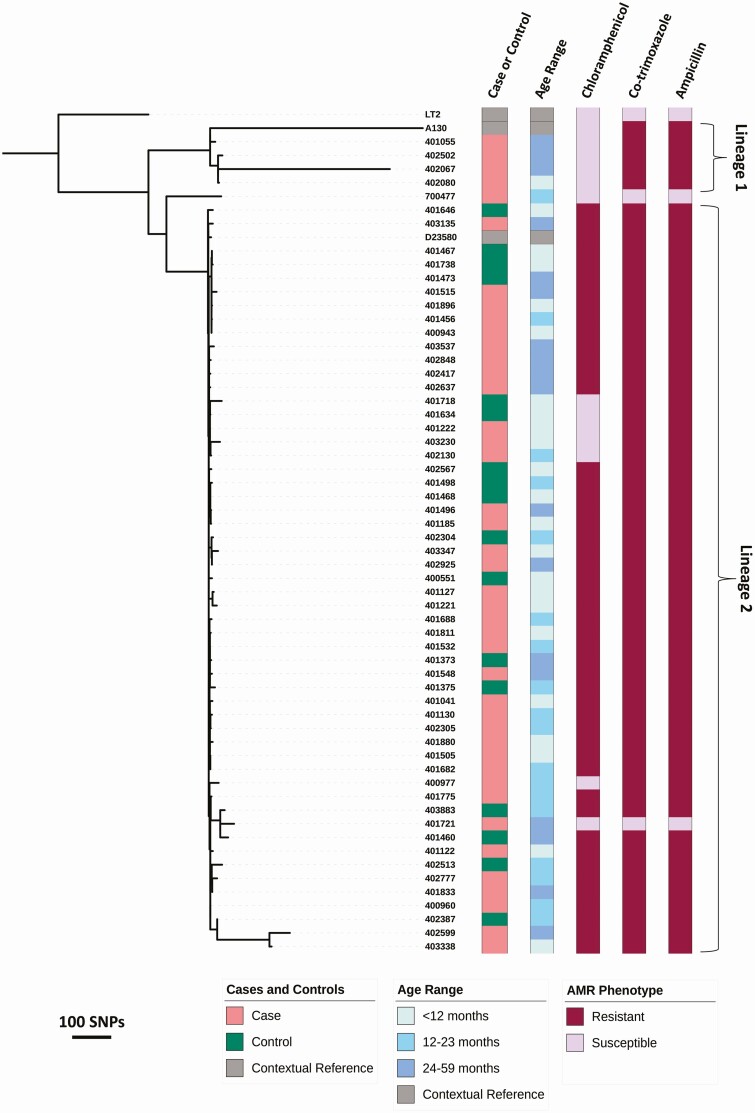
Genetic relationship between Salmonella Typhimurium ST313 isolated from MSD cases and diarrhea-free controls. The core genome maximum likelihood tree is shown for Salmonella Typhimurium ST313 isolated from the stool of cases and controls of children aged under 5 years in Kenya and Pakistan (1 isolate), which were collected as part of the GEMS. Scale bars in SNPs are shown beneath the phylogeny. Patient group, age range, and AMR data for the isolates are displayed using color strips created using Interactive Tree of Life (iTOL; Biobyte Solutions, Heidelberg, Germany) and are labeled and colored according to the in-laid key. Isolates that cluster with the lineage 1 or lineage 2 reference genomes are indicated. The tree is rooted using ST19. Abbreviations: AMR, antimicrobial resistance; GEMS, Global Enteric Multicenter Study; MSD, moderate-to-severe diarrhea; SNP, single nucleotide polymorphism; ST, sequence type.

References

    1. Jones TF, Ingram LA, Cieslak PR, et al. . Salmonellosis outcomes differ substantially by serotype. J Infect Dis 2008; 198:109–14. - PubMed
    1. Cardemil CV, Sherchand JB, Shrestha L, et al. . Pathogen-specific burden of outpatient diarrhea in infants in Nepal: a multisite prospective case-control study. J Pediatric Infect Dis Soc 2017; 6:e75–85. - PMC - PubMed
    1. Kwambana-Adams B, Darboe S, Nabwera H, et al. . Salmonella infections in The Gambia, 2005-2015. Clin Infect Dis 2015; 61(Suppl 4):S354–62. - PubMed
    1. Leung DT, Das SK, Malek MA, et al. . Non-typhoidal Salmonella gastroenteritis at a diarrheal hospital in Dhaka, Bangladesh, 1996–2011. Am J Trop Med Hyg 2013; 88:661– 9. - PMC - PubMed
    1. Taniuchi M, Sobuz SU, Begum S, et al. . Etiology of diarrhea in Bangladeshi infants in the first year of life analyzed using molecular methods. J Infect Dis 2013; 208:1794–802. - PMC - PubMed

Publication types

Substances