Review
. 2021 Jan 21;21(3):724.
doi: 10.3390/s21030724.

From Small Molecules Toward Whole Cells Detection: Application of Electrochemical Aptasensors in Modern Medical Diagnostics

Affiliations
Review

From Small Molecules Toward Whole Cells Detection: Application of Electrochemical Aptasensors in Modern Medical Diagnostics

Robert Ziółkowski et al. Sensors (Basel). .

Abstract

This paper focuses on the current state of art as well as on future trends in electrochemical aptasensors application in medical diagnostics. The origin of aptamers is presented along with the description of the process known as SELEX. This is followed by the description of the broad spectrum of aptamer-based sensors for the electrochemical detection of various diagnostically relevant analytes, including metal cations, abused drugs, neurotransmitters, cancer, cardiac and coagulation biomarkers, circulating tumor cells, and viruses. We described also possible future perspectives of aptasensors development. This concerns (i) the approaches to lowering the detection limit and improvement of the electrochemical aptasensors selectivity by application of the hybrid aptamer-antibody receptor layers and/or nanomaterials; and (ii) electrochemical aptasensors integration with more advanced microfluidic devices as user-friendly medical instruments for medical diagnostic of the future.

Keywords: SELEX; aptasensors; cancer biomarkers; electrochemistry; medical diagnostics; metal cations; microbial toxins.


Conflict of interest statement

The authors declare no conflict of interest.

Figures

Figure 1
Figure 1
Schematic representation of antibody, peptide, and nucleic acid aptamers both with their relative sizes and possible spatial constrains [2].
Figure 2
Figure 2
Schematic representation of the SELEX process.
Figure 3
Figure 3
Schematic representation of the working mechanism of an aptasensors selective toward mercury cation [59].
Figure 4
Figure 4
Lead determination using an electrochemical aptasensor developed on screen-printed transducers [72].
Figure 5
Figure 5
Scheme of the electrochemical aptasensor for potassium determination. Immobilization of the receptor layer on gold electrode depends on aptamer configuration, which is changed upon formation of the aptamer–K+ complex.
Figure 6
Figure 6
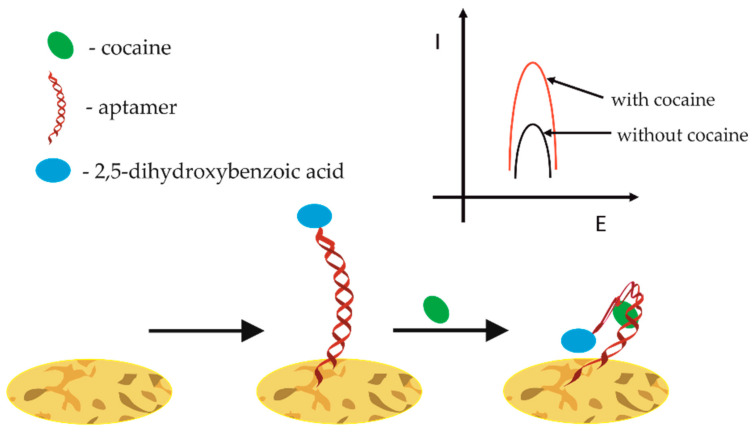
Signal on an electrochemical nanoporous gold-based aptasensor for the rapid detection of cocaine based on spatial changes of the double-stranded nucleic aptamer.
Figure 7
Figure 7
Scheme of the aptasensors construction and its integration in a wall-jet electrochemical cell with a real-time chronoamperometric response.
Figure 8
Figure 8
Working mechanism and construction of the electrochemical aptasensors toward adenosine triphosphate (ATP).
Figure 9
Figure 9
Mechanism and construction of aptasensor dedicated to PSA detection.
Figure 10
Figure 10
Schematic representation of construction and behavior of ordered mesoporous carbon–gold nanocomposite (OMC–Au) nano aptasensor for vascular endothelial growth factor (VEGF165) detection.
Figure 11
Figure 11
Schematic representation of sandwich aptasensor dedicated to thrombin detection.
Figure 12
Figure 12
Schematic representation of the construction of aptasensor for aflatoxin B detection.
Figure 13
Figure 13
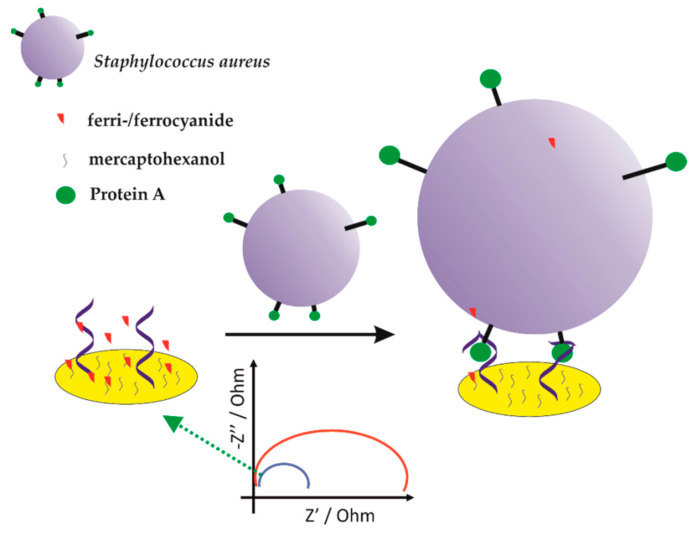
Impedimetric aptasensor scheme toward Staphylococcus aureus detection.
Figure 14
Figure 14
Possible configurations of aptamer–antibody hybrid receptor layers.
Figure 15
Figure 15
Scheme of the cancerous exosomes’ analysis with the use of dedicated microflow chip integrated with electrochemical aptasensors.

References

    1. Gold L., Janjic N., Jarvis T., Schneider D., Walker J.J., Wilcox S.K., Zichi D. Aptamers and the RNA World, Past and Present. Cold Spring Harb. Perspect. Biol. 2012;4:1–9. doi: 10.1101/cshperspect.a003582. - DOI - PMC - PubMed
    1. Reverdatto S., Burz D.S., Shekhtman A. Peptide Aptamers: Development and Applications. Curr. Top. Med. Chem. 2015;15:1082–1101. doi: 10.2174/1568026615666150413153143. - DOI - PMC - PubMed
    1. Han K., Liu T., Wang Y., Miao P. Electrochemical aptasensors for detection of small molecules, macromolecules, and cells. Rev. Anal. Chem. 2016;35:201–211. doi: 10.1515/revac-2016-0009. - DOI
    1. Colas P., Cohen B., Jessen T., Grishina I., McCoy J., Brent R. Genetic selection of peptide aptamers that recognize and inhibit cyclin-dependent kinase 2. Nature. 1996;380:548–550. doi: 10.1038/380548a0. - DOI - PubMed
    1. Kaur H., Bruno J.G., Kumar A., Sharma T.K. Aptamers in the Therapeutics and Diagnostics Pipelines. Theranostics. 2018;8:4016–4032. doi: 10.7150/thno.25958. - DOI - PMC - PubMed

LinkOut - more resources