Comparative Study
. 2021 Jan 25;13(1):17.
doi: 10.1186/s13148-020-00997-0.

Male obesity impacts DNA methylation reprogramming in sperm

Affiliations
Comparative Study

Male obesity impacts DNA methylation reprogramming in sperm

Sanaz Keyhan et al. Clin Epigenetics. .

Abstract

Background: Male obesity has profound effects on morbidity and mortality, but relatively little is known about the impact of obesity on gametes and the potential for adverse effects of male obesity to be passed to the next generation. DNA methylation contributes to gene regulation and is erased and re-established during gametogenesis. Throughout post-pubertal spermatogenesis, there are continual needs to both maintain established methylation and complete DNA methylation programming, even during epididymal maturation. This dynamic epigenetic landscape may confer increased vulnerability to environmental influences, including the obesogenic environment, that could disrupt reprogramming fidelity. Here we conducted an exploratory analysis that showed that overweight/obesity (n = 20) is associated with differences in mature spermatozoa DNA methylation profiles relative to controls with normal BMI (n = 47).

Results: We identified 3264 CpG sites in human sperm that are significantly associated with BMI (p < 0.05) using Infinium HumanMethylation450 BeadChips. These CpG sites were significantly overrepresented among genes involved in transcriptional regulation and misregulation in cancer, nervous system development, and stem cell pluripotency. Analysis of individual sperm using bisulfite sequencing of cloned alleles revealed that the methylation differences are present in a subset of sperm rather than being randomly distributed across all sperm.

Conclusions: Male obesity is associated with altered sperm DNA methylation profiles that appear to affect reprogramming fidelity in a subset of sperm, suggestive of an influence on the spermatogonia. Further work is required to determine the potential heritability of these DNA methylation alterations. If heritable, these changes have the potential to impede normal development.

Keywords: Epigenetics; Methylation; Obesity; Reprogramming; Sperm; TIEGER study.


Conflict of interest statement

The authors declare no competing interests.

Figures
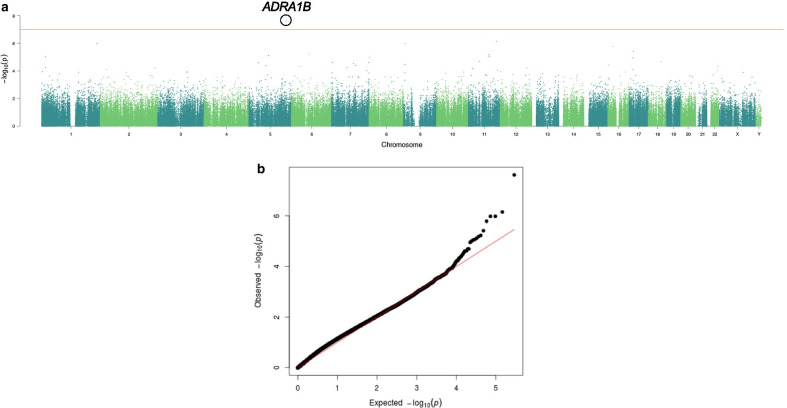
Fig. 1
Fig. 1
Methylation differences across the genome between sperm of men with normal versus overweight/obese BMIs. a Manhattan plot showing the distribution of significance levels [y axis, − log10(p)] across the genome, by genomic coordinates along each chromosome (x axis). b Quantile–quantile plot showing the distribution of expected p values (− log10(p); x axis) plotted against observed p values (y axis)
Fig. 2
Fig. 2
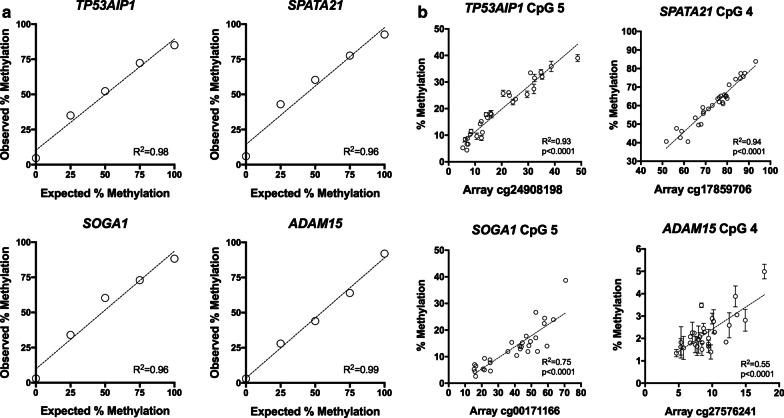
Validation of select methylation values obtained on the Illumina HumanMethylation450 BeadChip using an independent quantitative method. a Confirmation of pyrosequencing assay performance whereby methylation input (x axis) was compared to measured methylation (y axis) using defined mixtures of fully methylated and unmethylated DNAs. Data shown are the mean of triplicate measures. Some standard  deviations  were too small to be visible on the graph. b Comparison of DNA methylation measured on the Illumina platform (x axis) versus that measured by pyrosequencing (y axis) for the same CpG sites for n = 30 individuals. The average of duplicate measures is shown ± SD
Fig. 3
Fig. 3
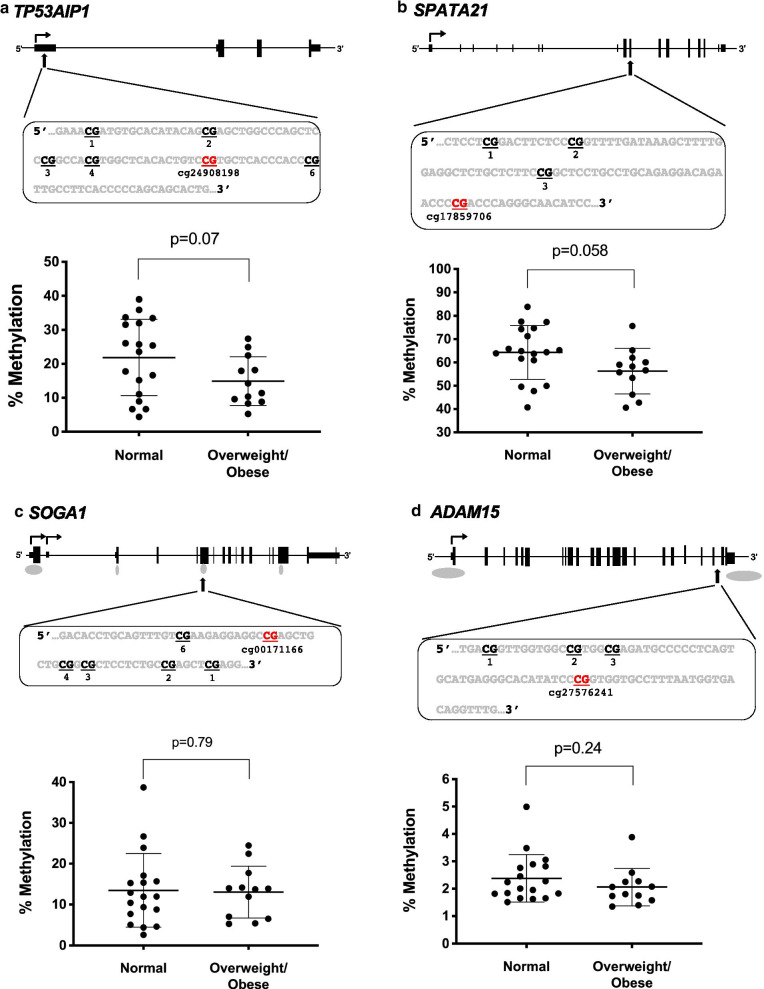
Pyrosequencing of candidate CpG sites, comparing values obtained from sperm of men with normal BMIs to those with overweight/obese BMIs. a Pyrosequencing data show differences between men with normal BMI (n = 18) and overweight/obese men (n = 12) for a TP53AIP1 (unpaired t test), b SPATA21 (unpaired t test) but not c SOGA1 (Mann–Whitney test) or d ADAM15 (Mann–Whitney test). The corresponding gene schematics with the sequence to analyze are above each gene, with the CpG site identified via 450K highlighted in red and the probe ID included
Fig. 4
Fig. 4
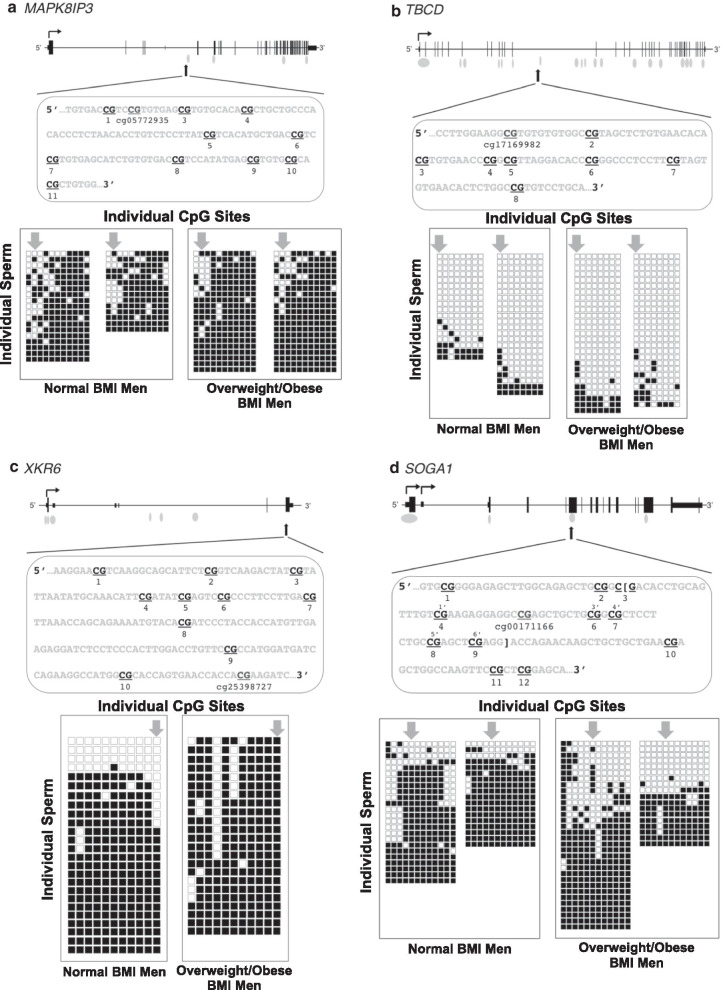
Non-random distribution of methylation changes across the sperm population by bisulfite sequencing of cloned alleles. For each gene, the genomic structure and relative position of the region sequenced are shown, with the actual sequence of the region, and CpG sites queried shown below. The CpG that exhibited differential methylation on the Illumina HumanMethylation450 (450K) bead chip is indicated, along with the probe ID. The numbering of the CpGs below the sequence corresponds to each of the CpGs analyzed. For SOGA1, the bracketed sequence and the numbering of CpGs from 1′ to 6′ are the CpG sites analyzed by bisulfite pyrosequencing (refer to Figs. 2 and 3). For each region, the PCR products derived from bisulfite-modified sperm DNA were cloned and sequenced from either two (panel c) or four (panels a, b and d) individuals per region. Results from men with a normal BMI are shown on the left for each gene and men with an overweight/obese BMI are shown on the right. The results for each individual are represented by a tight grouping of boxes, with the columns representing each CpG position in the sequence shown above, with numbering of each CpG from left to right. The rows represent the results for one individual clone. For example, in Panel a, data are shown for two men with normal BMI and two with overweight/obese BMI. There are 11 CpG sites analyzed for each individual, with 19 and 14 alleles, respectively, shown for the two men with normal BMI and 21 alleles each shown for the men with overweight/obese BMI. Filled boxes indicate the CpG is methylated; unfilled boxes indicate the CpG is unmethylated. The arrows point to the individual CpG detected as differentially methylated on the 450K platform

References

    1. Jirtle RL, Skinner MK. Environmental epigenomics and disease susceptibility. Nat Rev Genet. 2007;8(4):253–262. doi: 10.1038/nrg2045. - DOI - PMC - PubMed
    1. Ly L, Chan D, Trasler JM. Developmental windows of susceptibility for epigenetic inheritance through the male germline. Semin Cell Dev Biol. 2015;43:96–105. doi: 10.1016/j.semcdb.2015.07.006. - DOI - PubMed
    1. Ariel M, Cedar H, McCarrey J. Developmental changes in methylation of spermatogenesis-specific genes include reprogramming in the epididymis. Nat Genet. 1994;7(1):59–63. doi: 10.1038/ng0594-59. - DOI - PubMed
    1. Marques CJ, Joao Pinho M, Carvalho F, Bieche I, Barros A, Sousa M. DNA methylation imprinting marks and DNA methyltransferase expression in human spermatogenic cell stages. Epigenetics. 2011;6(11):1354–1361. doi: 10.4161/epi.6.11.17993. - DOI - PubMed
    1. Carrell DT. Epigenetics of the male gamete. Fertil Steril. 2012;97(2):267–274. doi: 10.1016/j.fertnstert.2011.12.036. - DOI - PubMed

Publication types