doi: 10.3201/eid2702.200019.
Anopheles stephensi Mosquitoes as Vectors of Plasmodium vivax and falciparum, Horn of Africa, 2019
- PMID: 33496217
- PMCID: PMC7853561
- DOI: 10.3201/eid2702.200019
Item in Clipboard
Anopheles stephensi Mosquitoes as Vectors of Plasmodium vivax and falciparum, Horn of Africa, 2019
Emerg Infect Dis.
2021 Feb.
Abstract
Anopheles stephensi mosquitoes, efficient vectors in parts of Asia and Africa, were found in 75.3% of water sources surveyed and contributed to 80.9% of wild-caught Anopheles mosquitoes in Awash Sebat Kilo, Ethiopia. High susceptibility of these mosquitoes to Plasmodium falciparum and vivax infection presents a challenge for malaria control in the Horn of Africa.
Keywords: Anopheles stephensi; Horn of Africa; Plasmodium falciparum; Plasmodium vivax; emerging; membrane feeding; mosquitoes; outbreak; parasites; transmission; urban malaria; vector competence.
Figures
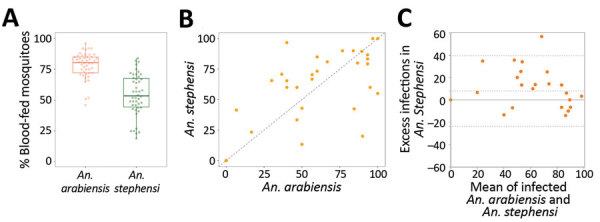
Comparison of feeding efficiency and infection rates for Anopheles stephensi and An. arabiensis mosquitoes in paired feeding experiments in study of An. stephensi mosquitoes as vectors of Plasmodium vivax and falciparum, Horn of Africa, 2019. A) Percentage of fully fed An. arabiensis mosquitoes (red) and An. stephensi mosquitoes (green). Box plots indicate median (midline), 25th (lower line), and 75th (upper line) percentiles of proportion of blood-fed mosquitoes. Whiskers indicate lower and upper 25% scores. Vertical lines indicate minimum and maximum values. B) Percentage of infected mosquitoes. C) Bland-Altman plot (difference plots) for mosquito infection rates in different mosquito species. Symbols indicate differences in infection rates in An. stephensi versus An. arabiensis (y-axis) mosquitoes in relation to mean infection rates in these 2 species (x-axis). Positive values (57.1%; 16/28) indicate a higher infection rate in An. stephensi mosquitoes; dotted lines indicate the 95% limits of agreement. There was no evidence that the correlation coefficient between the paired differences and means differed significantly from 0 (Pitman test of difference in variance, r = 0.026, p = 0.864).
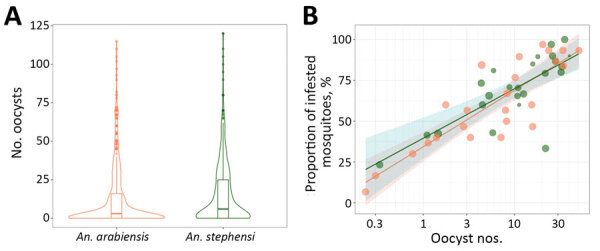
Comparison of relative oocyst numbers and infection rate for Anopheles stephensi and An. arabiensis mosquitoes in paired feeding experiments in study of An. stephensi mosquitoes as vectors of Plasmodium vivax and falciparum, Horn of Africa, 2019. Number of oocysts per infected midgut for individual mosquitoes of each of the 2 species. A) Violin plot showing estimated kernel density. Horizontal lines indicate median; box indicates interquartile range; and spikes indicate upper and lower adjacent values. The proportion of midguts with detectable oocysts (y-axis) is indicated in association with log10 transformed oocyst numbers (x-axis) for An. stephensi (green dots) and An. arabiensis (orange dots) mosquitoes. B) Data for 24 feeding experiments in which 723 An. arabiensis and 643 An. stephensi mosquitoes were dissected. Shaded area indicates 95% CI around estimates for An. stephensi (green) and An. arabiensis (orange) mosquitoes.
References
-
- World Health Organization. Vector alert: Anopheles stephensi invasion and spread [cited 2020 Sep 3]. https://www.who.int/publications/i/item/vector-alert-anopheles-stephensi...
-
- World Health Organization. Larval source management: a supplementary measure for malaria vector control: an operational manual [cited 2020 Dec 21]. https://apps.who.int/iris/bitstream/handle/10665/85379/9789241505604_eng...
Publication types
MeSH terms
Grants and funding
LinkOut - more resources
Full Text Sources
Other Literature Sources