


Clinical and economic burden of diabetic foot ulcers: A 5-year longitudinal multi-ethnic cohort study from the tropics
- PMID: 33497545
- PMCID: PMC8244009
- DOI: 10.1111/iwj.13540
Clinical and economic burden of diabetic foot ulcers: A 5-year longitudinal multi-ethnic cohort study from the tropics
Abstract
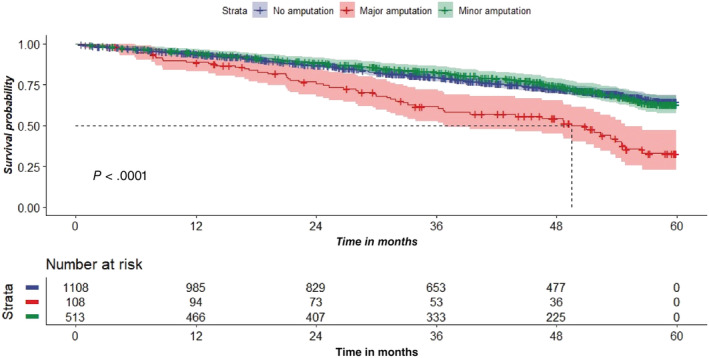
Diabetic foot ulcers (DFUs) present a substantial clinical and economic burden to healthcare systems around the world, with significant reductions in quality of life for those affected. We aimed to analyse the clinical and economic burden of DFU via a 5-year longitudinal multi-ethnic cohort study. A longitudinal analysis of inpatient and outpatient DFUs data over 5 years from a university tertiary hospital in Singapore was performed. Data included baseline characteristics, clinical outcomes, hospitalisation, and outpatient details. Descriptive statistics, Kaplan-Meier survival analyses, and Cox proportional hazard models were performed. Patients treated for DFUs (n = 1729, mean patient age of 63·4 years) were assessed. The cohort consists of Chinese (61.4%), Malay (13.5%), and Indian (18.4%) patients. Common comorbidities included peripheral arterial disease (74.8%), peripheral neuropathy (14.5%), and a median haemoglobin A1c of 9.9%. Patients underwent toe(s) amputation (36.4%), transmetatarsal amputations (16.9%), or major amputations (6·5%). The mean length of inpatient stay for ulcer-only, minor amputation, and major amputation was 13.3, 20.5, and 59.6 days, respectively. Mean cost per patient-year was US $3368 (ulcer-only), US $10468 (minor amputation), and US $30131 (major amputation). Minor amputation-free survival was 80.9% at 1 year and 56.9% at 5 years, while major amputation-free survival was 97.4% at 1 year and 91.0% at 5 years. In conclusion, within our multi-ethnic cohort of patients from the tropics, there was significant clinical and economic burden of DFUs, with a high wound per patient ratio and escalating healthcare costs corresponding to more proximal amputation levels.
Keywords: diabetic foot; healthcare costs; inpatient; outpatient; tropics.
© 2021 The Authors. International Wound Journal published by Medicalhelplines.com Inc (3M) and John Wiley & Sons Ltd.
Conflict of interest statement
All authors contributed to and approved the final manuscript. The authors declare no conflict of interest and all authors contributed sufficiently to be credited at co‐authors.
Figures

References
-
- World Health Organization World Health Organization Fact Sheet on Diabetes. 2019. https://www.who.int/news-room/fact-sheets/detail/diabetes. Accessed June 1, 2020.
-
- Boulton AJ, Vileikyte L, Ragnarson‐Tennvall G, Apelqvist J. The global burden of diabetic foot disease. Lancet. 2005;366(9498):1719‐1724. - PubMed
-
- Zhang P, Lu J, Jing Y, Tang S, Zhu BY. Global epidemiology of diabetic foot ulceration: a systematic review and meta‐analysis. Ann Med. 2017;49(2):106‐116. - PubMed
-
- Zhang Y, Lazzarini PA, McPhail SM, van Netten JJ, Armstrong DG, Pacella RE. Global disability burdens of diabetes‐related lower‐extremity complications in 1990 and 2016. Diabetes Care. 2020;43:964‐974. - PubMed
MeSH terms
Grants and funding
LinkOut - more resources
Full Text Sources
Other Literature Sources
Medical
