


Abiotic Stress in Crop Species: Improving Tolerance by Applying Plant Metabolites
- PMID: 33498148
- PMCID: PMC7908993
- DOI: 10.3390/plants10020186
Abiotic Stress in Crop Species: Improving Tolerance by Applying Plant Metabolites
Abstract
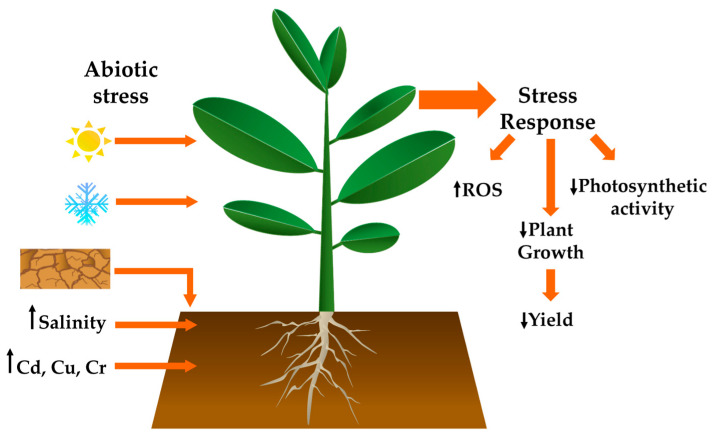
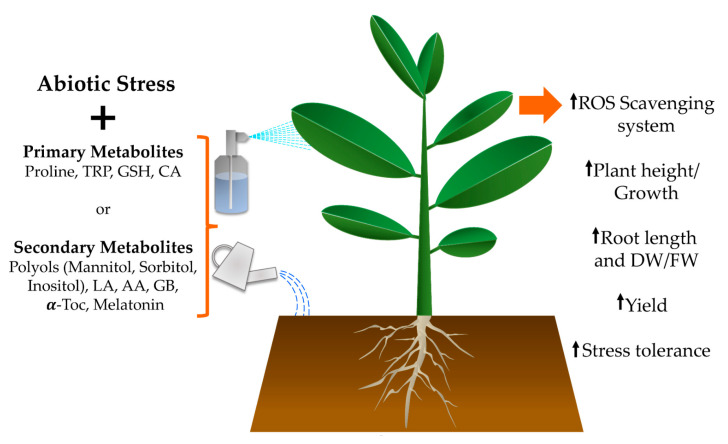
Reductions in crop yields brought about by abiotic stress are expected to increase as climate change, and other factors, generate harsher environmental conditions in regions traditionally used for cultivation. Although breeding and genetically modified and edited organisms have generated many varieties with greater abiotic stress tolerance, their practical use depends on lengthy processes, such as biological cycles and legal aspects. On the other hand, a non-genetic approach to improve crop yield in stress conditions involves the exogenous application of natural compounds, including plant metabolites. In this review, we examine the recent literature related to the application of different natural primary (proline, l-tryptophan, glutathione, and citric acid) and secondary (polyols, ascorbic acid, lipoic acid, glycine betaine, α-tocopherol, and melatonin) plant metabolites in improving tolerance to abiotic stress. We focus on drought, saline, heavy metal, and temperature as environmental parameters that are forecast to become more extreme or frequent as the climate continues to alter. The benefits of such applications are often evaluated by measuring their effects on metabolic, biochemical, and morphological parameters in a variety of crop plants, which usually result in improved yields when applied in greenhouse conditions or in the field. As this strategy has proven to be an effective way to raise plant tolerance to abiotic stress, we also discuss the prospect of its widespread implementation in the short term.
Keywords: drought stress; heavy metal stress; primary metabolite; salt stress; secondary metabolites.
Conflict of interest statement
The authors declare no conflict of interest. The funders had no role in the design of the study; in the collection, analyses, or interpretation of data; in the writing of the manuscript, or in the decision to publish the results.
Figures
References
-
- Döös B.R. Population growth and loss of arable land. Glob. Environ. Chang. 2002;12:303–311. doi: 10.1016/S0959-3780(02)00043-2. - DOI
-
- Hofmann D.J., Butler J.H., Tans P.P. A new look at atmospheric carbon dioxide. Atmos. Environ. 2009;43:2084–2086. doi: 10.1016/j.atmosenv.2008.12.028. - DOI
-
- U.S. Global Change Research Program . Global Climate Change Impacts in the United States: A State of Knowledge Report. Cambridge University Press; Cambridge, UK; New York, NY, USA: 2009.
-
- Bot A.J., Nachtergaele F.O., Young A. Land Resource Potential and Constraints at Regional and Country Levels. World Soil Resources Report; FAO; Rome, Italy: 2000. p. 122.
Publication types
Grants and funding
LinkOut - more resources
Full Text Sources
Other Literature Sources
Research Materials
