. 2021 Jan 20;14(3):478.
doi: 10.3390/ma14030478.

Effect of the Cross-Linking Density on the Swelling and Rheological Behavior of Ester-Bridged β-Cyclodextrin Nanosponges

Affiliations

Effect of the Cross-Linking Density on the Swelling and Rheological Behavior of Ester-Bridged β-Cyclodextrin Nanosponges

Gjylije Hoti et al. Materials (Basel). .

Abstract

The cross-linking density influences the physicochemical properties of cyclodextrin-based nanosponges (CD-NSs). Although the effect of the cross-linker type and content on the NSs performance has been investigated, a detailed study of the cross-linking density has never been performed. In this contribution, nine ester-bridged NSs based on β-cyclodextrin (β-CD) and different quantities of pyromellitic dianhydride (PMDA), used as a cross-linking agent in stoichiometric proportions of 2, 3, 4, 5, 6, 7, 8, 9, and 10 moles of PMDA for each mole of CD, were synthesized and characterized in terms of swelling and rheological properties. The results, from the swelling experiments, exploiting Flory-Rehner theory, and rheology, strongly showed a cross-linker content-dependent behavior. The study of cross-linking density allowed to shed light on the efficiency of the synthesis reaction methods. Overall, our study demonstrates that by varying the amount of cross-linking agent, the cross-linked structure of the NSs matrix can be controlled effectively. As PMDA βCD-NSs have emerged over the years as a highly versatile class of materials with potential applications in various fields, this study represents the first step towards a full understanding of the correlation between their structure and properties, which is a key requirement to effectively tune their synthesis reaction in view of any specific future application or industrial scale-up.

Keywords: Flory–Rehner theory; cross-linking density; rheology; swelling capacity; β-cyclodextrin nanosponges.


Conflict of interest statement

The authors declare no conflict of interest.

Figures
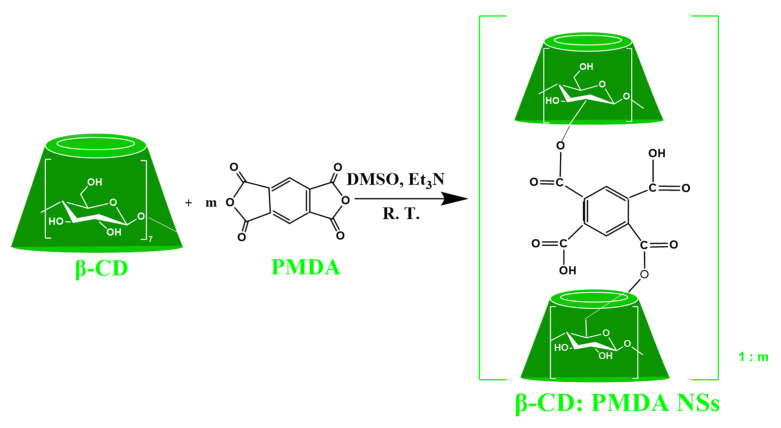
Figure 1
Figure 1
Esterification of β-CD with pyromellitic dianhydride.
Figure 2
Figure 2
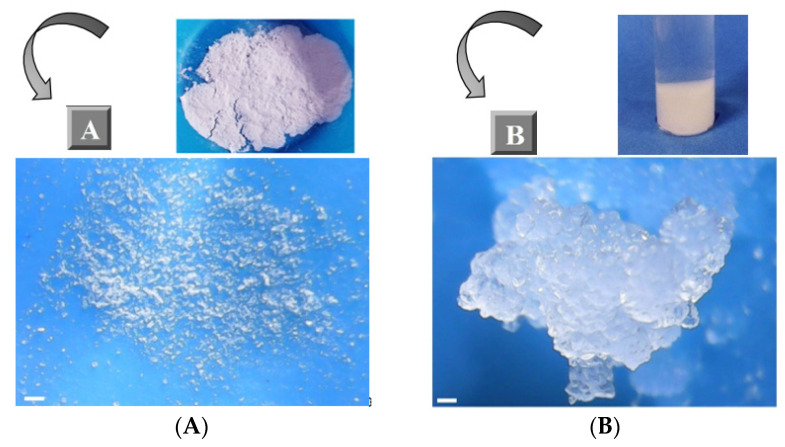
Images of β-CD:PMDA NS with molar ratio 1:6 in a dry state (A) and a swollen state (B). Scale bar: 1 mm. The images of other molar ratios are presented in Supplementary Material (Figure S3).
Figure 3
Figure 3
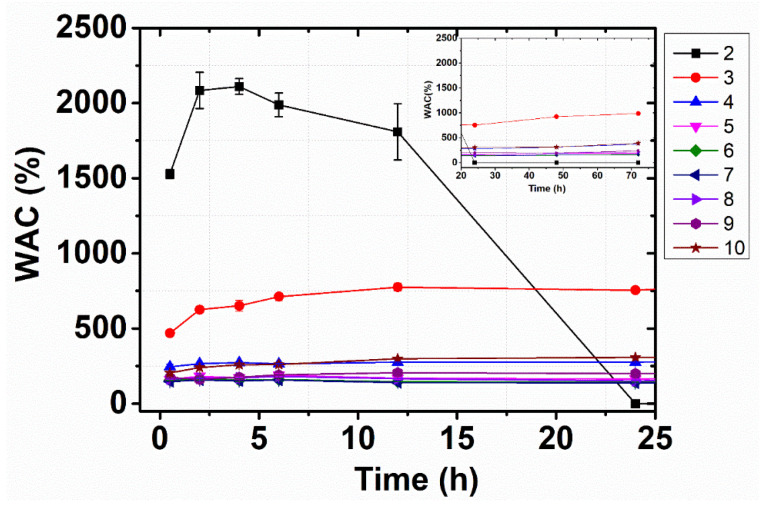
Water absorption capacity (WAC) as a function of the swelling time for each monomer ratio of β-CD:PMDA NSs. The points are the average of three experiments and the bars represent the standard deviation.
Figure 4
Figure 4
(A) Water absorption capacity (WAC) and (B) image of β-CD:PMDA NSs in a swollen state as a function of cross-linker to monomer ratio of β-CD:PMDA NSs. The points (A) are the average of three experiments and the bars represent the standard deviation.
Figure 5
Figure 5
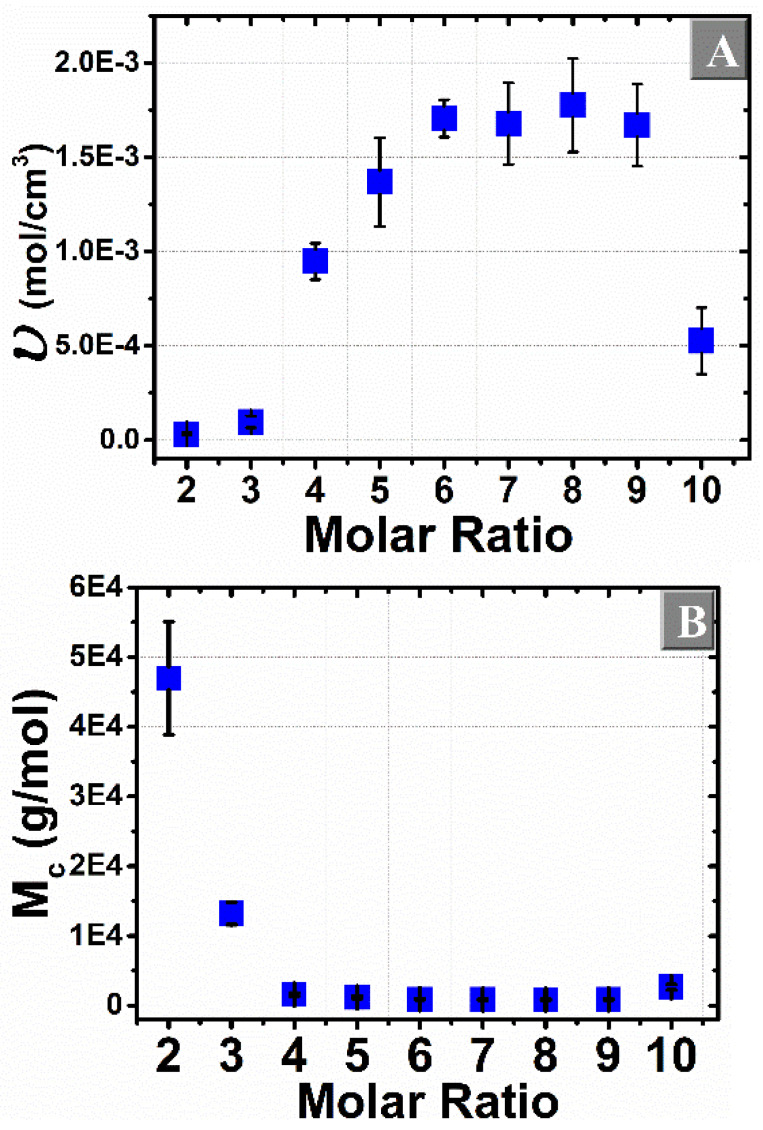
Mean values of (A) cross-linking density υ (mol/cm3) and (B) molecular weight between cross-links Mc (g/mol) from the equilibrium swelling of prepared NSs; vertical bars represent the standard deviation.
Figure 6
Figure 6
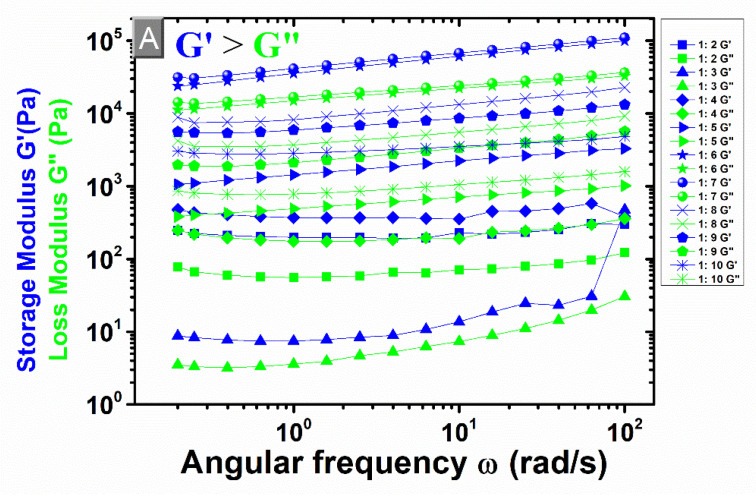
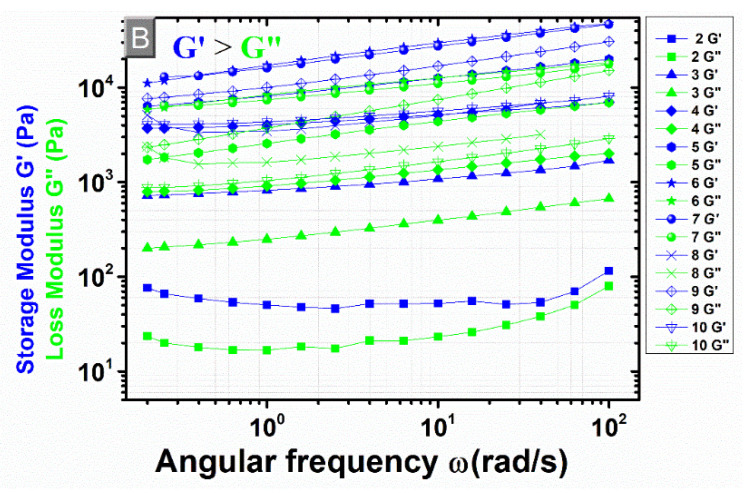
Storage (G’) and loss (G’’) modulus versus angular frequency for β-CD:PMDA molar ratio of 1:3, 1:4, 1:5, 1:6, 1:7, 1:8, 1:9, 1:10. (A) 1 mm gap size; (B) 2 mm gap size.
Figure 6
Figure 6
Storage (G’) and loss (G’’) modulus versus angular frequency for β-CD:PMDA molar ratio of 1:3, 1:4, 1:5, 1:6, 1:7, 1:8, 1:9, 1:10. (A) 1 mm gap size; (B) 2 mm gap size.
Figure 7
Figure 7
Storage (G’) and loss (G’’) modulus versus molar ratio of β-CD:PMDA (1:3, 1:4, 1:5, 1:6, 1:7, 1:8, 1:9, 1:10) at an angular frequency (ω) of 1 rad/s; (A) 1 mm gap size; (B) 2 mm gap size.
Figure 8
Figure 8
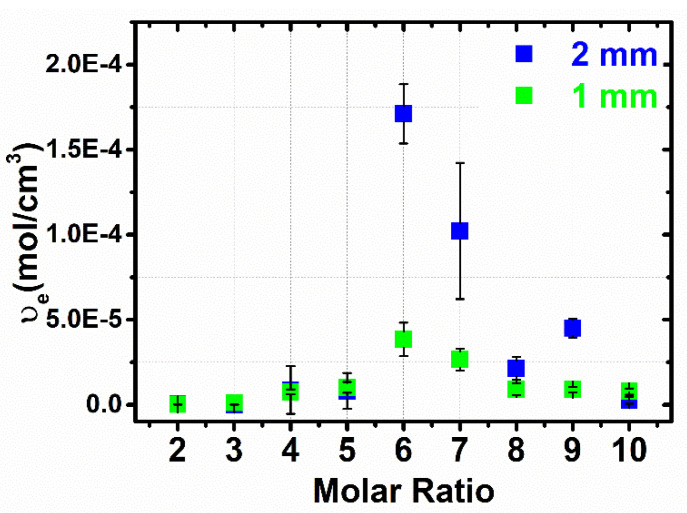
Effective sub-chain density (moles of effective sub-chains per unit volume) as a function of added cross-linker content. 1 mm; 2 mm; gap sizes, removing the extra sample outside the geometry and without solvent trap.
Figure 9
Figure 9
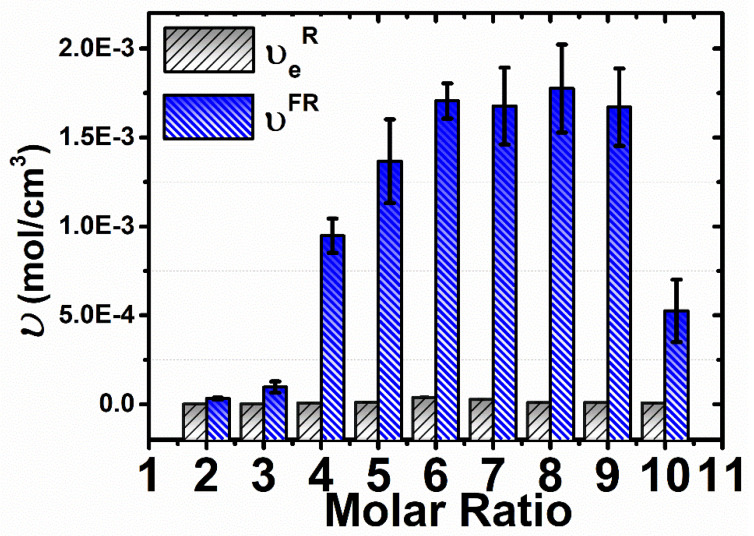
Comparison of the cross-linking densities obtained by two different methods: Flory–Rehner theory (υFR) and rheological measurements(υeR) for β-CD:PMDA NSs, at 2 mm gap size.

References

    1. Salimi-Kenari H., Mollaie F., Dashtimoghadam E., Imani M., Nyström B. Effects of chain length of the cross-linking agent on rheological and swelling characteristics of dextran hydrogels. Carbohydr. Polym. 2018;181:141–149. doi: 10.1016/j.carbpol.2017.10.056. - DOI - PubMed
    1. Hennink W.E., Nostrum C.F. Van Novel crosslinking methods to design hydrogels. Adv. Drug Deliv. Rev. 2012;64:223–236. doi: 10.1016/j.addr.2012.09.009. - DOI - PubMed
    1. Caldera F., Tannous M., Cavalli R., Zanetti M., Trotta F. Evolution of Cyclodextrin Nanosponges. Int. J. Pharm. 2017;531:470–479. doi: 10.1016/j.ijpharm.2017.06.072. - DOI - PubMed
    1. Oliveira V.A., Veloso T.C., Leao V.A. Hydrogels of cellulose acetate crosslinked with pyromellitic dianhydride-Part I: Synthesis and swelling kinetics. Artigo. 2013;36:102–106. doi: 10.1590/S0100-40422013000100019. - DOI
    1. Larrañeta E., Stewart S., Ervine M., Al-Kasasbeh R., Donnelly F.R. Hydrogels for Hydrophobic Drug Delivery. Classification, Synthesis and Applications. J. Funct. Biomater. 2018;9:13. doi: 10.3390/jfb9010013. - DOI - PMC - PubMed