


Cancer Treatment-Induced Accelerated Aging in Cancer Survivors: Biology and Assessment
- PMID: 33498754
- PMCID: PMC7865902
- DOI: 10.3390/cancers13030427
Cancer Treatment-Induced Accelerated Aging in Cancer Survivors: Biology and Assessment
Abstract
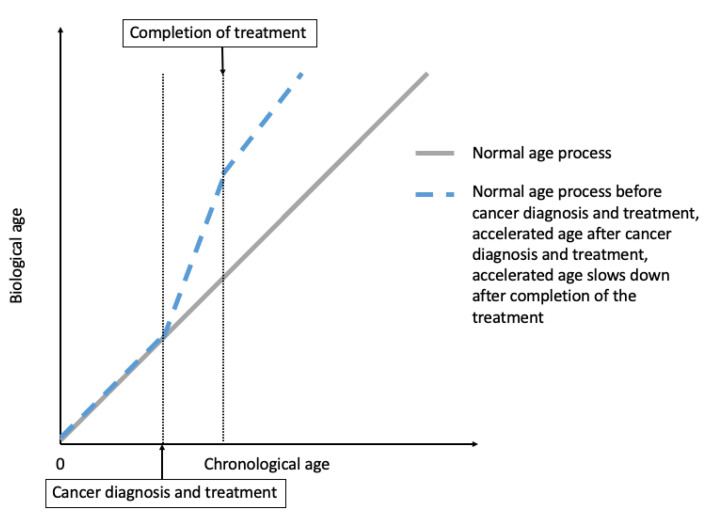
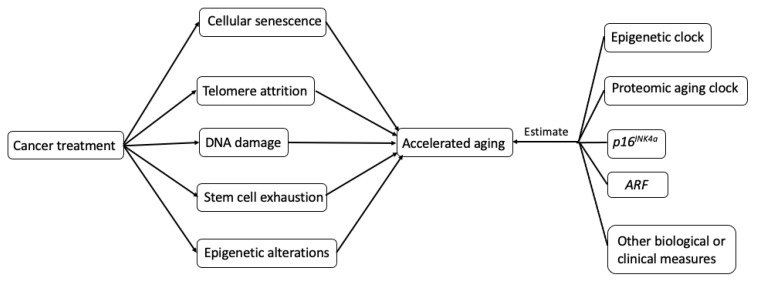
Rapid improvements in cancer survival led to the realization that many modalities used to treat or control cancer may cause accelerated aging in cancer survivors. Clinically, "accelerated aging" phenotypes in cancer survivors include secondary cancers, frailty, chronic organ dysfunction, and cognitive impairment, all of which can impact long-term health and quality of life in cancer survivors. The treatment-induced accelerated aging in cancer survivors could be explained by telomere attrition, cellular senescence, stem cell exhaustion, DNA damage, and epigenetic alterations. Several aging clocks and biomarkers of aging have been proposed to be potentially useful in estimating biological age, which can provide specific information about how old an individual is biologically independent of chronological age. Measuring biological age in cancer survivors may be important for two reasons. First, it can better predict the risk of cancer treatment-related comorbidities than chronological age. Second, biological age may provide additional value in evaluating the effects of treatments and personalizing cancer therapies to maximize efficacy of treatment. A deeper understanding of treatment-induced accelerated aging in individuals with cancer may lead to novel strategies that reduce the accelerated aging and improve the quality of life in cancer survivors.
Keywords: accelerated aging; cancer treatment; cellular senescence.
Conflict of interest statement
The authors declare no conflict of interest.
Figures
References
-
- Olsen J.H., Möller T., Anderson H., Langmark F., Sankila R., Tryggvadóttír L., Winther J.F., Rechnitzer C., Jonmundsson G., Christensen J., et al. Lifelong Cancer Incidence in 47 697 Patients Treated for Childhood Cancer in the Nordic Countries. J. Natl. Cancer Inst. 2009;101:806–813. doi: 10.1093/jnci/djp104. - DOI - PubMed
-
- Reulen R.C., Frobisher C., Winter D.L., Kelly J., Lancashire E.R., Stiller C.A., Pritchard-Jones K., Jenkinson H.C., Hawkins M.M., British Childhood Cancer Survivor Study Steering Group Long-term Risks of Subsequent Primary Neoplasms Among Survivors of Childhood Cancer. JAMA. 2011;305:2311–2319. doi: 10.1001/jama.2011.747. - DOI - PubMed
Publication types
LinkOut - more resources
Full Text Sources
Other Literature Sources
