


Antifungal Activity and Chemical Composition of Seven Essential Oils to Control the Main Seedborne Fungi of Cucurbits
- PMID: 33499094
- PMCID: PMC7912402
- DOI: 10.3390/antibiotics10020104
Antifungal Activity and Chemical Composition of Seven Essential Oils to Control the Main Seedborne Fungi of Cucurbits
Abstract
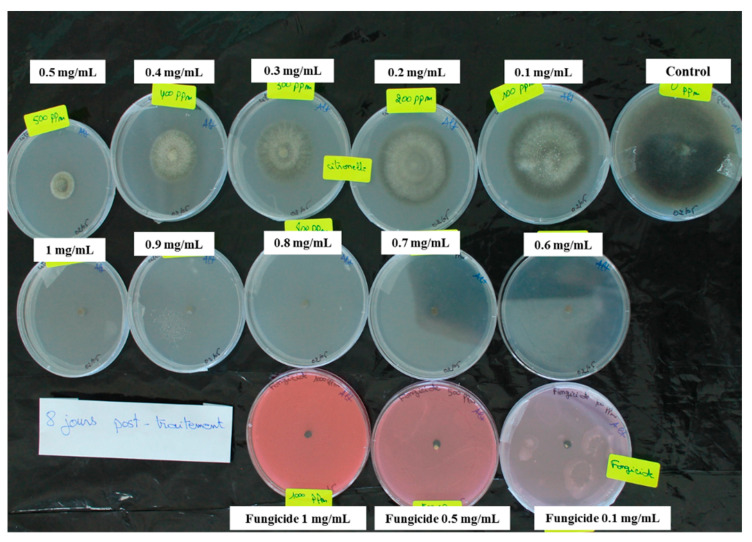
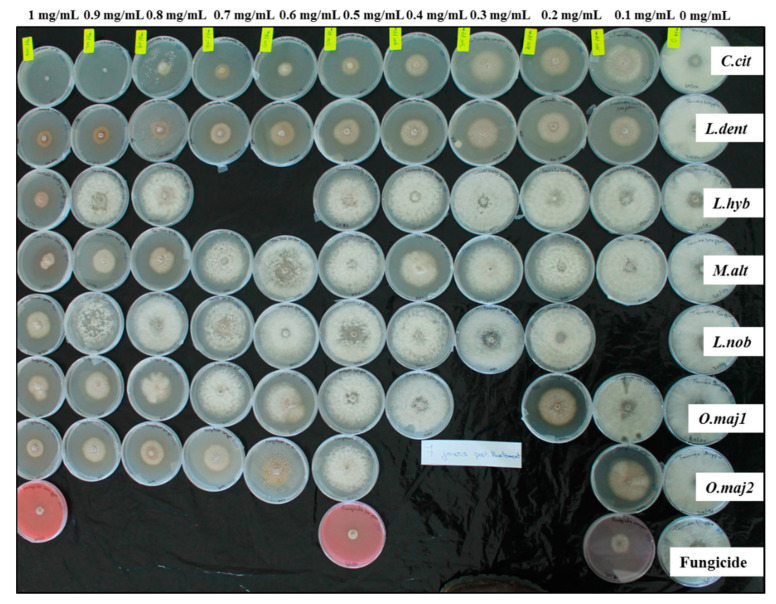
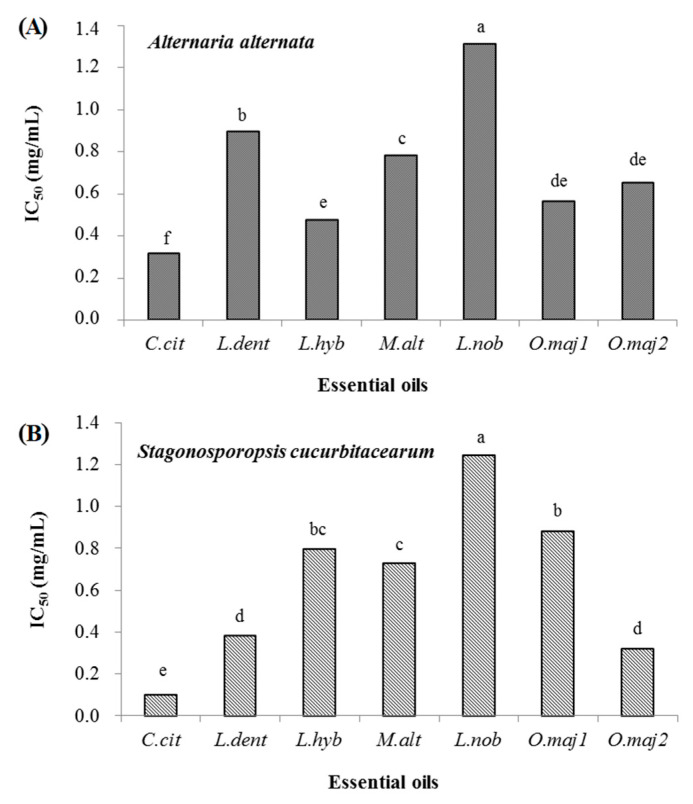
Essential oils represent novel alternatives to application of synthetic fungicides to control against seedborne pathogens. This study investigated seven essential oils for in vitro growth inhibition of the main seedborne pathogens of cucurbits. Cymbopogon citratus essential oil completely inhibited mycelial growth of Stagonosporopsis cucurbitacearum and Alternaria alternata at 0.6 and 0.9 mg/mL, respectively. At 1 mg/mL, Lavandula dentata, Lavandula hybrida, Melaleuca alternifolia, Laurus nobilis, and two Origanum majorana essential oils inhibited mycelia growth of A. alternata by 54%, 71%, 68%, 36%, 90%, and 74%, respectively. S. cucurbitacearum mycelia growth was more sensitive to Lavandula essential oils, with inhibition of ~74% at 1 mg/mL. To determine the main compounds in these essential oils that might be responsible for this antifungal activity, they were analyzed by gas chromatography-mass spectrometry (GC-MS). C. citratus essential oil showed cirtal as its main constituent, while L. dentata and L. nobilis essential oils showed eucalyptol. The M. alternifolia and two O. majorana essential oils had terpinen-4-ol as the major constituent, while for L. hybrida essential oil, this was linalool. Thus, in vitro, these essential oils can inhibit the main seedborne fungi of cucurbits, with future in vivo studies now needed to confirm these activities.
Keywords: Alternaria alternata; Cymbopogon citratus; GC-MS; Stagonosporopsis cucurbitacearum; cucurbits.
Conflict of interest statement
The authors declare that they have no conflicts of interest.
Figures
References
-
- Food and Agriculture Organization of the United Nations FAOSTAT Data. [(accessed on 27 October 2020)]; Available online: http://www.fao.org/faostat/en/#data/QC.
-
- Moumni M., Mancini V., Allagui M.B., Murolo S., Romanazzi G. Black rot of squash (Cucurbita moschata Duchesne) caused by Stagonosporopsis cucurbitacearum reported in Italy. Phytopathol. Mediterr. 2019;58:381–385. doi: 10.14601/Phytopathol_Mediter-10624. - DOI
-
- Nuangmek W., Aiduang W., Suwannarach N., Kumla J., Lumyong S. First report of gummy stem blight caused by Stagonosporopsis cucurbitacearum on cantaloupe in Thailand. Can. J. Plant Pathol. 2018;40:306–311. doi: 10.1080/07060661.2018.1424038. - DOI
LinkOut - more resources
Full Text Sources
Other Literature Sources
Miscellaneous
