


Bioactive Betulin and PEG Based Polyanhydrides for Use in Drug Delivery Systems
- PMID: 33499242
- PMCID: PMC7865682
- DOI: 10.3390/ijms22031090
Bioactive Betulin and PEG Based Polyanhydrides for Use in Drug Delivery Systems
Abstract
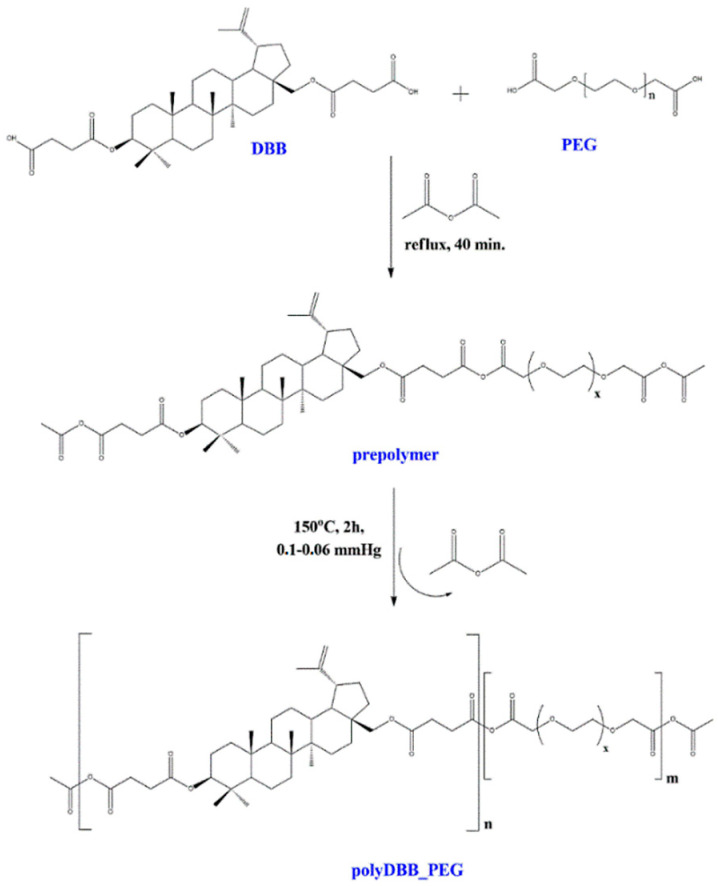
In the course of this study, a series of novel, biodegradable polyanhydrides based on betulin disuccinate and dicarboxylic derivatives of poly(ethylene glycol) were prepared by two-step polycondensation. These copolymers can be used as carriers in drug delivery systems, in the form of microspheres. Betulin and its derivatives exhibit a broad spectrum of biological activity, including cytotoxic activity, which makes them promising substances for use as therapeutic agents. Microspheres that were prepared from betulin based polyanhydrides show promising properties for use in application in drug delivery systems, including inhalation systems. The obtained copolymers release the active substance-betulin disuccinate-as a result of hydrolysis under physiological conditions. The use of a poly(ethylene glycol) derivative as a co-monomer increases the solubility and bioavailability of the obtained compounds. Microspheres with diameters in the range of 0.5-25 µm were prepared by emulsion solvent evaporation method and their physicochemical and aerodynamic properties were analyzed. The morphological characteristics of the microspheres depended on the presence of poly(ethylene glycol) (PEG) segment within the structure of polyanhydrides. The porosity of the particles depended on the amount and molecular weight of the PEG used and also on the speed of homogenization. The most porous particles were obtained from polyanhydrides containing 20% wt. of PEG 600 by using a homogenization speed of 18,000 rpm.
Keywords: betulin; biodegradable microspheres; cytostatic activity; drug delivery systems; polyanhydrides.
Conflict of interest statement
The authors declare no conflict of interest.
Figures
References
-
- Patočka J. Biologically active pentacyclic triterpenes and their current medicine signification. J. Appl. Biomed. 2003;1:7–12. doi: 10.32725/jab.2003.002. - DOI
-
- Muhammad A., Carlson R.M., Krasutsky P., Karim M. Inhibition of Epstein-Barr virus by the triterpenoid betulin diphosphate and uvaol. J. Microbiol. Biotechnol. 2004;14:1086–1088.
MeSH terms
Substances
LinkOut - more resources
Full Text Sources
Other Literature Sources
