. 2021 Jan 26;21(1):37.
doi: 10.1186/s12876-021-01613-y.

Short chain fatty acids and colon motility in a mouse model of irritable bowel syndrome

Affiliations

Short chain fatty acids and colon motility in a mouse model of irritable bowel syndrome

Ilnar F Shaidullov et al. BMC Gastroenterol. .

Abstract

Background: Irritable bowel syndrome (IBS) is defined as a multifactorial disorder associated with visceral hypersensitivity, altered gut motility and dysfunction of the brain-gut axis. Gut microbiota and its metabolites are proposed as possible etiological factors of IBS. Short chain fatty acids (SCFAs) induce both inhibitory and stimulatory action on colon motility, however, their effects on the IBS model were not investigated. The aim of our study was to investigate the level of SFCAs in feces and their effects on colon motility in a mouse model of IBS.

Methods: IBS model was induced in mice by intracolonic infusion of 1% acetic acid during the early postnatal period. Mice colon hypersensitivity was assessed by the threshold of the abdominal withdrawal reflex in response to colorectal distention. Colon contractility was studied using proximal colon specimens in isometric conditions. Transit rates were assessed by the pellet propulsion in the isolated colon. Concentrations of SCFAs in feces were measured using gas-liquid chromatography.

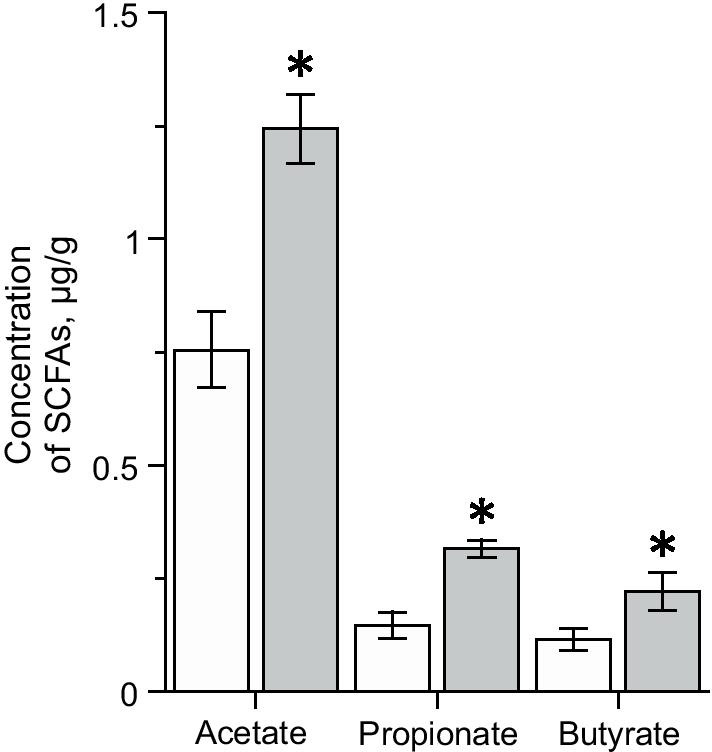
Results: The concentration of SCFAs in feces of IBS model mice was higher compared to the control group. Visceral sensitivity to colorectal distension and colonic transit rate were increased indicating IBS with predominant diarrhea. The frequency and amplitude of spontaneous contractions of proximal colon segments from IBS mice were higher, but carbachol induced contractions were lower compared to control. During acute application of SCFAs (sodium propionate, sodium acetate or butyric acid) dose-dependently (0.5-30 mM) decreased tonic tension, frequency and amplitude of spontaneous and carbachol-evoked contractions. In the mouse IBS group the inhibitory effects SCFAs on spontaneous and carbachol-evoked contractions were less pronounced. At the same time intraluminal administration of butyrate (5 mM) increased the transit rate in the colon of both groups, but its stimulatory effect was more pronounced in mouse IBS model group.

Conclusion: Our data indicate that the increased transit rate in the mouse IBS model group is associated with a disbalance of activating and inhibiting action of SCFAs due to chronically elevated SCFA levels, which may impact the pathogenesis of IBS with predominant diarrhea syndrome.

Keywords: Butyric  acid; Colonic transit; Irritable bowel syndrome (IBS); Mouse colon motility; Short chain fatty acids (SCFAs); Sodium propionate; Sodium  acetate.


Conflict of interest statement

The authors declare that they have no competing interest.

Figures
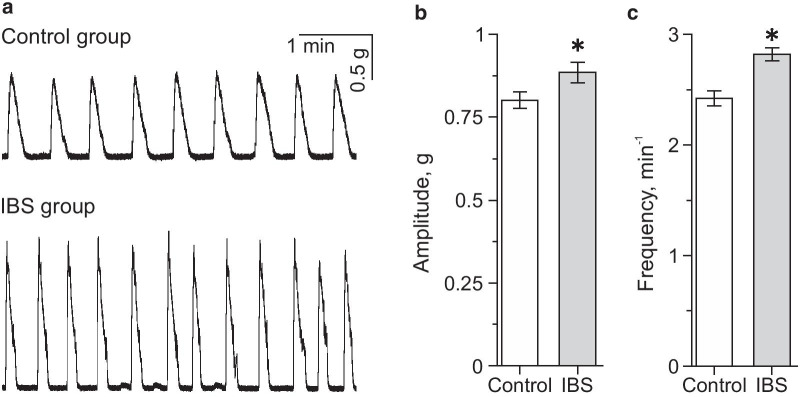
Fig. 1
Fig. 1
Spontaneous contractile activity of proximal colon from control and mouse IBS model groups. a Original recordings of spontaneous colon specimen activity in control and IBS model groups. Average amplitude (b) and frequency (c) of spontaneous contractions of specimen  from  the control (white column) and IBS model (grey column) groups. *p < 0.05 compared to the control group
Fig. 2
Fig. 2
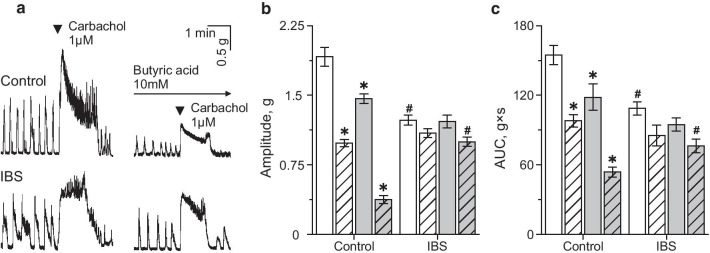
Effects of SCFAs on carbachol-evoked contractions of isolated mouse proximal column. a Original traces of carbachol-evoked contractions of proximal column before and after butyric acid (10 mM) incubation in control and in IBS model groups. Amplitude (b) and area under curve (AUC) (c) of carbachol-evoked contractions before (white column) and after incubation in sodium acetate (10 mM, dashed column), sodium propionate (10 mM, grey column) and butyric acid (10 mM, grey dashed column) in the control and IBS model groups. *p < 0.05 compared to carbachol effect before SCFAs application; #p < 0.05 compared to carbachol-evoked contractions in the control group
Fig. 3
Fig. 3
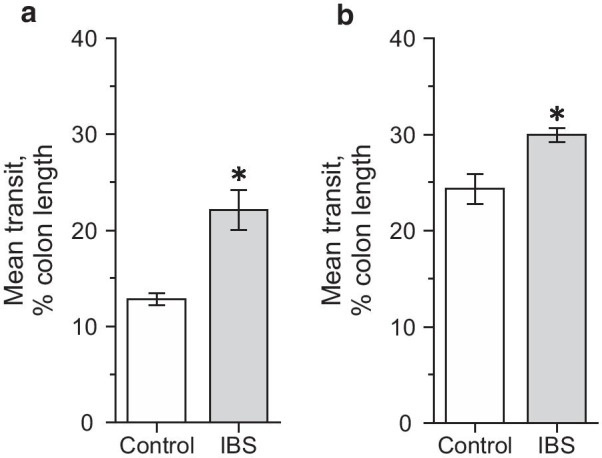
Colonic transit in control and mouse IBS model groups. Artificial pellet transit in colon of control (white column) and mouse IBS model (grey colon) groups before (a) and during intraluminal butyric acid (5 mM) infusion (b). *p < 0.05 compared to the control group
Fig. 4
Fig. 4
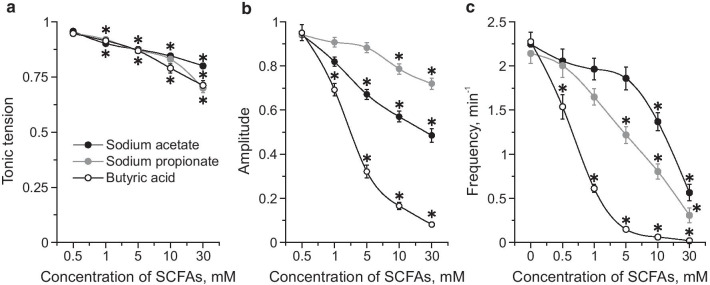
Dose-dependent effects of SCFAs on spontaneous contractions of isolated proximal colon. Effects of sodium acetate (black circles), sodium propionate (grey circles) and butyric acid (white circles) in concentrations of 0.5, 1, 5, 10 and 30 mM on tonic tension (a), amplitude (b) and frequency (c) of contractions of mouse proximal colon. * p < 0.05 compared to the initial value
Fig. 5
Fig. 5
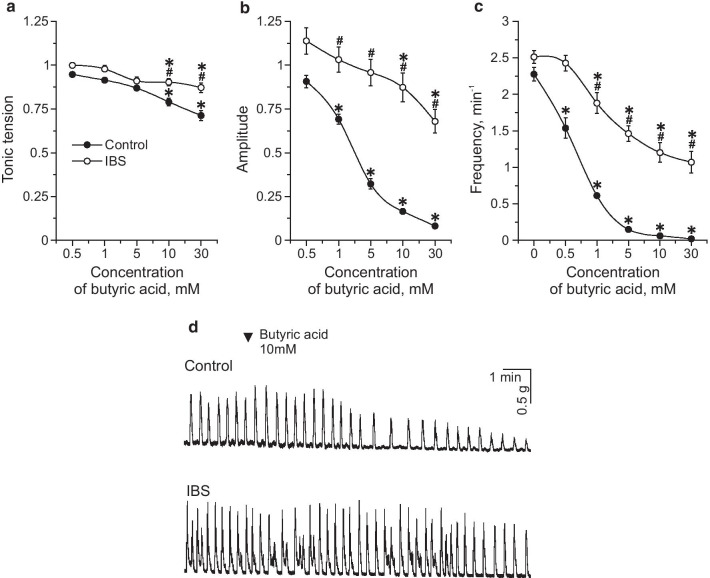
Effects of butyric acid on spontaneous contractions of mouse proximal colon in control and IBS model groups. Effects of butyric acid in concentrations of 0.5, 1, 5, 10 and 30 mM on tonic tension (a), amplitude (b) and frequency (c) of contractions of mouse colon segment of the control group (black circle) and in the IBS model group (white circle). d Original recordings of spontaneous contractions of proximal colon during butyric acid (10 mM) application in control and IBS model groups. *p < 0.05 compared to the initial value; # p < 0.05 compared to the effects of butyric acid in control.
Fig. 6
Fig. 6
Concentration of acetic, propionic and butyric acids in the feces of control (white column) and IBS groups (grey column) of mice. *p < 0.05 compared to control

References

    1. Drossman DA, Camilleri M, Mayer EA, Whitehead WE. AGA technical review on irritable bowel syndrome. Gastroenterology. 2002;123(6):2108–2131. doi: 10.1053/gast.2002.37095. - DOI - PubMed
    1. Ford AC, Lacy BE, Harris LA, Quigley EM, Moayyedi P. Effect of antidepressants and psychological therapies in irritable bowel syndrome: an updated systematic review and meta-analysis. Am J Gastroenterol. 2019;114(1):21–39. doi: 10.1038/s41395-018-0222-5. - DOI - PubMed
    1. Schmulson MJ, Drossman DA. What is new in Rome IV. J Neurogastroenterol Motil. 2017;23(2):151. doi: 10.5056/jnm16214. - DOI - PMC - PubMed
    1. Farzaei MH, Bahramsoltani R, Abdollahi M, Rahimi R. The role of visceral hypersensitivity in irritable bowel syndrome: pharmacological targets and novel treatments. J Neurogastroenterol Motil. 2016;22(4):558. doi: 10.5056/jnm16001. - DOI - PMC - PubMed
    1. Spiller R, Garsed K. Infection, inflammation, and the irritable bowel syndrome. Dig Liver Dis. 2009;41(12):844–849. doi: 10.1016/j.dld.2009.07.007. - DOI - PubMed

Substances

LinkOut - more resources