. 2021 Mar 19;59(4):e02438-20.
doi: 10.1128/JCM.02438-20. Print 2021 Mar 19.

A New SARS-CoV-2 Dual-Purpose Serology Test: Highly Accurate Infection Tracing and Neutralizing Antibody Response Detection

Affiliations

A New SARS-CoV-2 Dual-Purpose Serology Test: Highly Accurate Infection Tracing and Neutralizing Antibody Response Detection

Sean C Taylor et al. J Clin Microbiol. .

Abstract

Many severe acute respiratory syndrome coronavirus 2 (SARS-CoV-2) serology tests have proven to be less accurate than expected and do not assess antibody function as neutralizing, correlating with protection from reinfection. A new assay technology measuring the interaction of the purified SARS-CoV-2 spike protein receptor binding domain (RBD) with the extracellular domain of the human angiotensin-converting enzyme 2 (hACE2) receptor detects these important antibodies. The cPass surrogate virus neutralization test (sVNT), compared directly with eight SARS-CoV-2 IgG serology and two live-cell neutralization tests, gives similar or improved accuracy for qualitative delineation between positive and negative individuals in a fast, scalable, and high-throughput assay. The combined data support the cPass sVNT as a tool for highly accurate SARS-CoV-2 immunity surveillance of infected/recovered and/or vaccinated individuals as well as drug and convalescent-phase donor screening. The data also preview a novel application for the cPass sVNT in calibrating the stringency of live-cell neutralization tests and its use in longitudinal testing of recovered and/or vaccinated patients.

Keywords: ELISA; SARS-CoV-2; neutralizing antibodies; serology; vaccines.


Figures

FIG 1
FIG 1
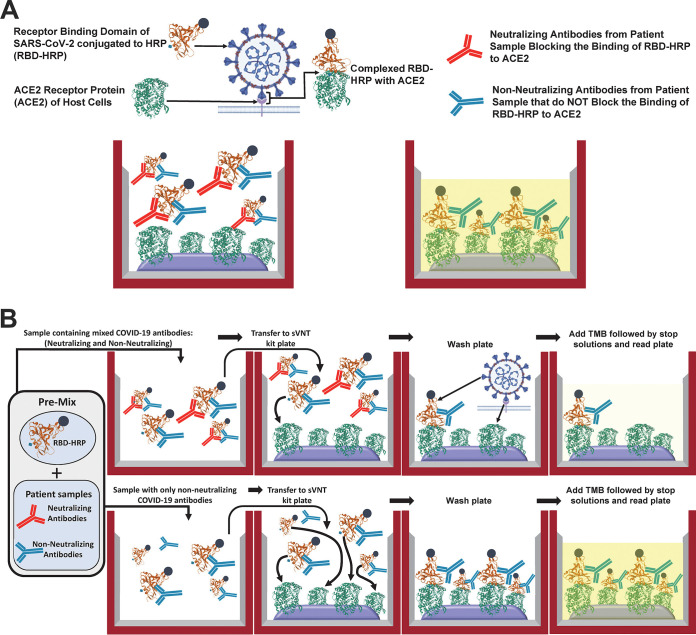
cPass sVNT design and description. (A) sVNT design. The test consists of a purified RBD-HRP conjugate (brown) in solution and ELISA plates coated with the hACE2 receptor (green), which form a strong complex. When mixed with a sample containing proteins, small molecules, or antibodies that block the interaction between the RBD and the hACE2 receptor, a low OD450 will be measured after incubation with TMB and stop solution. (B) Performing the sVNT. Sample dilutions are initially mixed with the RBD-HRP solution, with incubation for 30 min at 37°C to permit the binding of components to the RBD. If the sample does not contain constituents that bind and block the RBD-hACE2 interaction (bottom four wells), the RBD-HRP will bind to the hACE2-coated wells, giving a yellow color after incubation with TMB for 15 min at 37°C followed by stop solution. If the sample contains blocking constituents, they will bind to the RBD during the initial 30 min and inhibit the interaction with hACE (top four wells), giving a light-yellow color after the addition of stop solution.
FIG 2
FIG 2
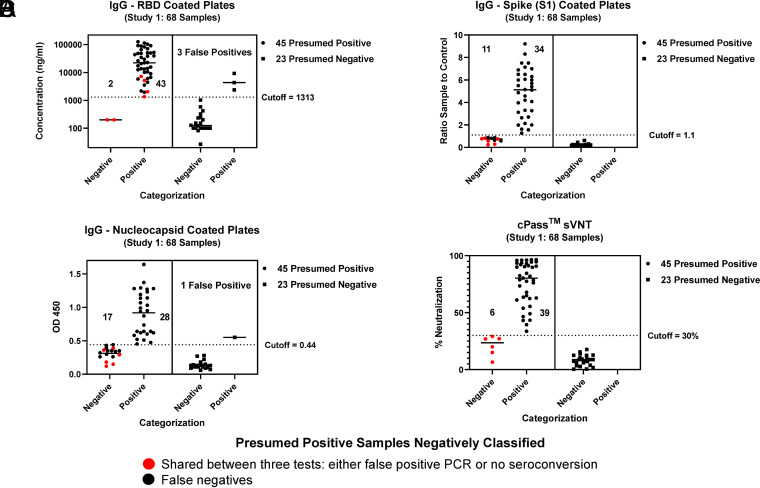
Study 1: direct comparison between nucleocapsid-, RBD-, and spike (S1)-coated IgG ELISA plates with the cPass sVNT. (A) RBD-coated plate; (B) nucleocapsid-coated plate; (C) spike (S1)-coated plate; (D) cPass sVNT. Forty-five PCR-positive samples from patients with blood drawn more than 14 days after PCR testing were categorized by the four tests (round symbols at the left side of each chart). Of the negative delineated samples, six were shared between three tests (red dots). Twenty-three prepandemic presumed negative samples were categorized by the four tests (square symbols at the right side of each chart). Both the nucleocapsid- and RBD-coated IgG ELISA plates gave false positives.
FIG 3
FIG 3
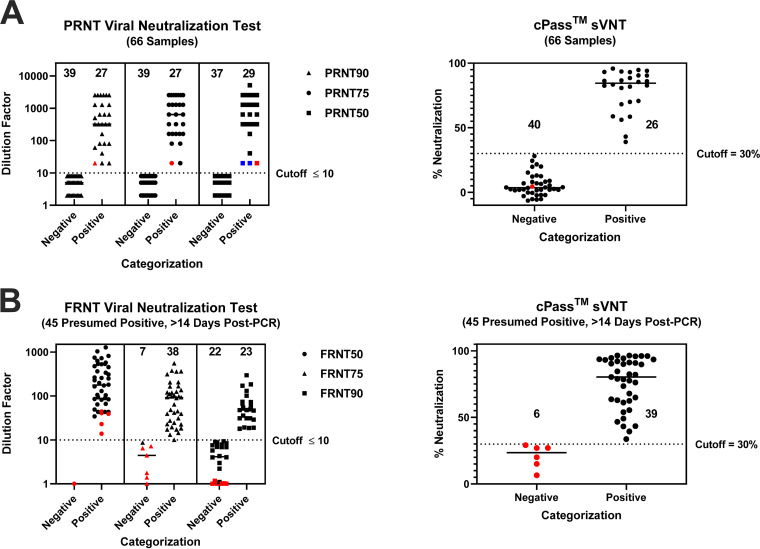
Direct comparison between the PRNT, FRNT (at different analysis stringencies), and sVNT. (A) PRNT. Sixty-six samples were assayed between the PRNT50, PRNT75, PRNT90, and sVNT. One sample was discordant between the sVNT and the PRNT75 and PRNT90 (red dot). Two samples were discordant between the PRNT50 and PRNT75 (blue dots). For the PRNT, negative samples with values below 10 were randomly assigned values of 2, 5, or 8 to more easily visualize the number of negative samples. (B) FRNT. Forty-five presumed positive samples were tested between the FRNT50, FRNT75, and FRNT90 and the sVNT. The same six samples were categorized as negative by the sVNT, FRNT75, and FRNT90 (red dots). One sample was discordant between the FRNT75 and sVNT. For the FRNT, all samples with a value of zero were assigned a value of 1 to more easily visualize the negative samples.
FIG 4
FIG 4
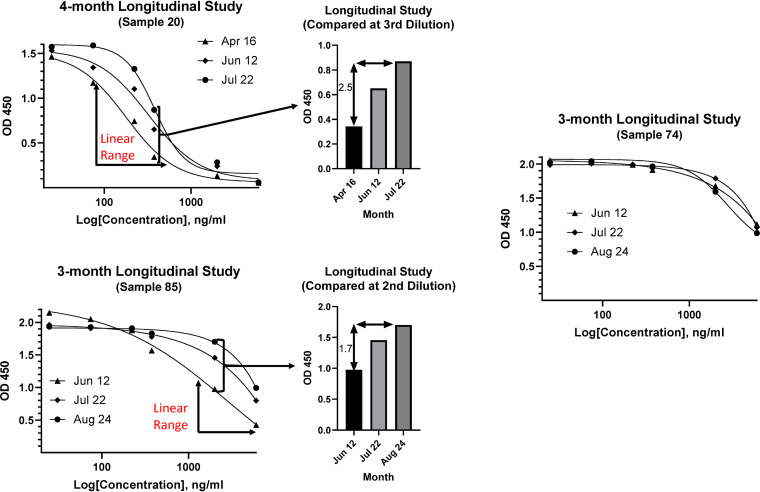
Longitudinal assessment of viral titers by the cPass sVNT for serum samples taken at different time points postinfection. Samples were initially diluted 1:10 according to the kit instructions and then serially diluted 1:3 for an additional five dilutions to generate a competition curve for each sample at each time point. Samples 20 and 85 were compared for titers within the linear range of each curve or by the OD450 ratio.

References

    1. Brotherhood L, Kircher P, Santos C, Tertilt M. 2020. An economic model of the Covid-19 epidemic: the importance of testing and age-specific policies. CRC TR 224 Discussion Paper Series crctr224_2020_175v1, University of Bonn and University of Mannheim, Germany. https://ideas.repec.org/p/bon/boncrc/crctr224_2020_175v1.html.
    1. Salathé M, Althaus CL, Neher R, Stringhini S, Hodcroft E, Fellay J, Zwahlen M, Senti G, Battegay M, Wilder-Smith A, Eckerle I, Egger M, Low N. 2020. COVID-19 epidemic in Switzerland: on the importance of testing, contact tracing and isolation. Swiss Med Wkly 150:w20225. 10.4414/smw.2020.20225. - DOI - PubMed
    1. Kyhlstedt M, Andersson SW. 2020. Diagnostic and digital solutions to address the COVID-19 pandemic: the need for international collaboration to close the gap. Health Policy Technol 9:126–128. 10.1016/j.hlpt.2020.04.010. - DOI - PMC - PubMed
    1. West CP, Montori VM, Sampathkumar P. 2020. COVID-19 testing: the threat of false-negative results. Mayo Clin Proc 95:1127–1129. 10.1016/j.mayocp.2020.04.004. - DOI - PMC - PubMed
    1. Mathur G, Mathur S. 2020. Antibody testing for COVID-19: can it be used as a screening tool in areas with low prevalence? Am J Clin Pathol 154:1–3. 10.1093/ajcp/aqaa082. - DOI - PMC - PubMed

Substances