


This is a preprint.
An Autoantigen Atlas from Human Lung HFL1 Cells Offers Clues to Neurological and Diverse Autoimmune Manifestations of COVID-19
- PMID: 33501444
- PMCID: PMC7836114
- DOI: 10.1101/2021.01.24.427965
An Autoantigen Atlas from Human Lung HFL1 Cells Offers Clues to Neurological and Diverse Autoimmune Manifestations of COVID-19
Update in
-
An Autoantigen Atlas From Human Lung HFL1 Cells Offers Clues to Neurological and Diverse Autoimmune Manifestations of COVID-19.Front Immunol. 2022 Mar 24;13:831849. doi: 10.3389/fimmu.2022.831849. eCollection 2022. Front Immunol. 2022. PMID: 35401574 Free PMC article.
Abstract
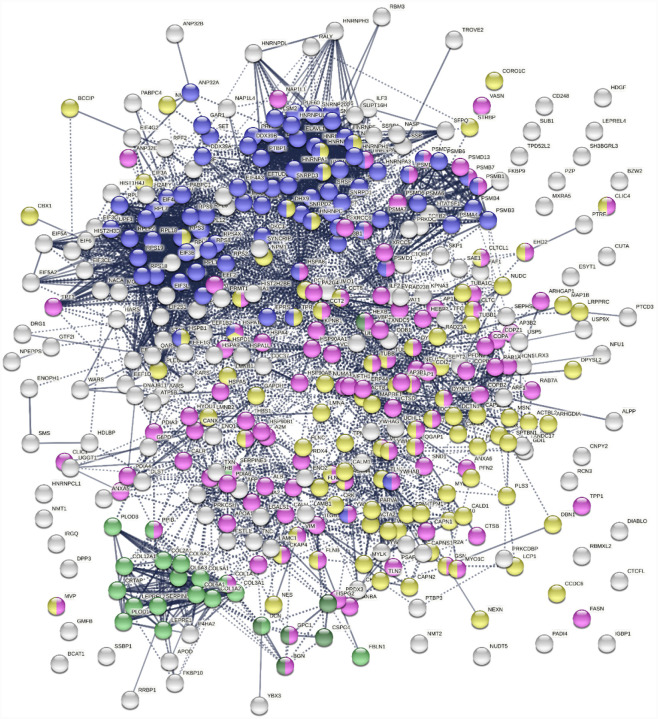
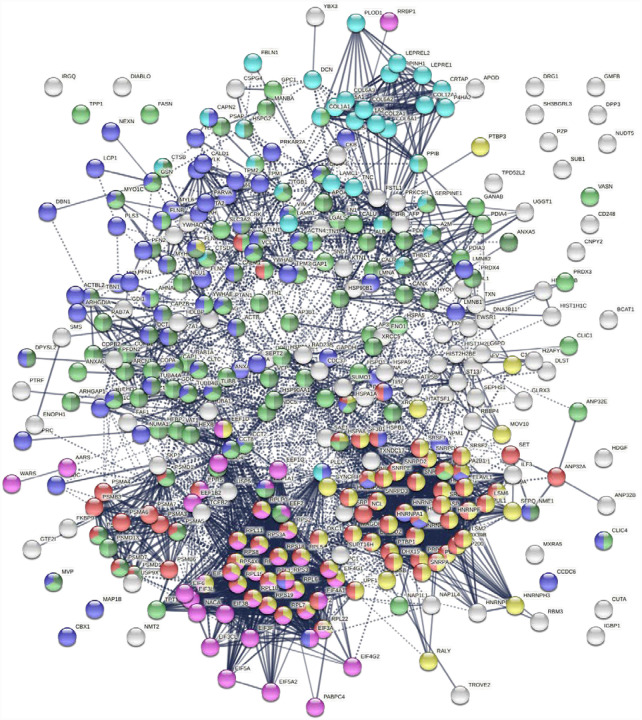
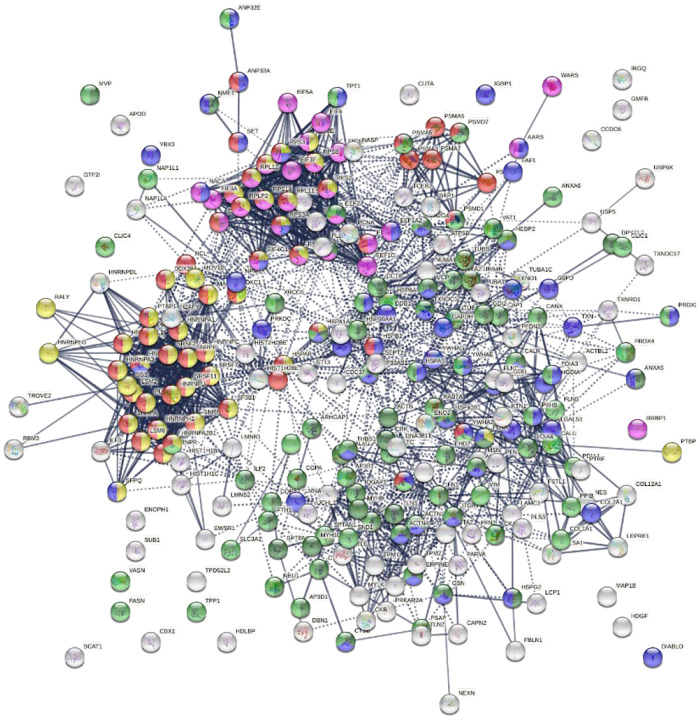
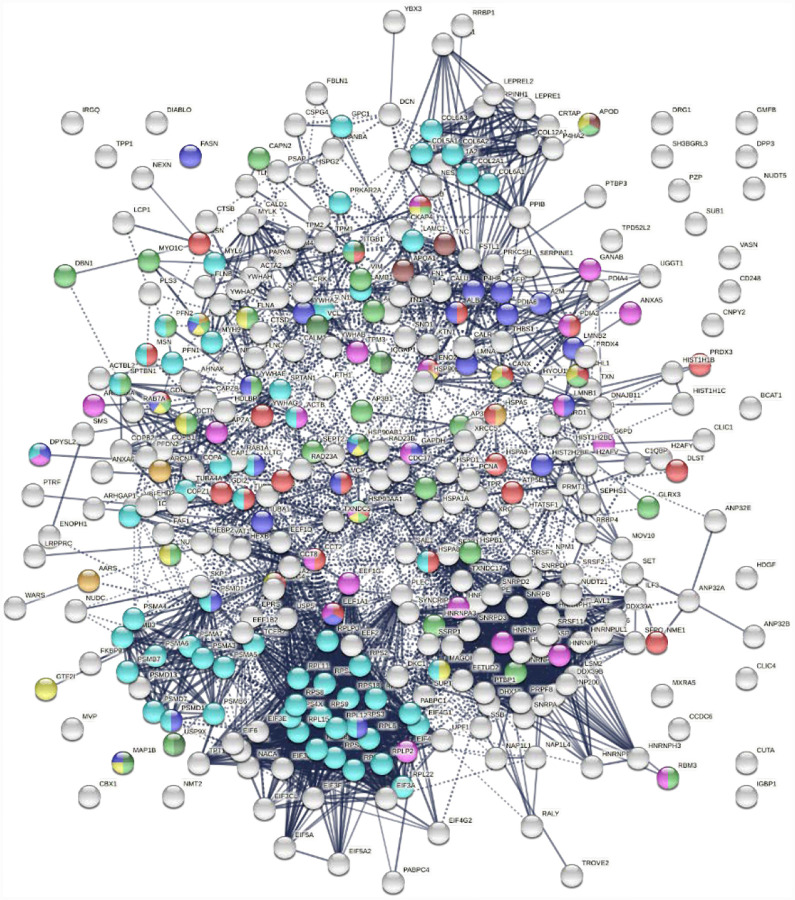
COVID-19 is accompanied by a myriad of both transient and long-lasting autoimmune responses. Dermatan sulfate (DS), a glycosaminoglycan crucial for wound healing, has unique affinity for autoantigens (autoAgs) from apoptotic cells. DS-autoAg complexes are capable of stimulating autoreactive B cells and autoantibody production. Using DS affinity, we identified an autoantigenome of 408 proteins from human fetal lung fibroblast HFL11 cells, at least 231 of which are known autoAgs. Comparing with available COVID data, 352 proteins of the autoantigenome have thus far been found to be altered at protein or RNA levels in SARS-Cov-2 infection, 210 of which are known autoAgs. The COVID-altered proteins are significantly associated with RNA metabolism, translation, vesicles and vesicle transport, cell death, supramolecular fibrils, cytoskeleton, extracellular matrix, and interleukin signaling. They offer clues to neurological problems, fibrosis, smooth muscle dysfunction, and thrombosis. In particular, 150 altered proteins are related to the nervous system, including axon, myelin sheath, neuron projection, neuronal cell body, and olfactory bulb. An association with the melanosome is also identified. The findings from our study illustrate a strong connection between viral infection and autoimmunity. The vast number of COVID-altered proteins with propensity to become autoAgs offers an explanation for the diverse autoimmune complications in COVID patients. The variety of autoAgs related to mRNA metabolism, translation, and vesicles raises concerns about potential adverse effects of mRNA vaccines. The COVID autoantigen atlas we are establishing provides a detailed molecular map for further investigation of autoimmune sequelae of the pandemic.
Conflict of interest statement
Competing interest statement
JYW is the founder and Chief Scientific Officer of Curandis. WZ was supported by the NIH and declares no competing interests. MWR and VBR are volunteers of Curandis. MHR is a member of the Scientific Advisory Boards of Trans-Hit, Proscia, and Universal DX but these companies have no relation to the study.
Figures



References
-
- Clausen T. M., Sandoval D. R., Spliid C. B., Pihl J., Perrett H. R., Painter C. D., Narayanan A., Majowicz S. A., Kwong E. M., McVicar R. N., Thacker B. E., Glass C. A., Yang Z., Torres J. L., Golden G. J., Bartels P. L., Porell R. N., Garretson A. F., Laubach L., Feldman J., Yin X., Pu Y., Hauser B. M., Caradonna T. M., Kellman B. P., Martino C., Gordts P., Chanda S. K., Schmidt A. G., Godula K., Leibel S. L., Jose J., Corbett K. D., Ward A. B., Carlin A. F., Esko J. D., SARS-CoV-2 Infection Depends on Cellular Heparan Sulfate and ACE2. Cell 183, 1043–1057.e1015 (2020). - PMC - PubMed
-
- Luteijn R. D., van Diemen F., Blomen V. A., Boer I. G. J., Manikam Sadasivam S., van Kuppevelt T. H., Drexler I., Brummelkamp T. R., Lebbink R. J., Wiertz E. J., A Genome-Wide Haploid Genetic Screen Identifies Heparan Sulfate-Associated Genes and the Macropinocytosis Modulator TMED10 as Factors Supporting Vaccinia Virus Infection. Journal of virology 93, (2019). - PMC - PubMed
-
- Gao H., Lin Y., He J., Zhou S., Liang M., Huang C., Li X., Liu C., Zhang P., Role of heparan sulfate in the Zika virus entry, replication, and cell death. Virology 529, 91–100 (2019). - PubMed
Publication types
Grants and funding
LinkOut - more resources
Full Text Sources
Other Literature Sources
Miscellaneous
