


The influence of vector-borne disease on human history: socio-ecological mechanisms
- PMID: 33501751
- PMCID: PMC7969392
- DOI: 10.1111/ele.13675
The influence of vector-borne disease on human history: socio-ecological mechanisms
Abstract
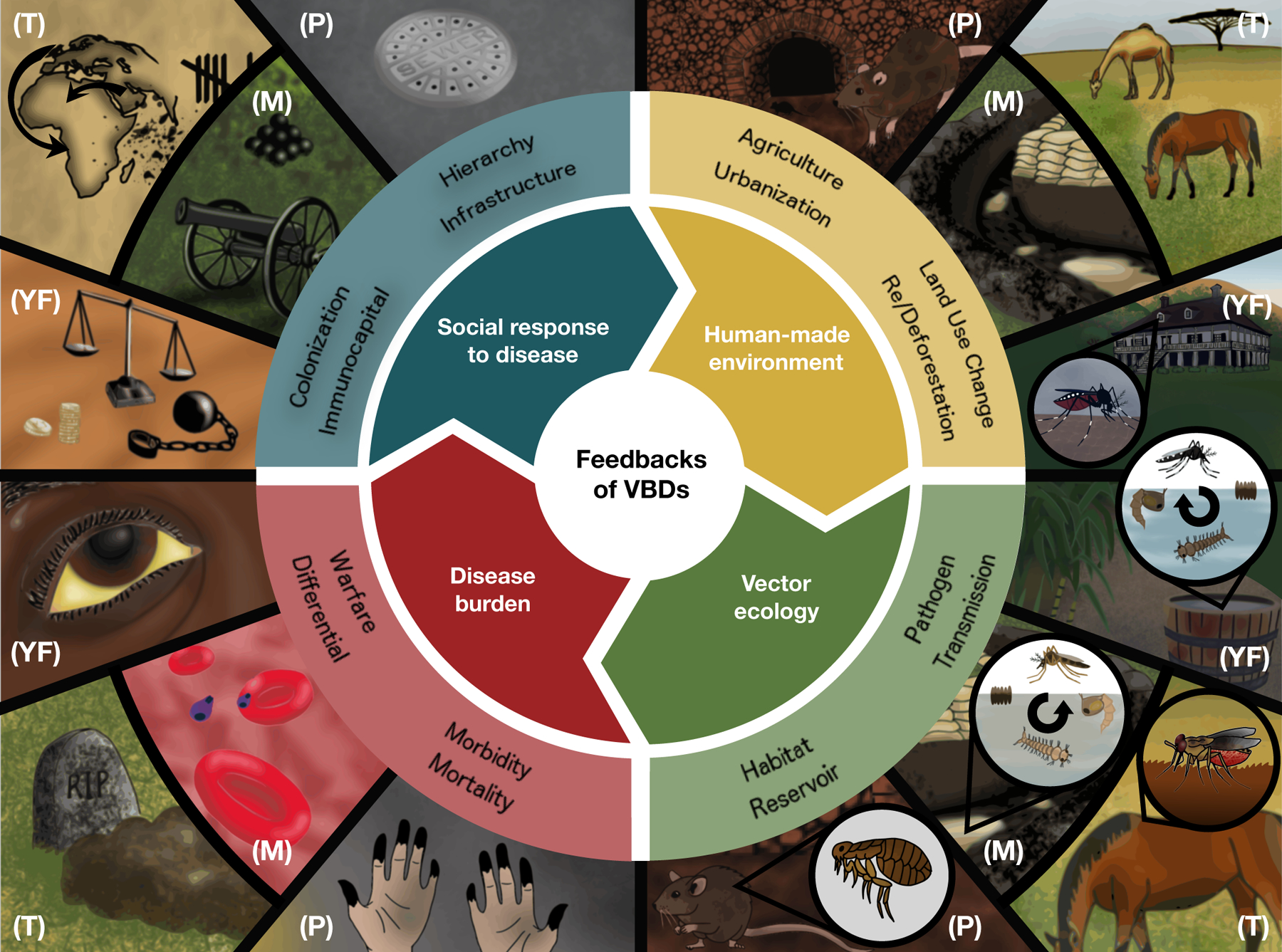
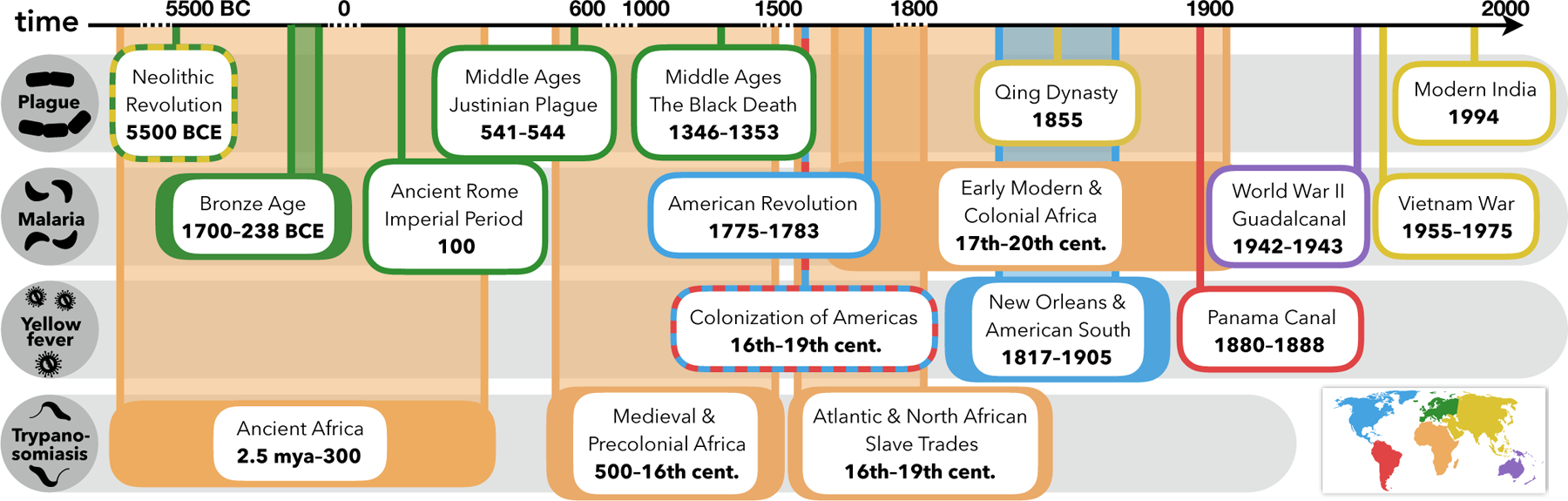
Vector-borne diseases (VBDs) are embedded within complex socio-ecological systems. While research has traditionally focused on the direct effects of VBDs on human morbidity and mortality, it is increasingly clear that their impacts are much more pervasive. VBDs are dynamically linked to feedbacks between environmental conditions, vector ecology, disease burden, and societal responses that drive transmission. As a result, VBDs have had profound influence on human history. Mechanisms include: (1) killing or debilitating large numbers of people, with demographic and population-level impacts; (2) differentially affecting populations based on prior history of disease exposure, immunity, and resistance; (3) being weaponised to promote or justify hierarchies of power, colonialism, racism, classism and sexism; (4) catalysing changes in ideas, institutions, infrastructure, technologies and social practices in efforts to control disease outbreaks; and (5) changing human relationships with the land and environment. We use historical and archaeological evidence interpreted through an ecological lens to illustrate how VBDs have shaped society and culture, focusing on case studies from four pertinent VBDs: plague, malaria, yellow fever and trypanosomiasis. By comparing across diseases, time periods and geographies, we highlight the enormous scope and variety of mechanisms by which VBDs have influenced human history.
Keywords: Arthropod; colonialism; disease ecology; environment; malaria; mosquito; plague; trypanosomiasis; vector-borne disease; yellow fever.
© 2021 John Wiley & Sons Ltd.
Figures
References
-
- Alawieh A, Musharrafieh U, Jaber A, Berry A, Ghosn N & Bizri AR (2014). Revisiting leishmaniasis in the time of war: the Syrian conflict and the Lebanese outbreak. Int. J. Infect. Dis, 29, 115–119. - PubMed
-
- Allison AC (2009). Genetic control of resistance to human malaria. Curr. Opin. Immunol, 21, 499–505. - PubMed
-
- Alsan M (2015). The Effect of the TseTse Fly on African Development. Am. Econ. Rev, 105, 382–410.
Publication types
MeSH terms
Grants and funding
- R35GM133439/GM/NIGMS NIH HHS/United States
- Ric Weiland Graduate Fellowship in the Humanities
- NSF Graduate Research Fellowship 1650114/National Science Foundation
- Environmental Ventures Program from the Stanford Woods Institute for the Environment
- Stanford Graduate Fellowship
- Stanford King Center for Global Development
- Stanford Data Science Scholars
- Illich-Sadowsky Fellowship through the Stanford Interdisciplinary Graduate Fellowship
- DEB-1716698/National Science Foundation
- Helman Scholarship
- NSF Graduate Research Fellowship 1650042/National Science Foundation
- Terman Fellowship
- EEID grant 2011147/TW/FIC NIH HHS/United States
- DEB-1518681/National Science Foundation
- Huck Institutes of the Life Sciences at Penn State University
- R35 GM133439/GM/NIGMS NIH HHS/United States
- DEB-2011147/National Science Foundation
LinkOut - more resources
Full Text Sources
Other Literature Sources
Medical
Research Materials
