


Pulmonary embolism at autopsy in cancer patients
- PMID: 33501757
- PMCID: PMC8252008
- DOI: 10.1111/jth.15250
Pulmonary embolism at autopsy in cancer patients
Abstract
Background: Pulmonary embolism (PE) is a potentially fatal disease, but data on the incidence of fatal PE in cancer patients are scant.
Objective: We sought to estimate the proportion of cancer patients with PE at autopsy.
Methods: For this retrospective cohort study, all autopsy reports of cancer patients were retrieved from PALGA: Dutch Pathology Registry and used for data extraction. The primary outcome was PE at time of autopsy, defined as any clot obstructing a pulmonary artery. The secondary outcome was venous thromboembolism, defined as the composite of thrombotic PE, deep vein thrombosis, splanchnic vein thrombosis, or internal jugular vein thrombosis.
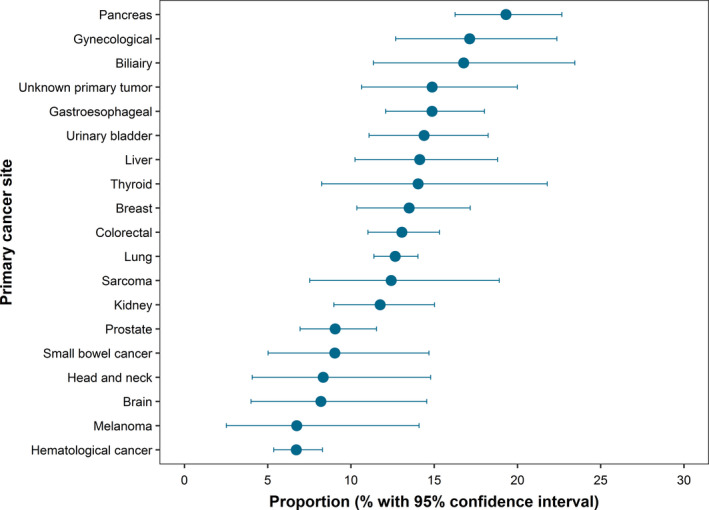
Results: A total of 9571 cancer patients were included. In 1191 (12.4%; 95% confidence interval [CI], 11.8-13.1) patients, one or more PE events were observed at autopsy, of whom 1074 (90.2%) had a thrombotic embolism, 168 (14.1%) a tumor embolism, 9 (0.8%) a septic embolism, 7 (0.6%) a fat tissue embolism, and 3 (0.3%) a bone marrow embolism. Among patients with PE for whom the cause of death was specified in the autopsy report, death was considered PE-related in 642 patients (66.7%), which was 6.7% of the total study population. Venous thromboembolism was observed in 1223 (12.8%; 95% CI, 12.1-13.5) patients.
Conclusion: The proportion of PE in cancer patients at autopsy is substantial. Although the study population is not representative for the total cancer population, it suggests that PE is an important disease complication in cancer patients.
Keywords: autopsy; neoplasms; pulmonary embolism; thrombosis; venous thromboembolism.
© 2021 The Authors. Journal of Thrombosis and Haemostasis published by Wiley Periodicals LLC on behalf of International Society on Thrombosis and Haemostasis.
Conflict of interest statement
Dr. van Es has received advisory board fees from Bayer, Daiichi Sankyo, and LEO Pharma, which were transferred to his institution. Dr. Kamphuisen received research funding from Daiichi Sankyo. Dr. Middeldorp received grants and fees paid to her institution from GlaxoSmithKline, BMS/Pfizer, Aspen, Daiichi Sankyo, Bayer, Boehringer Ingelheim, Sanofi, and Portola. The remaining authors declare no conflict of interest.
Figures

Comment in
-
Prevalence of pulmonary embolism in 127 945 autopsies performed in cancer patients in the United States between 2003 and 2019.J Thromb Haemost. 2021 Jun;19(6):1591-1593. doi: 10.1111/jth.15321. J Thromb Haemost. 2021. PMID: 34047011 No abstract available.
References
-
- Sørensen H, Mellemkjær L, Olsen J, Baron J. Prognosis of cancers associated with venous thromboembolism. N Engl J Med. 2000;343(25):1846‐1850. - PubMed
-
- Carrier M, Abou‐Nassar K, Mallick R, et al. Apixaban to prevent venous thromboembolism in patients with cancer. N Engl J Med. 2019;380(8):711‐719. - PubMed
MeSH terms
LinkOut - more resources
Full Text Sources
Other Literature Sources
Medical
