. 2021 Apr 1;320(4):L545-L556.
doi: 10.1152/ajplung.00232.2020. Epub 2021 Jan 27.

Insulin acutely increases agonist-induced airway smooth muscle contraction in humans and rats

Affiliations

Insulin acutely increases agonist-induced airway smooth muscle contraction in humans and rats

Becky J Proskocil et al. Am J Physiol Lung Cell Mol Physiol. .

Abstract

Obesity increases incidence and severity of asthma but the molecular mechanisms are not completely understood. Hyperinsulinemia potentiates vagally induced bronchoconstriction in obese rats. Since bronchoconstriction results from airway smooth muscle contraction, we tested whether insulin changed agonist-induced airway smooth muscle contraction. Obesity-prone and resistant rats were fed a low-fat diet for 5 wk and treated with insulin (Lantus, 3 units/rat sc) 16 h before vagally induced bronchoconstriction was measured. Ex vivo, contractile responses to methacholine were measured in isolated rat tracheal rings and human airway smooth muscle strips before and after incubation (0.5-2 h) with 100 nM insulin or 13.1 nM insulin like growth factor-1 (IGF-1). M2 and M3 muscarinic receptor mRNA expression was quantified by qRT-PCR and changes in intracellular calcium were measured in response to methacholine or serotonin in isolated rat tracheal smooth muscle cells treated with 1 µM insulin. Insulin, administered to animals 16 h prior, potentiated vagally induced bronchoconstriction in both obese-prone and resistant rats. Insulin, not IGF-1, significantly increased methacholine-induced contraction of rat and human isolated airway smooth muscle. In cultured rat tracheal smooth muscle cells, insulin significantly increased M2, not M3, mRNA expression and enhanced methacholine- and serotonin-induced increase in intracellular calcium. Insulin alone did not cause an immediate increase in intracellular calcium. Thus, insulin acutely potentiated agonist-induced increase in intracellular calcium and airway smooth muscle contraction. These findings may explain why obese individuals with hyperinsulinemia are prone to airway hyperreactivity and give insights into future targets for asthma treatment.

Keywords: airway hyperreactivity; asthma; hyperinsulinemia; intracellular calcium; obesity.


Figures
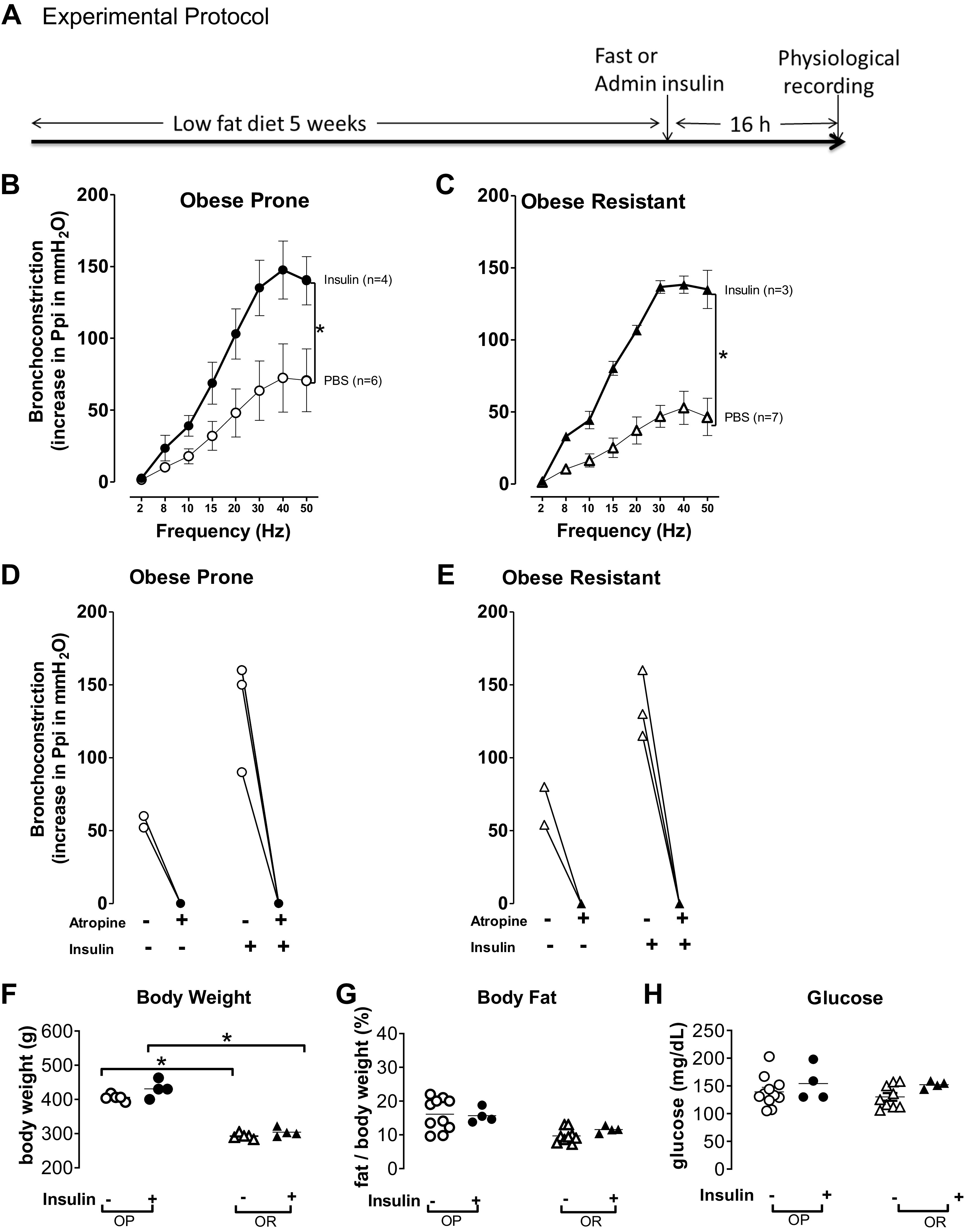
Figure 1.
Figure 1.
Insulin-potentiated vagally induced bronchoconstriction. A: obese-prone (OP) and obese-resistant (OR) rats were fed a low-fat diet for 5 wk. Sixteen hours before measuring airway function, rats were either treated with 100 μL of phosphate-buffered saline (PBS) subcutaneously and fasted overnight or treated with supplemental insulin (Lantus, 3 units/rat subcutaneously) with free access to food. BC: electrical stimulation of both vagus nerves (2–50 Hz, 20 V, 0.4 ms pulse duration, for 6 s at 40 s intervals) caused frequency-dependent bronchoconstriction that was not significantly different between obese-prone rats (B, open circles) and obese-resistant rats (C, open triangles) treated with PBS. After a subcutaneous injection of insulin 16 h before measuring airway physiology, insulin significantly potentiated bronchoconstriction in both obese-prone (B, filled circles) and obese-resistant rats (C, filled triangles). D and E: atropine blocked vagally induced bronchoconstriction at 50 Hz (open symbols, bronchoconstriction before atropine; filled symbols, bronchoconstriction after atropine). F: obese-prone rats (OP, circles) on a high-fat diet for 5 wk weighed significantly more than obese-resistant (OR, triangles) rats on the same diet, regardless of insulin treatment. G: body fat, as a % of weight, was not significantly different among any groups. H: in rats not treated with insulin, fasting glucose was not different between obese-prone (open circles) or obese-resistant (open triangles) rats. Glucose was also not different between obese-prone and -resistant rats treated with insulin and with unlimited access to food, (filled symbols). Data are represented as means ± SE. *P < 0.05.
Figure 2.
Figure 2.
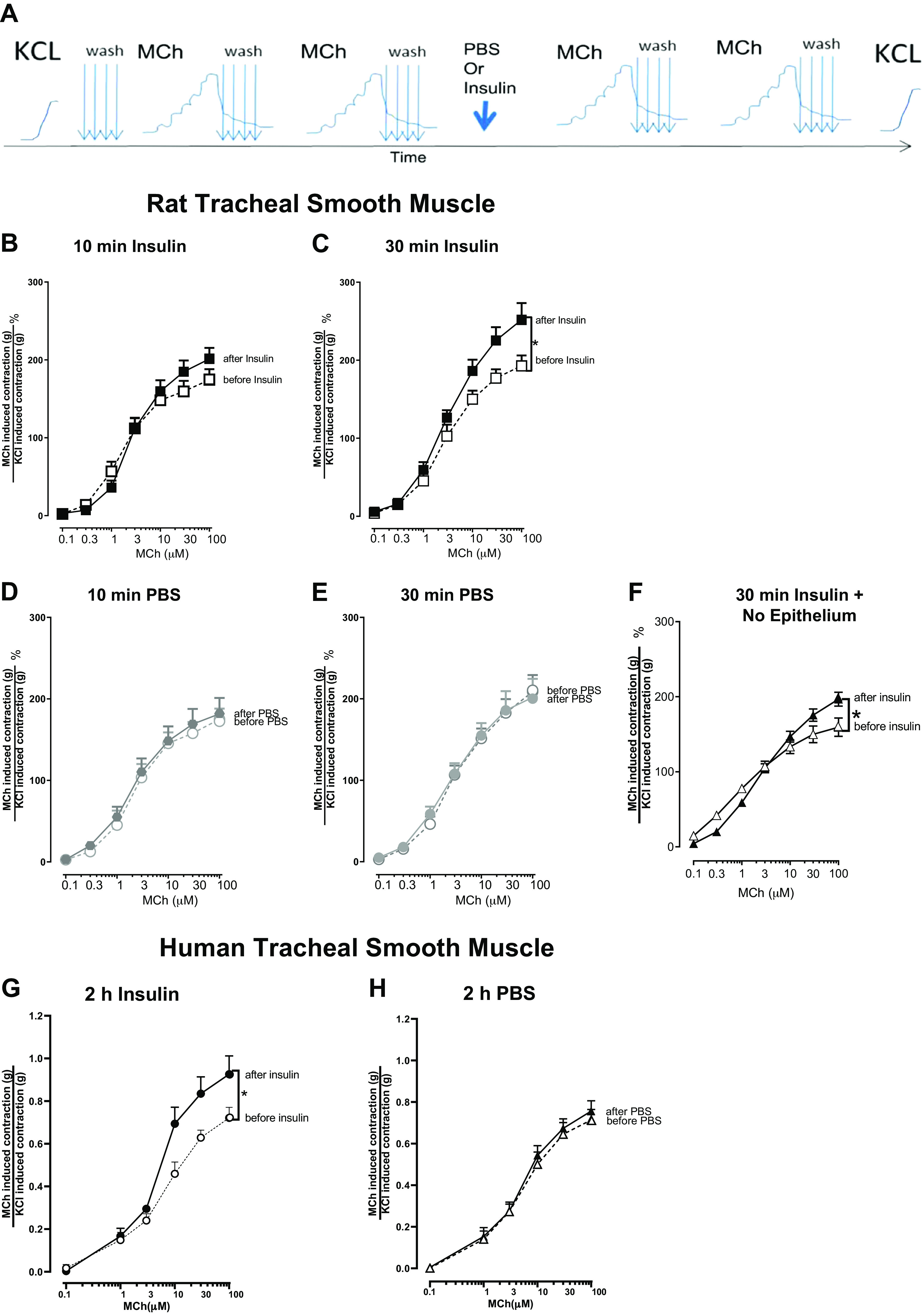
Methacholine (MCh)-induced contraction of tracheal smooth muscle is potentiated by insulin, in both rats and humans. A: the experimental protocol for organ baths experiments (see methods for more details). Methacholine-induced contraction was measured before and after treatment with 1 μM insulin. In intact rat tracheal rings, methacholine-induced contraction was measured before and after a 10- or 30-min treatment with 1 μM insulin (B and C) or PBS (D and E). In rat tracheal rings without airway epithelium, methacholine-induced contraction was measured before and after a 30-min treatment with 1 μM insulin (F). In intact human tracheal smooth muscle strips, methacholine-induced contraction was measured before and 2 h after treatment with 1 μM insulin (G) or PBS (H). Methacholine-induced contractions were normalized to contractions induced by 100 mM KCl. Data shown are means ± SE of two replicates each from 6–9 smooth muscle strips (n = 6–10). *P < 0.05. PBS, phosphate-buffered saline.
Figure 3.
Figure 3.
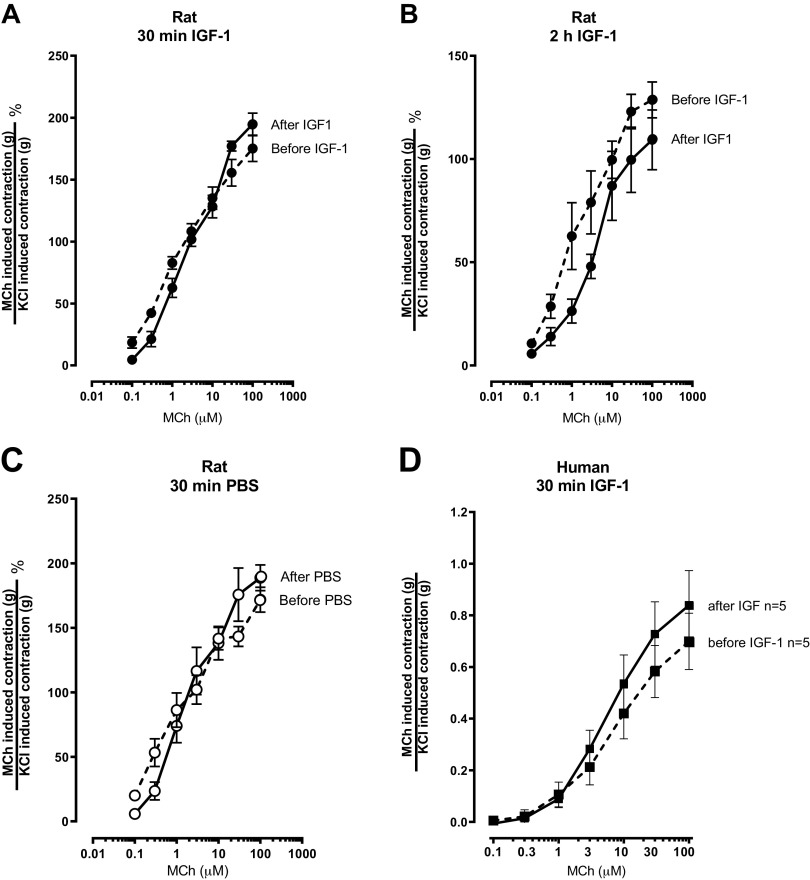
IGF-1 did not potentiate methacholine (MCh)-induced contraction of rat or human tracheal smooth muscle. Methacholine-induced smooth muscle contraction was measured in rat tracheal rings before and after a 30-min (A) or 2-h (B) exposure to 100 ng/mL rat IGF-1 and in human tracheal smooth muscle strips before and after a 30-min exposure to 20 ng/mL human IGF-1 (D). C: methacholine-induced smooth muscle contraction in rat tracheal rings was also measured before and after a 30-min treatment with PBS (vehicle for IGF-1). Methacholine-induced contractions were normalized to contraction induced by 100 mM KCl. Data shown are means ± SE of two replicates each from 3 rat tracheas (n = 3; AC) and 2 replicates each from 5 human donors (n = 5; D). PBS, phosphate-buffered saline.
Figure 4.
Figure 4.
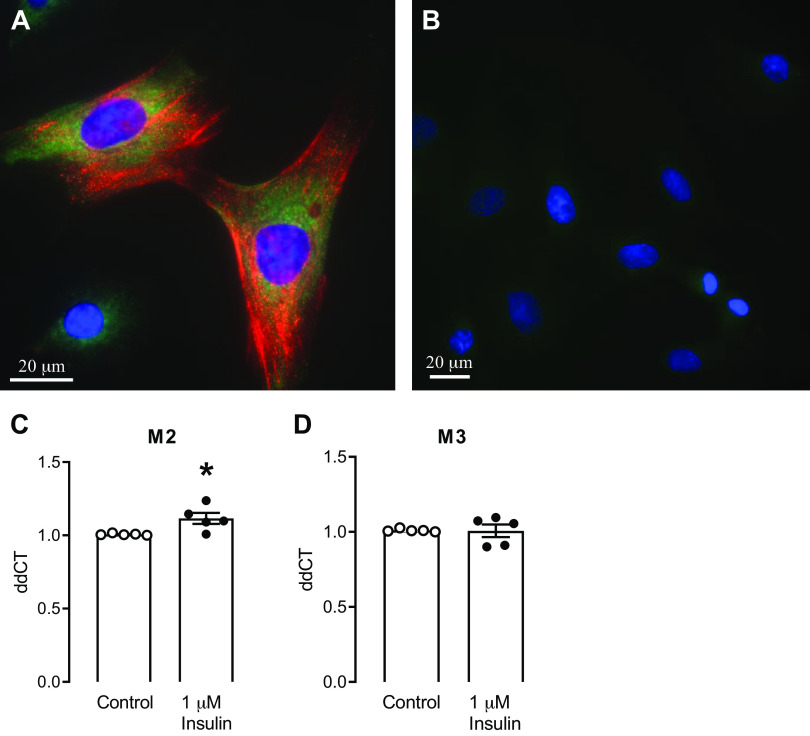
Rat tracheal smooth muscle cells isolated from wild type rats. Cell phenotype was verified by staining with anti-actin antibody (A; red). Insulin receptor expression on these tracheal smooth muscle cells is shown by positive staining with an anti-insulin receptor β antibody (A; green). B: no primary control for both antibodies; (blue, DAPI nuclear stain). Insulin (1 μM for 3 h) increased M2 muscarinic receptor mRNA (C), but did not change M3 muscarinic receptor mRNA expression (D) in cultured rat tracheal smooth muscle cells. Data shown are means ± SE. *P ≤ 0.05 (n = 5 cultures from separate rats).
Figure 5.
Figure 5.
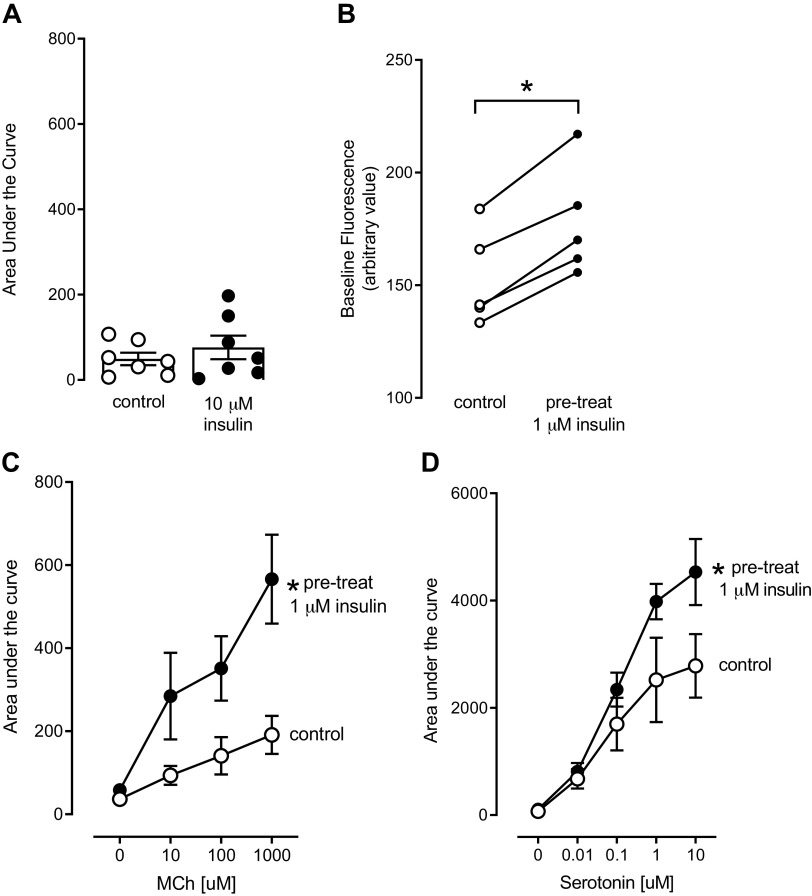
Insulin potentiates agonist-induced increases in intracellular calcium in rat tracheal smooth muscle cells. Insulin (10 μM) did not cause an immediate, acute increase in intracellular calcium in cells preloaded with the calcium-sensitive indicator Fluo4 (A). However, pretreatment with 1 μM insulin for 3 h significantly increased baseline fluorescence (B). Methacholine (10, 1,000 μM, MCh) and serotonin (0.01–10 μM) each caused concentration-dependent increases in intracellular calcium (C and D, respectively, open circles), that were significantly potentiated in cells pretreated with 1 μM insulin for 3 h (C and D, filled circles). (n = 5). *P < 0.05.

References

    1. Centers for Disease Control and Prevention. FastStats! (Online). https://www.cdc.gov/nchs/fastats/default.htm.
    1. Bibi H, Shoseyov D, Feigenbaum D, Genis M, Friger M, Peled R, Sharff S. The relationship between asthma and obesity in children: is it real or a case of over diagnosis? J Asthma 41: 403–410, 2004. doi: 10.1081/JAS-120026097. - DOI - PubMed
    1. Brumpton B, Langhammer A, Romundstad P, Chen Y, Mai XM. General and abdominal obesity and incident asthma in adults: the HUNT study. Eur Respir J 41: 323–329, 2013. doi: 10.1183/09031936.00012112. - DOI - PubMed
    1. Brumpton BM, Camargo CA , Jr, Romundstad PR, Langhammer A, Chen Y, Mai XM. Metabolic syndrome and incidence of asthma in adults: the HUNT study. Eur Respir J 42: 1495–1502, 2013. doi: 10.1183/09031936.00046013. - DOI - PubMed
    1. Cottrell L, Neal WA, Ice C, Perez MK, Piedimonte G. Metabolic abnormalities in children with asthma. Am J Respir Crit Care Med 183: 441–448, 2011. doi: 10.1164/rccm.201004-0603OC. - DOI - PMC - PubMed

Publication types

MeSH terms

LinkOut - more resources