


Pandemic buying: Testing a psychological model of over-purchasing and panic buying using data from the United Kingdom and the Republic of Ireland during the early phase of the COVID-19 pandemic
- PMID: 33503049
- PMCID: PMC7840055
- DOI: 10.1371/journal.pone.0246339
Pandemic buying: Testing a psychological model of over-purchasing and panic buying using data from the United Kingdom and the Republic of Ireland during the early phase of the COVID-19 pandemic
Abstract
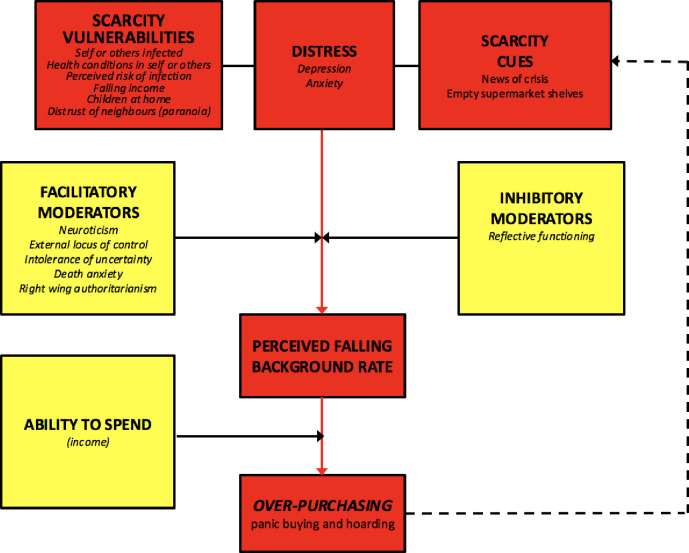
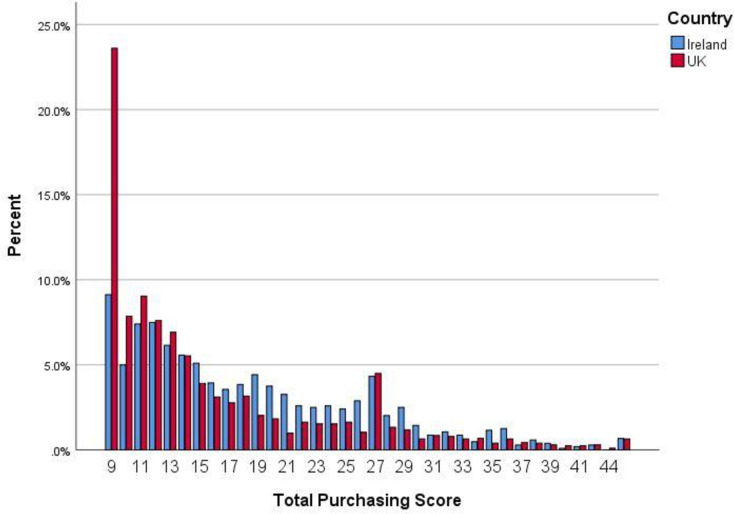
The over-purchasing and hoarding of necessities is a common response to crises, especially in developed economies where there is normally an expectation of plentiful supply. This behaviour was observed internationally during the early stages of the Covid-19 pandemic. In the absence of actual scarcity, this behaviour can be described as 'panic buying' and can lead to temporary shortages. However, there have been few psychological studies of this phenomenon. Here we propose a psychological model of over-purchasing informed by animal foraging theory and make predictions about variables that predict over-purchasing by either exacerbating or mitigating the anticipation of future scarcity. These variables include additional scarcity cues (e.g. loss of income), distress (e.g. depression), psychological factors that draw attention to these cues (e.g. neuroticism) or to reassuring messages (eg. analytical reasoning) or which facilitate over-purchasing (e.g. income). We tested our model in parallel nationally representative internet surveys of the adult general population conducted in the United Kingdom (UK: N = 2025) and the Republic of Ireland (RoI: N = 1041) 52 and 31 days after the first confirmed cases of COVID-19 were detected in the UK and RoI, respectively. About three quarters of participants reported minimal over-purchasing. There was more over-purchasing in RoI vs UK and in urban vs rural areas. When over-purchasing occurred, in both countries it was observed across a wide range of product categories and was accounted for by a single latent factor. It was positively predicted by household income, the presence of children at home, psychological distress (depression, death anxiety), threat sensitivity (right wing authoritarianism) and mistrust of others (paranoia). Analytic reasoning ability had an inhibitory effect. Predictor variables accounted for 36% and 34% of the variance in over-purchasing in the UK and RoI respectively. With some caveats, the data supported our model and points to strategies to mitigate over-purchasing in future crises.
Conflict of interest statement
The authors have declared that no competing interests exist.
Figures
References
-
- Jones L. What’s behind the great toilet roll grab? BBC News. 2020. March 26th Available from https://www.bbc.co.uk/news/business-52040532
-
- O’Connell M, de Paula A, Smith K. Preparing for a pandemic: Spending dynamics and panic buying during the COVID-19 first wave. London: Institute for Fiscal Studies; 2020. Available from https://www.ifs.org.uk/publications/15100 - PMC - PubMed
-
- Jolly W. New data shows massive increases—and decreases—in consumer spending due to COVID-19. Savings.com.au [Internet]. 24th March2020. Available from: https://www.savings.com.au/credit-cards/new-data-shows-massive-increases....
-
- Wilkes J. Has there always been panic buying? And when have people panic shopped through history? History Extra [Internet]. 7th May 2020. Available from: https://www.historyextra.com/period/20th-century/toilet-paper-shortage-w....
Publication types
MeSH terms
Grants and funding
LinkOut - more resources
Full Text Sources
Other Literature Sources
Medical
