


Associations of Dietary Intake on Biological Markers of Inflammation in Children and Adolescents: A Systematic Review
- PMID: 33503979
- PMCID: PMC7911843
- DOI: 10.3390/nu13020356
Associations of Dietary Intake on Biological Markers of Inflammation in Children and Adolescents: A Systematic Review
Abstract
Background: In children and adolescents, chronic low-grade inflammation has been implicated in the pathogenesis of co- and multi-morbid conditions to mental health disorders. Diet quality is a potential mechanism of action that can exacerbate or ameliorate low-grade inflammation; however, the exact way dietary intake can regulate the immune response in children and adolescents is still to be fully understood.
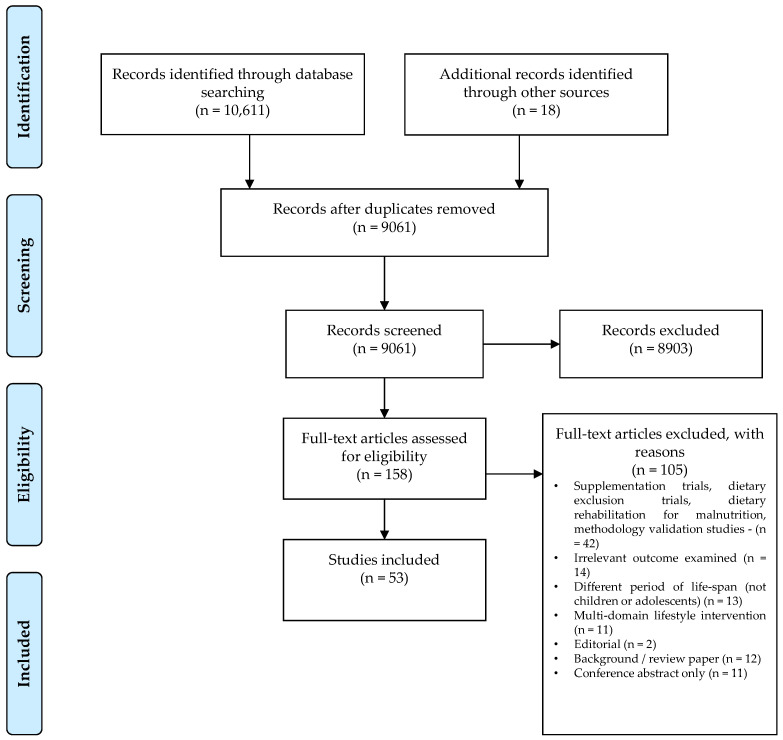
Methods: Studies that measured dietary intake (patterns of diet, indices, food groups, nutrients) and any inflammatory biomarkers in children and adolescents aged 2 to19 years and published until November 2020 were included in this systematic review, and were selected in line with PRISMA guidelines through the following databases: Academic Search Complete, CINAHL, Global Health, Medline COMPLETE and Web of Science-Core Collection. A total of 53 articles were identified.
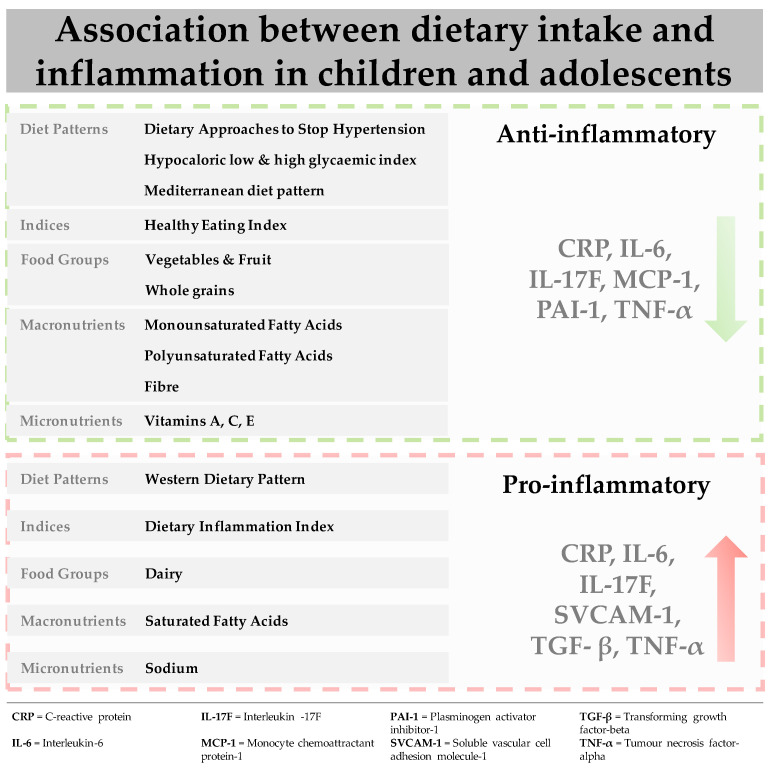
Results: Results show that adequate adherence to healthful dietary patterns such as the Mediterranean diet, or food groups such as vegetables and fruit, or macro/micro nutrients such as fibre or vitamin C and E, are associated with decreased levels of pro-inflammatory biomarkers, mainly c-reactive protein (CRP), interleukin-6 (IL-6) and tumour necrosis factor-alpha (TNF-α), whereas adherence to a Western dietary pattern, as well as intake of food groups such as added sugars, macro-nutrients such as saturated fatty acids or ultra-processed foods, is associated with higher levels of the same pro-inflammatory biomarkers.
Conclusions: This is the first systematic review examining dietary intake and biological markers of inflammation in both children and adolescents. A good quality diet, high in vegetable and fruit intake, wholegrains, fibre and healthy fats ameliorates low-grade inflammation, and therefore represents a promising therapeutic approach, as well as an important element for disease prevention in both children and adolescents.
Keywords: CRP; adolescent; biomarkers; children; cytokine; dietary intake; dietary pattern; inflammation; interleukin; macronutrients.
Conflict of interest statement
Authors declare no conflict of interest.
Figures
References
-
- Calder P.C., Ahluwalia N., Brouns F., Buetler T., Clement K., Cunningham K., Esposito K., Jö Nsson L.S., Kolb H., Lansink M., et al. Dietary factors and low-grade inflammation in relation to overweight and obesity commissioned by the ILSI Europe Metabolic Syndrome and Diabetes Task Force. Br. J. Nutr. 2011;106:S1–S78. doi: 10.1017/S0007114511005460. - DOI - PubMed
-
- Minihane A.M., Vinoy S., McArdle H.J., Kremer B.H.A., Sterkman L., Vafeiadou K., Benedetti M.M., Williams C.M., Calder P.C., Russell W.R., et al. Low-grade inflammation, diet composition and health: Current research evidence and its translation. Br. J. Nutr. 2015;114:999–1012. doi: 10.1017/S0007114515002093. - DOI - PMC - PubMed
-
- Giacobbe J., Benoiton B., Zunszain P., Pariante C.M., Borsini A. The Anti-Inflammatory Role of Omega-3 Polyunsaturated Fatty Acids Metabolites in Pre-Clinical Models of Psychiatric, Neurodegenerative, and Neurological Disorders. Front. Psychiatry. 2020;11 doi: 10.3389/fpsyt.2020.00122. - DOI - PMC - PubMed
-
- Zunszain P.A., Hepgul N., Pariante C.M. Springer; Berlin, Germany: 2012. Inflammation and Depression. Behavioral Neurobiology of Depression and its Treatment; pp. 135–151.
Publication types
MeSH terms
Substances
Grants and funding
LinkOut - more resources
Full Text Sources
Other Literature Sources
Medical
Research Materials
Miscellaneous
