Review
. 2021 Jan 27;20(1):22.
doi: 10.1186/s12943-021-01312-y.

Progress on pivotal role and application of exosome in lung cancer carcinogenesis, diagnosis, therapy and prognosis

Affiliations
Review

Progress on pivotal role and application of exosome in lung cancer carcinogenesis, diagnosis, therapy and prognosis

Ming-Yue Li et al. Mol Cancer. .

Abstract

Lung cancer is often diagnosed at an advanced stage and has a poor prognosis. Conventional treatments are not effective for metastatic lung cancer therapy. Although some of molecular targets have been identified with favorable response, those targets cannot be exploited due to the lack of suitable drug carriers. Lung cancer cell-derived exosomes (LCCDEs) receive recent interest in its role in carcinogenesis, diagnosis, therapy, and prognosis of lung cancer due to its biological functions and natural ability to carry donor cell biomolecules. LCCDEs can promote cell proliferation and metastasis, affect angiogenesis, modulate antitumor immune responses during lung cancer carcinogenesis, regulate drug resistance in lung cancer therapy, and be now considered an important component in liquid biopsy assessments for detecting lung cancer. Therapeutic deliverable exosomes are emerging as promising drug delivery agents specifically to tumor high precision medicine because of their natural intercellular communication role, excellent biocompatibility, low immunogenicity, low toxicity, long blood circulation ability, biodegradable characteristics, and their ability to cross various biological barriers. Several studies are currently underway to develop novel diagnostic and prognostic modalities using LCCDEs, and to develop methods of exploiting exosomes for use as efficient drug delivery vehicles. Current status of lung cancer and extensive applicability of LCCDEs are illustrated in this review. The promising data and technologies indicate that the approach on LCCDEs implies the potential application of LCCDEs to clinical management of lung cancer patients.

Keywords: Lung cancer cell-derived exosomes (LCCDEs); carcinogenesis; diagnosis; prognosis; therapy.


Conflict of interest statement

The authors declare no competing interests.

Figures
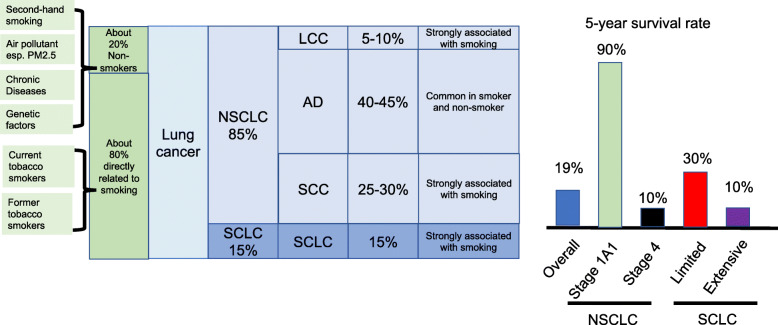
Fig. 1
Fig. 1
Distribution of cases in lung cancer, 5-year survival rate of lung cancer based on subtypes and stages, and risk factors contributing to lung carcinogenesis. Small-cell lung carcinoma (SCLC) and non-small cell lung carcinoma (NSCLC), accounting for 15% and 85% of all lung cancers respectively. Squamous cell carcinoma (SCC), adenocarcinoma (AD), and large cell carcinoma (LCC) comprises 25–30%, 40-45% and 5–10% of lung cancers. The overall 5-year survival rate of lung cancer is about 19%. Low lung cancer survival rates are due to patients diagnosed with metastatic disease. Among patients with NSCLC, 5-year relative survival rate reach 90% for stage 1A1 but drop below 10% for stage 4. Among patients with SCLC, 5-year relative survival rates are about 30% for limited disease and below 10% for extensive disease. About 80% of lung cancer cases are directly related to smoking. About 20% of lung cancer cases are developed in Non-smokers.
Fig. 2
Fig. 2
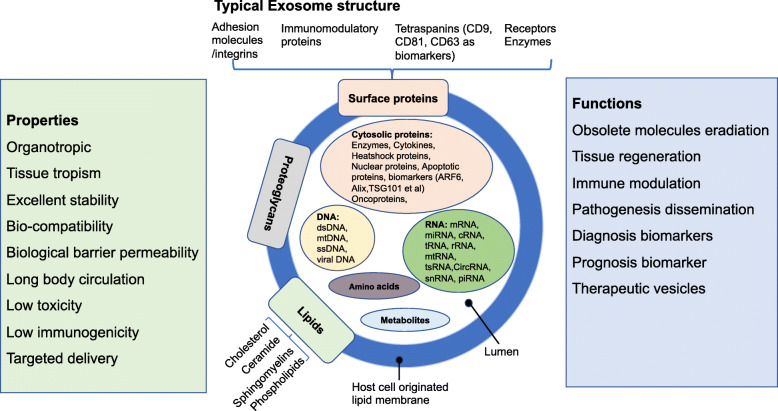
Typical structure, biological properties and functions of exosomes. Exosomes (size range ~40 to 160 nm) are extracellular vesicles generated by all cells. Exosomes can contain different types of cell surface proteins, intracellular protein, RNA, DNA, amino acids, and metabolites. Exosome surface proteins include tetraspanins, integrins, immunomodulatory proteins, and more. Several molecules are used as exosome markers (CD9, CD81, CD63, TSG101, ceramide, and Alix). Exosomes can be a highly heterogeneous population with pleiotropic functions. They are mediators of near and long-distance intercellular communication in health and disease and affect various aspects of cell biology.
Fig. 3
Fig. 3
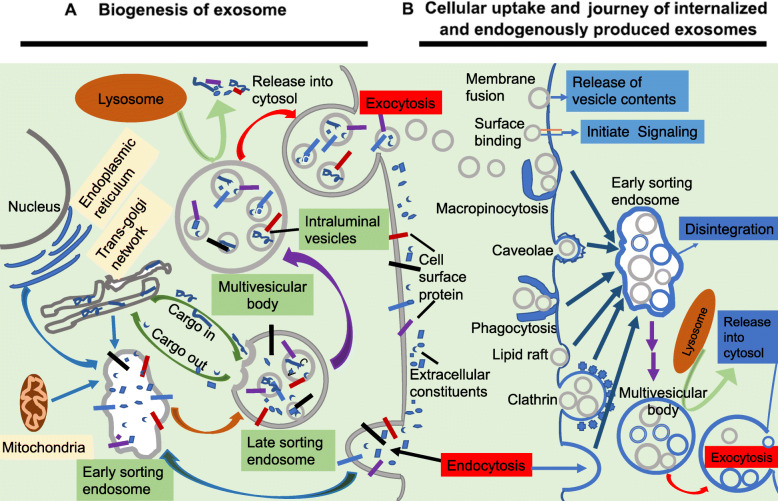
Biogenesis of exosomes, and cellular uptake and journey of internalized and endogenously produced exosomes. a Biogenesis of exosomes. Extracellular constituents along with cell surface proteins enter cells through endocytosis of plasma membrane segments. This resulting plasma membrane bud leads to the formation of Early sorting endosomes (ESEs) or fuses with ESEs pre-formed by the constituents of the endoplasmic reticulum (ER), trans-Golgi network (TGN), and mitochondria. ESEs give rise to Late sorting endosomes (LSEs). Invagination in the LSE results in the Multivesicular bodys (MVBs) generation containing Intraluminal vesicles (ILVs) as future exosomes. MVBs can ultimately undergo degradation in the lysosomes with the degradation products recycled by the cells. MVBs can also be transported to the plasma membrane and dock on the luminal side of the plasma membrane. Exocytosis follows and results in the release of the exosomes. b Cellular uptake and journey of internalized and endogenously produced exosomes. In the recipient cell (which can be the exosome-producing cell itself), exogenous exosomes may be internalized by multiple pathways and can undergo various fates. Depending on the cell type, extracellular exosomes can dock either at the plasma membrane to release their intraluminal contents into the cytoplasm of recipient cell by fusion. They can remain bound to the surface (for example, to integrins) and initiate intracellular signalling pathways (for example, antigen presentation). Extracellular exosomes may also be internalized by various types of endocytosis: phagocytosis, micropinocytosis, clathrin-dependent endocytosis, lipid raft dependent endocytosis, and caveolae endocytosis. Internalization will target exogenous extracellular exosomes into the canonical endosomal pathway, whereby they reach MVBs, in which the internalized exosomes are likely to mix with endogenous ILVs. Exosome biogenesis and cellular uptake pathways intersection results in a composition of net production of mixed endogenous and exogenous exosomes population.
Fig. 4
Fig. 4
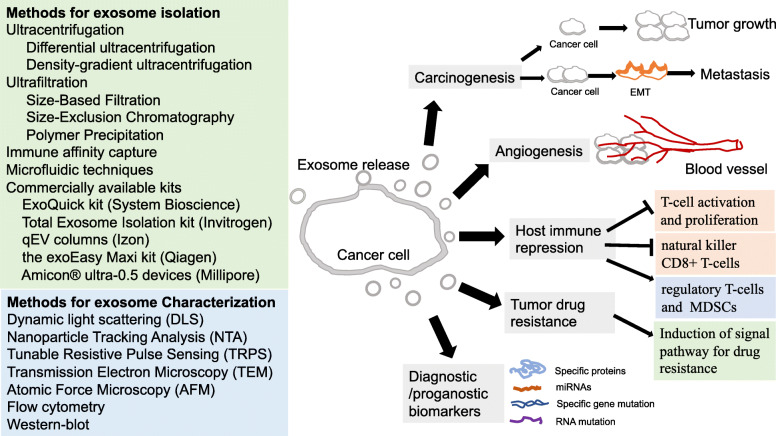
Exosome isolation, characterization, and tumor-derived exosomes role in tumor development. Methods for exosome isolation and characterization are listed. Tumor-derived exosomes role in tumor development includes to promote cancer carcinogenesis, angiogenesis, and drug resistance, help cancer cell escape from host immune system, and can be useful diagnostic and/or prognostic biomarkers.
Fig. 5
Fig. 5
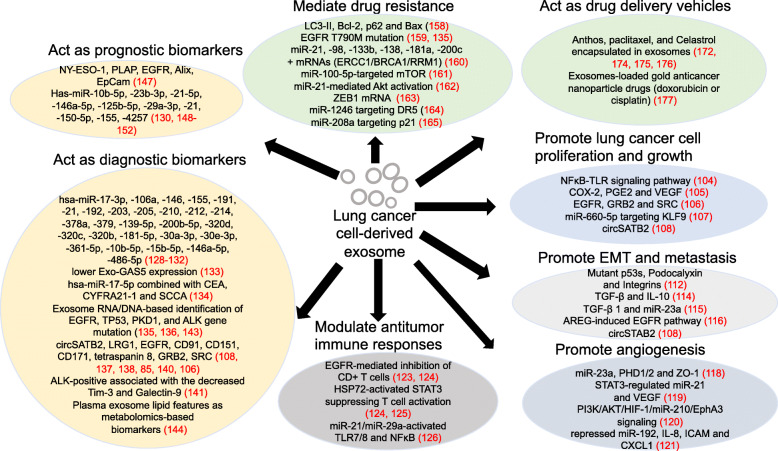
Summary of the potential molecules in lung cancer cell-derived exosomes in carcinogenesis, diagnosis, prognosis, and therapy of lung cancer. Lung cancer cell derived-exosomes have potential role in promoting lung cancer growth, metastasis, and angiogenesis; modulating antitumor immune responses and drug resistance to lung cancer; acting as diagnosis and prognosis biomarkers in lung cancer; and exploring as therapy vesicles for lung cancer drugs.

References

    1. Bray F, Ferlay J, Soerjomataram I, Siegel RL, Torre LA, Jemal A. Global cancer statistics 2018: GLOBOCAN estimates of incidence and mortality worldwide for 36 cancers in 185 countries. CA Cancer J Clin. 2018;68(6):394–424. - PubMed
    1. Zappa C, Mousa SA. Non-small cell lung cancer: current treatment and future advances. Transl Lung Cancer Res. 2016;5(3):288–300. doi: 10.21037/tlcr.2016.06.07. - DOI - PMC - PubMed
    1. Kenfield SA, Wei EK, Stampfer MJ, Rosner BA, Colditz GA. Comparison of aspects of smoking among the four histological types of lung cancer. Tob Control. 2008;17(3):198–204. doi: 10.1136/tc.2007.022582. - DOI - PMC - PubMed
    1. Muscat JE, Stellman SD, Zhang ZF, Neugut AI, Wynder EL. Cigarette smoking and large cell carcinoma of the lung. Cancer Epidemiol Biomark Prev. 1997;6(7):477–480. - PubMed
    1. Couraud S, Zalcman G, Milleron B, Morin F, Souquet PJ. Lung cancer in never smokers--a review. Eur J Cancer. 2012;48(9):1299–1311. doi: 10.1016/j.ejca.2012.03.007. - DOI - PubMed

Publication types

Substances