


Sexually Transmitted Infection Diagnoses and Access to a Sexual Health Service Before and After the National Lockdown for COVID-19 in Melbourne, Australia
- PMID: 33506064
- PMCID: PMC7665697
- DOI: 10.1093/ofid/ofaa536
Sexually Transmitted Infection Diagnoses and Access to a Sexual Health Service Before and After the National Lockdown for COVID-19 in Melbourne, Australia
Abstract
Background: We aimed to examine the impact of lockdown on sexually transmitted infection (STI) diagnoses and access to a public sexual health service during the coronavirus disease 2019 (COVID-19) pandemic in Melbourne, Australia.
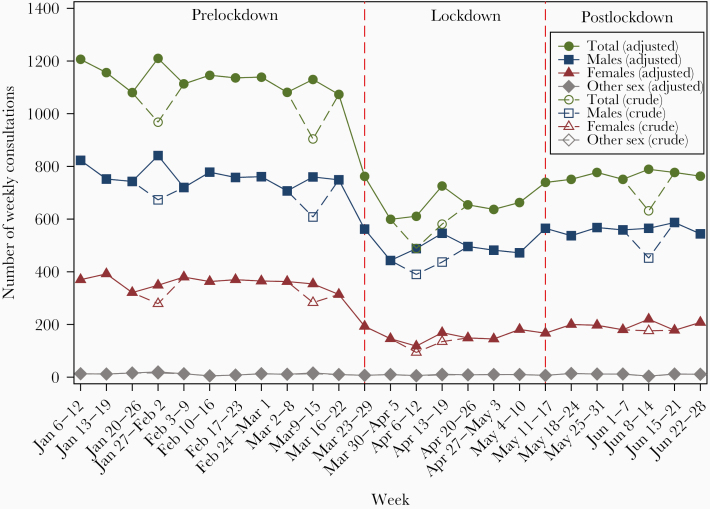
Methods: The operating hours of Melbourne Sexual Health Centre (MSHC) remained the same during the lockdown. We examined the number of consultations and STIs at MSHC between January and June 2020 and stratified the data into prelockdown (February 3 to March 22), lockdown (March 23 to May 10), and postlockdown (May 11 to June 28), with 7 weeks in each period. Incidence rate ratios (IRRs) and their 95% confidence intervals (CI) were estimated using Poisson regression models.
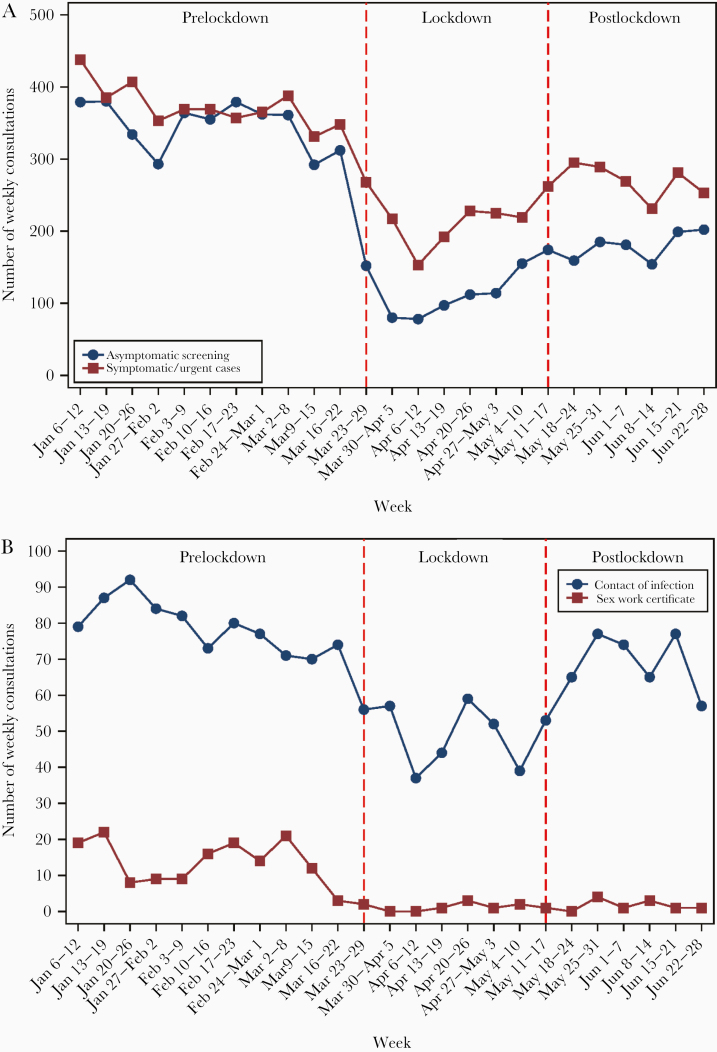
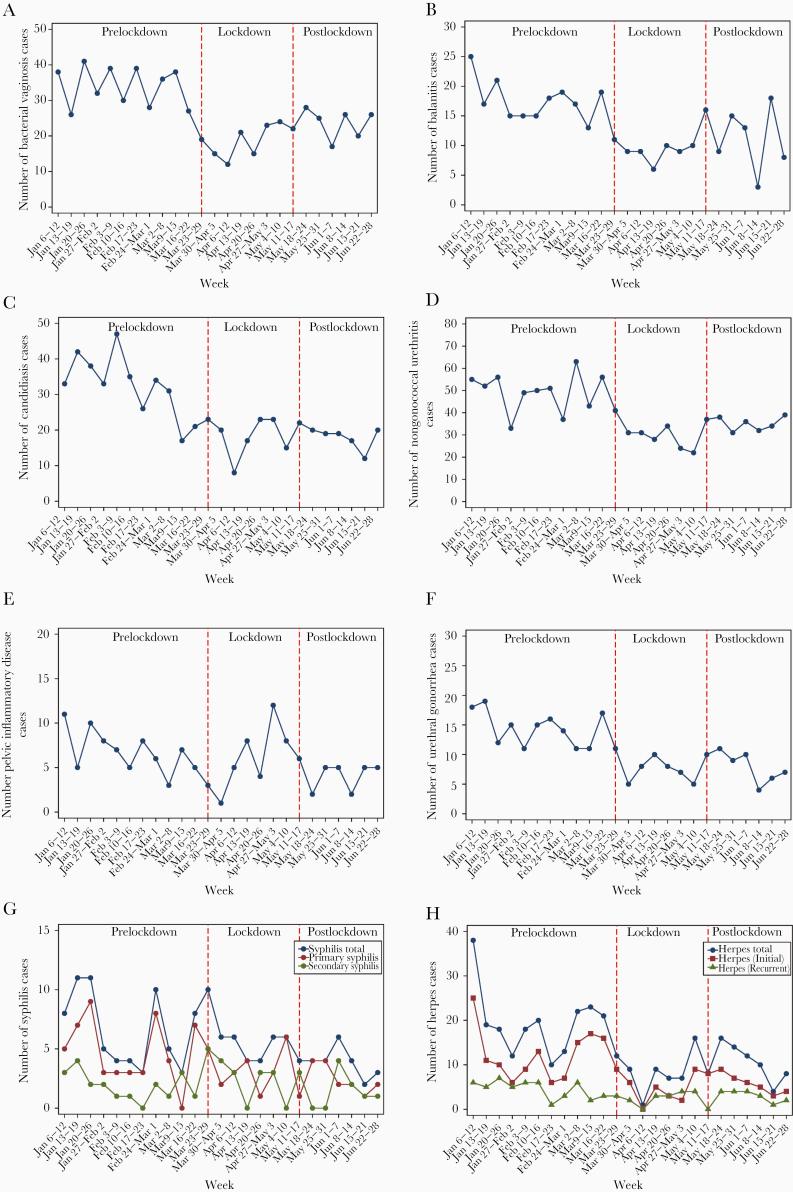
Results: The total number of consultations dropped from 7818 in prelockdown to 4652 during lockdown (IRR, 0.60; 95% CI, 0.57-0.62) but increased to 5347 in the postlockdown period (IRR, 1.15; 95% CI, 1.11-1.20). There was a 68% reduction in asymptomatic screening during lockdown (IRR, 0.32; 95% CI, 0.30-0.35), but it gradually increased during the postlockdown period (IRR, 1.59; 95% CI, 1.46-1.74). Conditions with milder symptoms showed a marked reduction, including nongonococcal urethritis (IRR, 0.60; 95% CI, 0.51-0.72) and candidiasis (IRR, 0.61; 95% CI, 0.49-0.76), during lockdown compared with prelockdown. STIs with more marked symptoms did not change significantly, including pelvic inflammatory disease (IRR, 0.95; 95% CI, 0.61-1.47) and infectious syphilis (IRR, 1.14; 95% CI, 0.73-1.77). There was no significant change in STI diagnoses during postlockdown compared with lockdown.
Conclusions: The public appeared to be prioritizing their attendance for sexual health services based on the urgency of their clinical conditions. This suggests that the effectiveness of clinical services in detecting, treating, and preventing onward transmission of important symptomatic conditions is being mainly preserved despite large falls in absolute numbers of attendees.
Keywords: Australia; COVID; coronavirus; health service; sexual health; sexually transmitted infections.
© The Author(s) 2020. Published by Oxford University Press on behalf of Infectious Diseases Society of America.
Figures
References
-
- COVID-19 National Incident Room Surveillance Team. COVID-19, Australia: epidemiology report 20 (fortnightly reporting period ending 5 July 2020) Commun Dis Intell (2018) 2020; 44.
-
- Coombe J, Kong FYS, Bittleston H, et al. Love during lockdown: findings from an online survey examining the impact of COVID-19 on the sexual practices of people living in Australia [published online ahead of print November 17, 2020]. Sex Transm Infect 2020. doi: 10.1136/sextrans-2020-054688 - DOI - PubMed
-
- Hammoud MA, Maher L, Holt M, et al. Physical distancing due to COVID-19 disrupts sexual behaviours among gay and bisexual men in Australia: Implications for trends in HIV and other sexually transmissible infections. J Acquir Immune Defic Syndr 2020; 85:309–15. - PubMed
-
- de Sousa AFL, Oliveira LB, Schneider G, et al. Casual sex among MSM during the period of social isolation in the COVID-19 pandemic: nationwide study in Brazil and Portugal. medRxiv 2020.06.07.20113142 [Preprint]. 23 September 2020. Available at: https://doi.org/10.1101/2020.06.07.20113142.
