. 2021 Jul;135(4):1151-1160.
doi: 10.1007/s00414-021-02509-y. Epub 2021 Jan 28.

Evaluation of microhaplotypes in forensic kinship analysis from a Swedish population perspective

Affiliations

Evaluation of microhaplotypes in forensic kinship analysis from a Swedish population perspective

Adam Staadig et al. Int J Legal Med. 2021 Jul.

Abstract

The development of massively parallel sequencing (MPS) technology has enabled the discovery of several new types of forensic markers where microhaplotypes are one of these promising novel genetic markers. Microhaplotypes are, commonly, less than 300 nucleotides in length and consist of two or more closely linked single-nucleotide polymorphisms (SNPs). In this study, we have examined a custom-made QIAseq Microhaplotype panel (Qiagen), including 45 different microhaplotype loci. DNA libraries were prepared according to the GeneRead DNAseq Targeted Panels V2 library preparation workflow (Qiagen) and sequenced on a MiSeq FGx instrument (Verogen). We evaluated the performance of the panel based on 75 samples of Swedish origin and haplotype frequencies were established. We performed sensitivity studies and could detect haplotypes at input amounts down to 0.8 ng. We also studied mixture samples with two contributors for which haplotypes, for the minor contributor, were detectable down to the level of 1:100. Furthermore, we executed kinship simulations to evaluate the usefulness of this panel in kinship analysis. The results showed that both paternity and full sibling cases can clearly be solved. When simulating a half sibling versus unrelated case scenario, there were, however, some overlap of the likelihood ratio distributions potentially resulting in inconclusiveness. To conclude, the results of this initial study are promising for further implementation of this microhaplotype assay into the forensic field, although we noticed some primer design issues that could be optimized, which possibly would increase the power of the assay.

Keywords: Forensic genetics; Genetic marker; Human identification; Kinship analysis; Microhaplotypes; Population genetics.


Conflict of interest statement

The authors declare no competing interests.

Figures

Fig. 1
Fig. 1
The read coverage (log10) for the 75 population samples are illustrated as a boxplot and the dashed line at the bottom represents the read coverage threshold of 200 reads. All samples are well above the threshold and are quite well balanced among each other
Fig. 2
Fig. 2
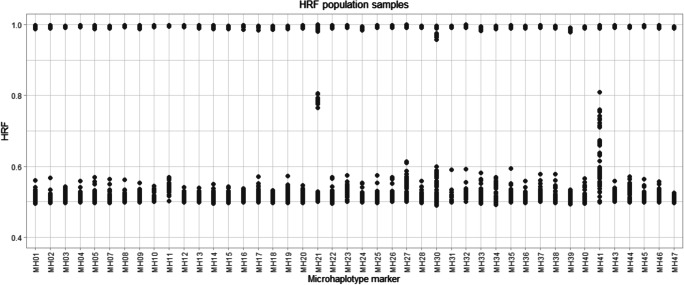
The haplotype read frequency (HRF) is presented for each of the 75 analysed population samples. Two markers, MH21 and MH41, display an imbalanced pattern
Fig. 3
Fig. 3
The proportion of haplotypes that met the above-defined quality controls (black bars) is presented together with the proportion of correctly typed haplotypes that met the quality criteria (grey bars). Only a few dropouts were seen down to 1.6 ng. However, the lowest input amount showed a notable number of dropouts resulting in both complete locus dropouts and false homozygotes
Fig. 4
Fig. 4
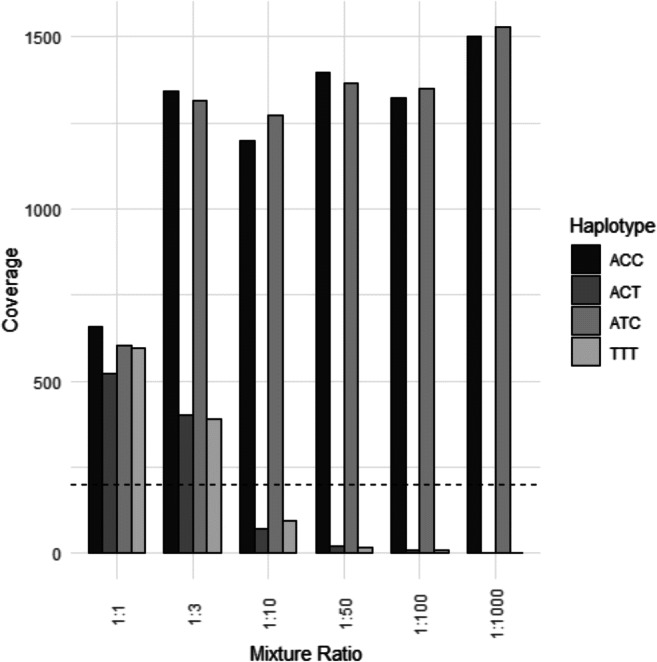
A boxplot of the read coverage for the different mixture ratios. The dashed line represents the user-defined threshold of 200 reads. The 1:3 ratio can easily be detected; however, we can distinguish the ratio pattern for the mixtures down to 1:100 although the read coverage is relatively low for those mixtures
Fig. 5
Fig. 5
The number of genetic inconsistencies from 10,000 simulations of trio paternity tests is presented. The quantity ranges from 8 to 24 with an average of 16 markers
Fig. 6
Fig. 6
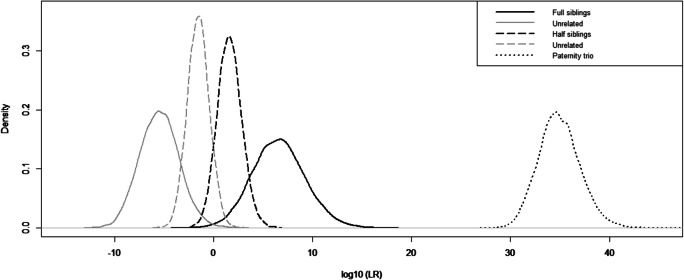
Distribution curves of LR for three tested relationships from 10,000 simulations are presented. The black lines show the LR for hypothesis H1 to be true and the grey lines represent the alternative hypothesis H2 to be true. The solid lines demonstrate the full sibling versus unrelated simulation, the dashed lines show the half sibling versus unrelated simulation and the dotted line represents the paternity trio versus maternity duo case. The full sibling simulation shows a clear separation of the hypothesis while there is a small overlap in the half sibling simulations

References

    1. Børsting C, Morling N. Next generation sequencing and its applications in forensic genetics. Forensic Sci Int Genet. 2015;18:78–89. doi: 10.1016/j.fsigen.2015.02.002. - DOI - PubMed
    1. Kidd KK, et al. Microhaplotype loci are a powerful new type of forensic marker. Forensic Sci Int Genet Suppl Ser. 2013;4(1):e123–e124. doi: 10.1016/j.fsigss.2013.10.063. - DOI
    1. Pakstis AJ, Fang R, Furtado MR, Kidd JR, Kidd KK. Mini-haplotypes as lineage informative SNPs and ancestry inference SNPs. Eur J Hum Genet. 2012;20(11):1148–1154. doi: 10.1038/ejhg.2012.69. - DOI - PMC - PubMed
    1. Kidd KK, Pakstis AJ, Speed WC, Lagacé R, Chang J, Wootton S, Haigh E, Kidd JR. Current sequencing technology makes microhaplotypes a powerful new type of genetic marker for forensics. Forensic Sci Int Genet. 2014;12:215–224. doi: 10.1016/j.fsigen.2014.06.014. - DOI - PubMed
    1. Reich DE, Schaffner SF, Daly MJ, McVean G, Mullikin JC, Higgins JM, Richter DJ, Lander ES, Altshuler D. Human genome sequence variation and the influence of gene history, mutation and recombination. Nat Genet. 2002;32(1):135–142. doi: 10.1038/ng947. - DOI - PubMed

Substances