


Development and Feasibility of a Family-Based Health Behavior Intervention Using Intelligent Personal Assistants: Randomized Controlled Trial
- PMID: 33507155
- PMCID: PMC7878108
- DOI: 10.2196/17501
Development and Feasibility of a Family-Based Health Behavior Intervention Using Intelligent Personal Assistants: Randomized Controlled Trial
Abstract
Background: Intelligent personal assistants such as Amazon Echo and Google Home have become increasingly integrated into the home setting and, therefore, may facilitate behavior change via novel interactions or as an adjunct to conventional interventions. However, little is currently known about their potential role in this context.
Objective: This feasibility study aims to develop the Intelligent Personal Assistant Project (IPAP) and assess the acceptability and feasibility of this technology for promoting and maintaining physical activity and other health-related behaviors in both parents and children.
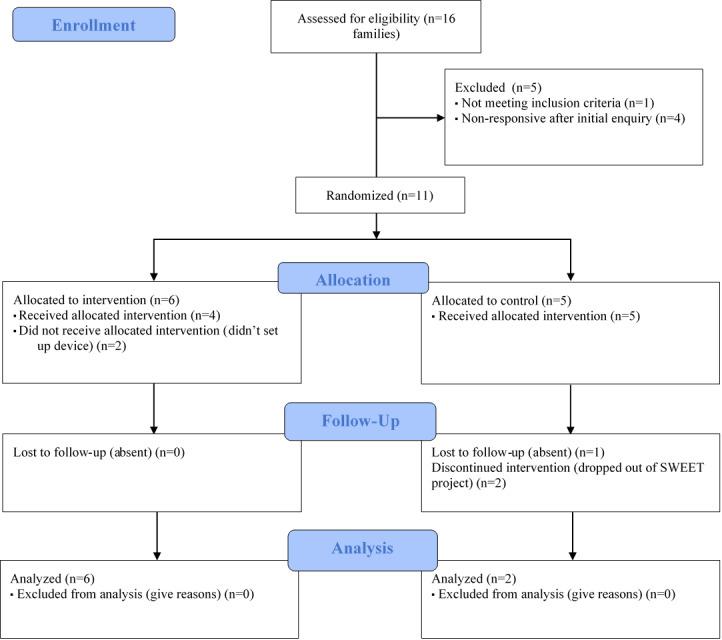
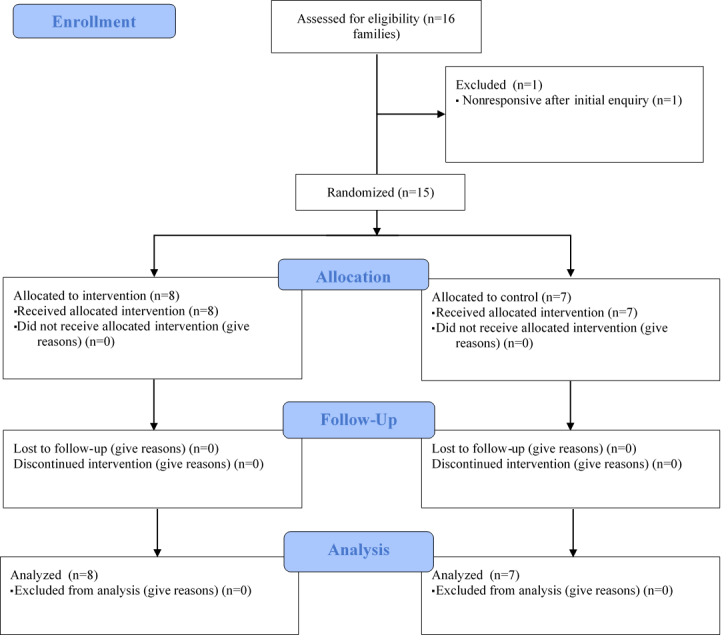
Methods: This pilot feasibility study was conducted in 2 phases. For phase 1, families who were attending a community-based weight management project were invited to participate, whereas phase 2 recruited families not currently receiving any additional intervention. Families were randomly allocated to either the intervention group (received a smart speaker for use in the family home) or the control group. The IPAP intervention aimed to promote positive health behaviors in the family setting through utilization of the functions of a smart speaker and its linked intelligent personal assistant. Data were collected on recruitment, retention, outcome measures, intervention acceptability, device interactions, and usage.
Results: In total, 26 families with at least one child aged 5 to 12 years were recruited, with 23 families retained at follow-up. Across phase 1 of the intervention, families interacted with the intelligent personal assistant a total of 65 times. Although device interactions across phase 2 of the intervention were much higher (312 times), only 10.9% (34/312) of interactions were coded as relevant (related to diet, physical activity or well-being). Focus groups highlighted that the families found the devices acceptable and easy to use and felt that the prompts or reminders were useful in prompting healthier behaviors. Some further intervention refinements in relation to the timing of prompts and integrating feedback alongside the devices were suggested by families.
Conclusions: Using intelligent personal assistants to deliver health-related messages and information within the home is feasible, with high levels of engagement reported by participating families. This novel feasibility study highlights important methodological considerations that should inform future trials testing the effectiveness of intelligent personal assistants in promoting positive health-related behaviors.
Trial registration: ISRCTN Registry ISRCTN16792534; http://www.isrctn.com/ISRCTN16792534.
Keywords: children; healthy eating; mobile phone; parent; physical activity; technology.
©Angela Carlin, Caomhan Logue, Jonathan Flynn, Marie H Murphy, Alison M Gallagher. Originally published in JMIR Formative Research (http://formative.jmir.org), 28.01.2021.
Conflict of interest statement
Conflicts of Interest: None declared.
Figures
References
-
- NatCen Social Research and UCL . Government Statistical Service. Surrey: NHS Digital; 2017. Dec 13, [2020-12-21]. Health Survey for England 2016. https://files.digital.nhs.uk/pdf/s/q/hse2016-summary.pdf.
-
- Health Survey Northern Ireland. Belfast: Department of Health; 2017. Oct 24, [2020-12-21]. Health Survey Northern Ireland: First Results 2016/17. https://www.health-ni.gov.uk/publications/health-survey-northern-ireland....
-
- Woods C, Powell C, Saunders JA, O'Brien W, Murphy MH, Duff C, Farmer O, Johnston A, Connolly S, Belton S. The Children's Sport Participation and Physical Activity Study 2018 (CSPPA 2018) Research Gate. 2019 Sep doi: 10.13140/RG.2.2.22091.95521. https://www.researchgate.net/publication/336126414_The_Children's_Sport_... - DOI
-
- Department of Health and Social Care. Downing Street: Government Digital Service; 2017. Jan 20, [2020-12-21]. Childhood Obesity: A Plan for Action. https://www.gov.uk/government/publications/childhood-obesity-a-plan-for-....
LinkOut - more resources
Full Text Sources
Other Literature Sources
