Review
. 2021 Apr;78(7):3141-3158.
doi: 10.1007/s00018-020-03731-4. Epub 2021 Jan 28.

Nuclear organization and regulation of the differentiated state

Affiliations
Review

Nuclear organization and regulation of the differentiated state

Eliya Bitman-Lotan et al. Cell Mol Life Sci. 2021 Apr.

Abstract

Regulation of the differentiated identity requires active and continued supervision. Inability to maintain the differentiated state is a hallmark of aging and aging-related disease. To maintain cellular identity, a network of nuclear regulators is devoted to silencing previous and non-relevant gene programs. This network involves transcription factors, epigenetic regulators, and the localization of silent genes to heterochromatin. Together, identity supervisors mold and maintain the unique nuclear environment of the differentiated cell. This review describes recent discoveries regarding mechanisms and regulators that supervise the differentiated identity and protect from de-differentiation, tumorigenesis, and attenuate forced somatic cell reprograming. The review focuses on mechanisms involved in H3K9me3-decorated heterochromatin and the importance of nuclear lamins in cell identity. We outline how the biophysical properties of these factors are involved in self-compartmentalization of heterochromatin and cell identity. Finally, we discuss the relevance of these regulators to aging and age-related disease.

Keywords: Aging; Cell identity; Chromatin; Gene regulation; H3K9me3; LLPS; Lamin.


Conflict of interest statement

The authors declare that they have no conflict of interest.

Figures
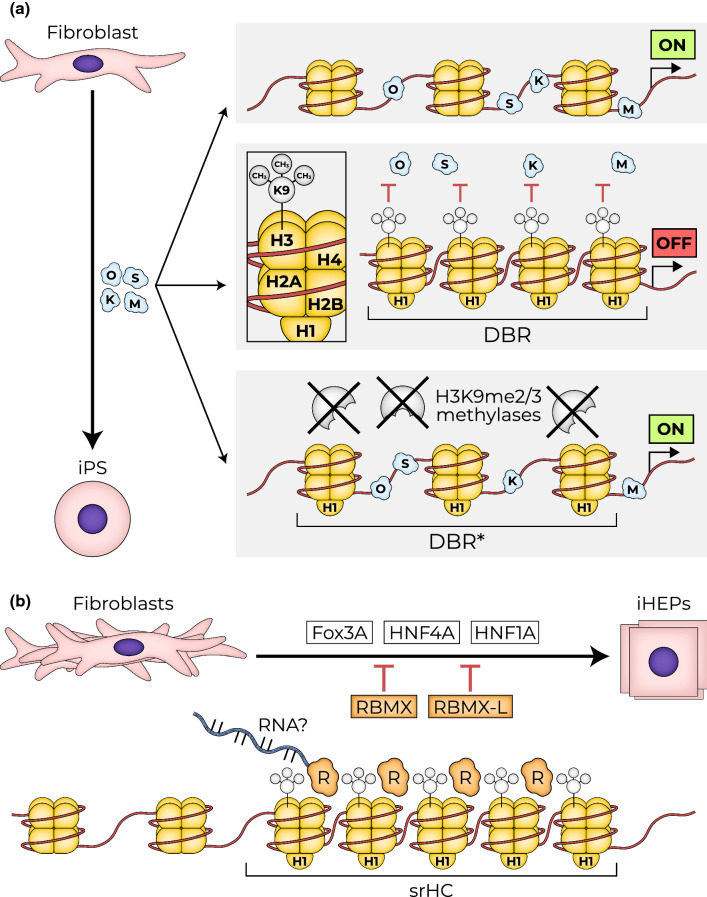
Fig. 1
Fig. 1
H3K9me2/3-marked heterochromatin attenuates reprograming. a Reprogramming of fibroblast to iPs: Expression of Oct4, Sox-2, Klf-4, and c-Myc (OSKM) transcription factors in fibroblast results in generation of iPSs. H3K9me3-marked heterochromatin at developmentally bound genomic regions (DBR) prevent the binding of OSKM to these genomic regions. Eliminating H3K9me2/3 methylases enables OSKM binding to DBR regions (DBR*) and enhances reprograming [40]. b Conversion of fibroblasts to hepatocytes (iHEP). Expression of hepatic “founding” transcription factors converts fibroblasts into hepatocytes. iHEP is inhibited by RBMX and RBMX-L RNA-binding proteins. RBMX and RBMX-L were identified as bound to H3K9me3-sonication-resistant heterochromatin (srHC). Their elimination during iHEP generation increased conversion efficiency [28]
Fig. 2
Fig. 2
Mechanisms of anchoring heterochromatin to nuclear lamina. a In C. elegans, histone methylases SET-25 and MET-2 di and tri methylate H3K9. Subsequently, H3K9me2/3 is anchored to the nuclear lamina by the direct binding of CEC-4, resulting in sequestration of heterochromatin in the nuclear periphery [58]. b In vertebrates, H3K9me2/3-marked heterochromatin is bound by HP1. HP1 is recognized and binds to PRR14. PRR14 also has a lamina-binding domain that is required for anchoring H3K9me2/3 heterochromatin to the nuclear lamina, likely in a phosphorylation-dependent manner [85]
Fig. 3
Fig. 3
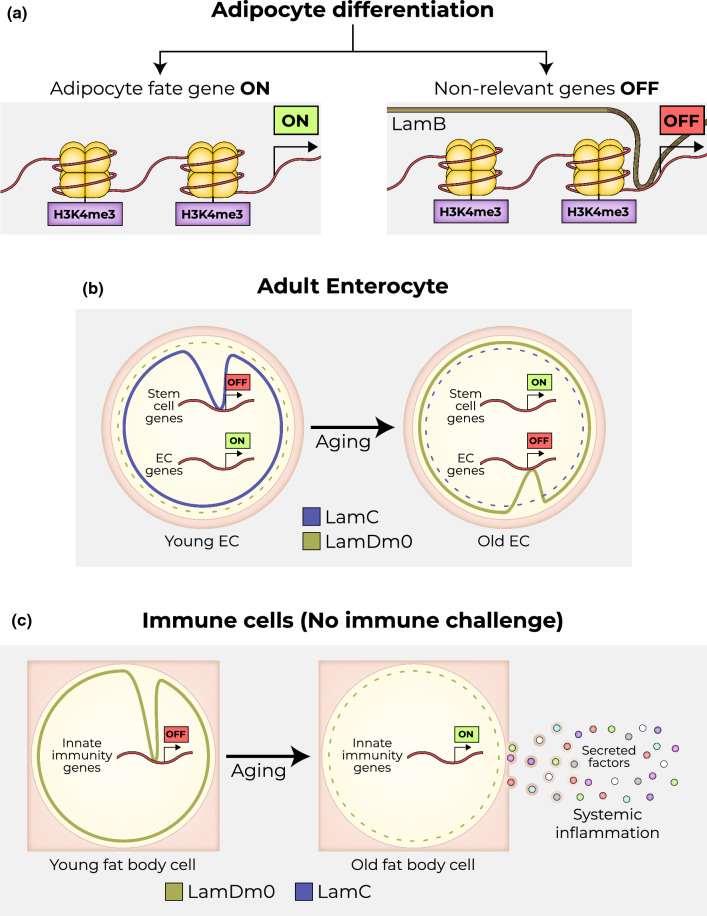
Lamin actively silences gene expression. a During adipocyte differentiation, adipocyte fate genes are expressed. Conversely, LaminA/C binds to the vicinity of transcriptional start sites and prevents the expression of other fate genes, albeit the observation that histone tails within the regulatory regions of these genes are marked by activating histone mark, such as H3K4me3. b Loss of LamDm0 in fat body cells during aging results in ectopic activation of immune gene signature and in systemic inflammation. c Aging ECs flip lamin organization, reverting to a stem-like configuration
Fig. 4
Fig. 4
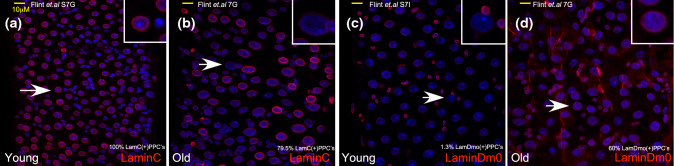
ad Expression of lamins in young and old midguts. Confocal microscopy images of young (4 days) and old (4 weeks) adult-derived midguts immuno-stained as indicated. DAPI (blue) marks DNA and arrows points to cells shown in insets (a, b) in young adults, LamC (red) is homogenously expressed in all ECs, and its level is reduced in aged ECs. c, d Lamin Dm0 (red), the stem cell-related lamin, is expressed only in progenitor cells in young guts, but is ectopically expressed in polyploid EC-like cells in old guts. The precent of polyploid cells (PPCs) that are positive for the indicated protein in the figure is presented. The figure is adopted from [109]

References

    1. Hobert O, Kratsios P. Neuronal identity control by terminal selectors in worms, flies, and chordates. Curr Opin Neurobiol. 2019;56:97–105. doi: 10.1016/j.conb.2018.12.006. - DOI - PubMed
    1. Azagra A, Marina-Zárate E, Ramiro AR, et al. From loops to looks: transcription factors and chromatin organization shaping terminal B cell differentiation. Trends Immunol. 2020;41:46–60. doi: 10.1016/j.it.2019.11.006. - DOI - PubMed
    1. Rajagopal J, Stanger BZ. Plasticity in the adult: how should the Waddington diagram be applied to regenerating tissues? Dev Cell. 2016;36:133–137. doi: 10.1016/j.devcel.2015.12.021. - DOI - PubMed
    1. Waddington C. Genetic assimilation of the bithorax phenotype. Evolution. 1956;10:1–13. doi: 10.2307/2406091. - DOI
    1. Waddington CH. The strategy of the genes: a discussion of some aspects of theoretical biology. London: George Allen and Unwin; 1957.

LinkOut - more resources