


Phytoassisted synthesis of magnesium oxide nanoparticles from Pterocarpus marsupium rox.b heartwood extract and its biomedical applications
- PMID: 33507438
- PMCID: PMC7843771
- DOI: 10.1186/s43141-021-00119-0
Phytoassisted synthesis of magnesium oxide nanoparticles from Pterocarpus marsupium rox.b heartwood extract and its biomedical applications
Abstract
Background: Unlike chemical techniques, the combination of metal oxide nanoparticles utilizing plant concentrate is a promising choice. The purpose of this work was to synthesize magnesium oxide nanoparticles (MgO-NPs) utilizing heartwood aqueous extract of Pterocarpus marsupium. The heartwood extract of Pterocarpus marsupium is rich in polyphenolic compounds and flavonoids that can be used as a green source for large-scale, simple, and eco-friendly production of MgO-NPs. The phytoassisted synthesis of MgO is characterized by UV-Visible spectroscopy, X-ray diffraction (XRD), dynamic light scattering (DLS), Fourier transform infrared spectroscopy (FT-IR), scanning electron microscopy (SEM) with EDS (energy dispersive X-ray spectroscopy), and transmission electron microscopy (TEM).
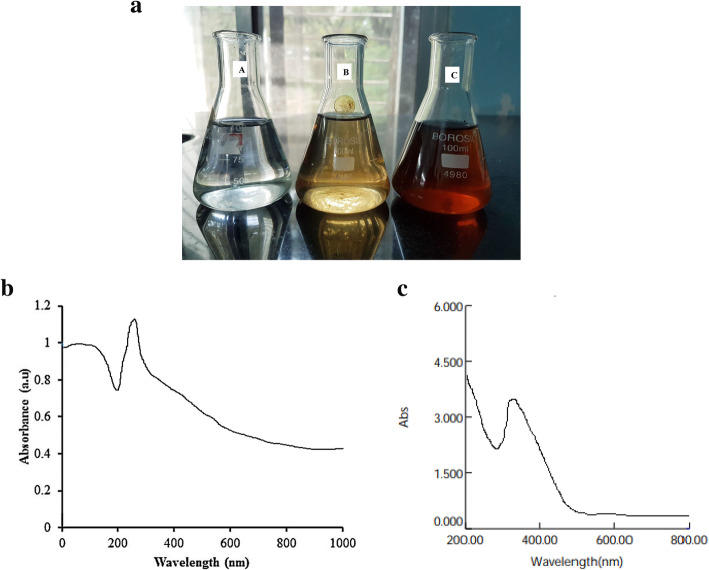
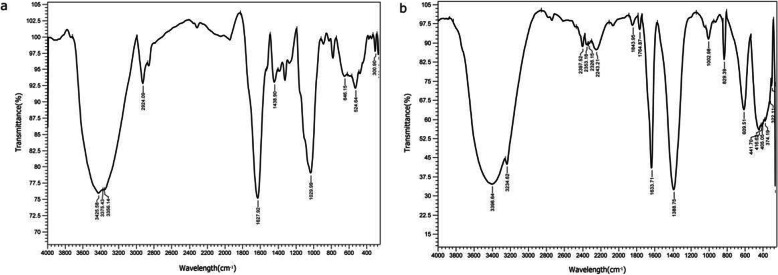
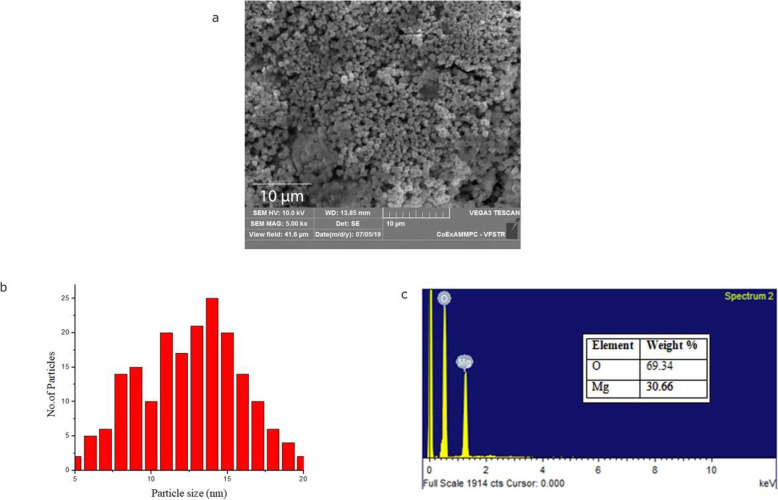
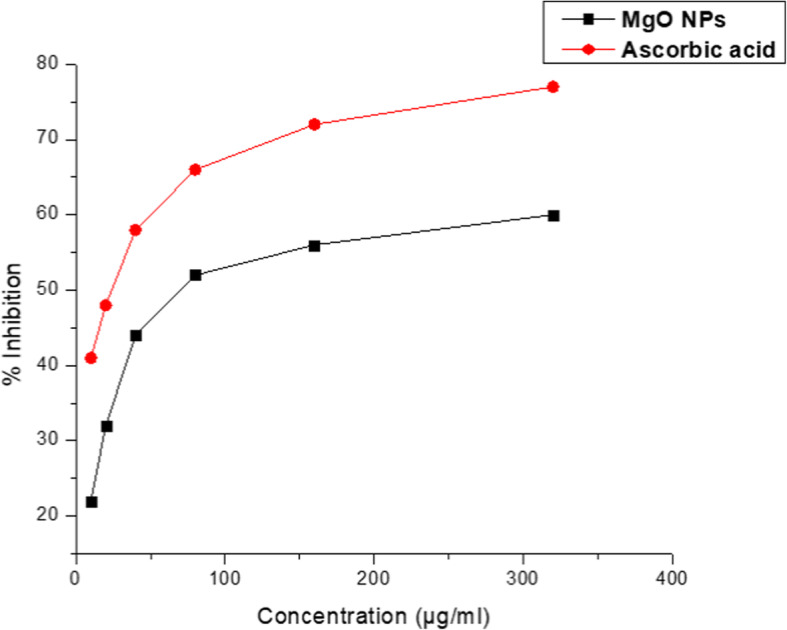
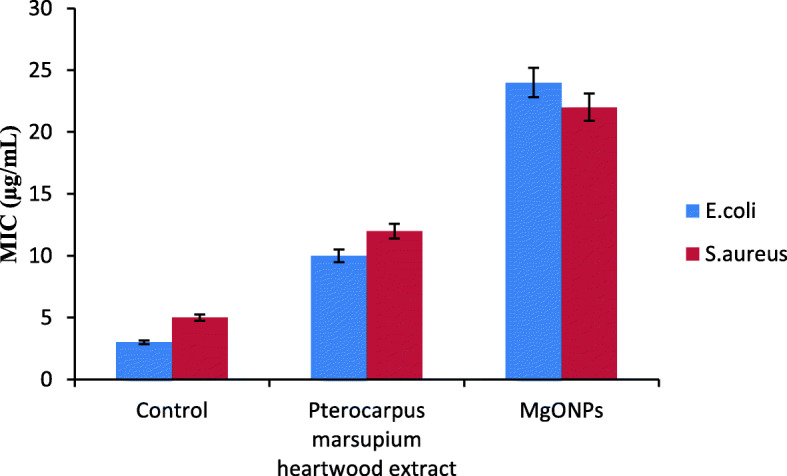
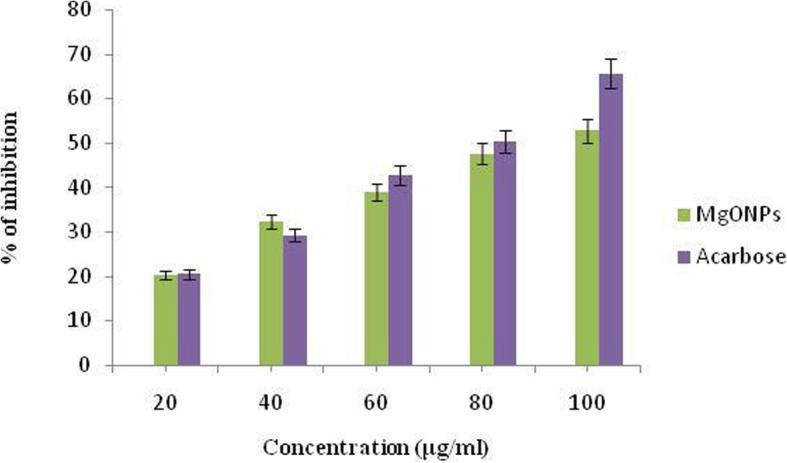
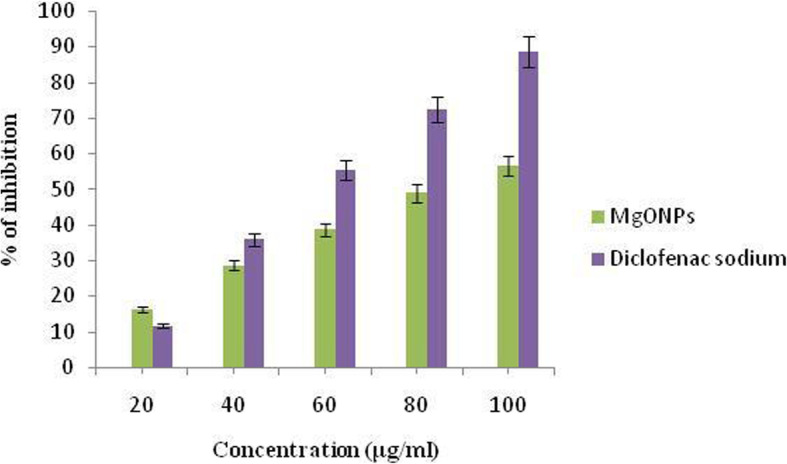
Results: The formation of MgO-NPs is confirmed by a visual color change from colorless to dark brown and they displayed a wavelength of 310 nm in UV-Spectrophotometry analysis. The crystalline nature of the obtained biosynthesized nanoparticles are revealed by X-ray diffraction analysis. SEM results revealed the synthesized magnesium oxide nanoparticles formed by this cost-effective method are spherically shaped with an average size of < 20 nm. The presence of magnesium and oxygen were confirmed by the EDS data. TEM analysis proved the spherical shape of the nanoparticles with average particle size of 13.28 nm and SAED analysis confirms the crystalline nature of MgO-NPs. FT-IR investigation confirms the existence of the active compounds required to stabilize the magnesium oxide nanoparticles with hydroxyl and carboxyl and phenolic groups that act as reducing, stabilizing, and capping agent. All the nanoparticles vary in particle sizes between 15 and 25 nm and obtained a polydispersity index value of 0.248. The zeta-potential was measured and found to be - 2.9 mV. Further, MgO-NPs were tested for antibacterial action against Staphylococcus aureus (Gram-positive bacteria) and Escherichia coli (Gram-negative bacteria) by minimum inhibitory concentration technique were found to be potent against both the bacteria. The blended nanoparticles showed good antioxidant activity examined by the DPPH radical scavenging method, showed good anti-diabetic activity determined by alpha-amylase inhibitory activity, and displayed strong anti-inflammatory activity evaluated by the albumin denaturation method.
Conclusions: The investigation reports the eco-friendly, cost-effective method for synthesizing magnesium oxide nanoparticles from Pterocarpus marsupium Rox.b heartwood extract with biomedical applications.
Keywords: Anti-diabetic activity; Anti-inflammatory activity; Antimicrobial activity; Antioxidant activity; Magnesium oxide nanoparticles; Pterocarpus marsupium.
Conflict of interest statement
The authors declare that they have no competing interests.
Figures



References
-
- Abdelghany TM, Al-Rajhi AMH, Al Abboud MA, et al. Recent advances in green synthesis of silver nanoparticles and their applications: about future directions—a review. Bionanoscience. 2018;8:5–16. doi: 10.1007/s12668-017-0413-3. - DOI
-
- Mirzaei H, Davoodnia A. Microwave-assisted sol-gel synthesis of MgO nanoparticles and their catalytic activity in the synthesis of hantzsch 1, 4-dihydropyridines. Chin J Catal. 2012;33:1502–1507. doi: 10.1016/S1872-2067(11)60431-2. - DOI
-
- Kalaiarasi R, Jayallakshmi N, Venkatachalam P. Phytosynthesis of nanoparticles and its applications. Plant Cell Biotechnol Mol Biol. 2010;11:1–16.
-
- Jeevanandam J, Chan YS, Danquah MK (2016) Biosynthesis of metal and metal oxide nanoparticles. Chem Bio Eng. 10.1002/cben.201500018
LinkOut - more resources
Full Text Sources
Other Literature Sources