


Atrial fibrillation prevalence, awareness and management in a nationwide survey of adults in China
- PMID: 33509976
- PMCID: PMC7958113
- DOI: 10.1136/heartjnl-2020-317915
Atrial fibrillation prevalence, awareness and management in a nationwide survey of adults in China
Abstract
Objective: To determine AF prevalence and gaps in atrial fibrillation (AF) awareness and management in China.
Methods: We conducted a community-based survey of 47 841 adults (age ≥45 years) in seven geographic regions of China between 2014 and 2016. Participants underwent a structured questionnaire, a standard 12-lead ECG, physical examination and blood sampling. AF prevalence, defined by either ECG detection or self-report, was estimated according to sampling weights, non-response and age and sex distribution of the population. We used multivariable logistic regression to estimate associations among sociodemographic, clinical and geographic factors with the AF prevalence, awareness and treatment.
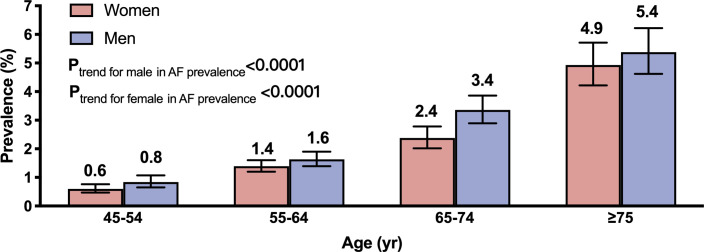
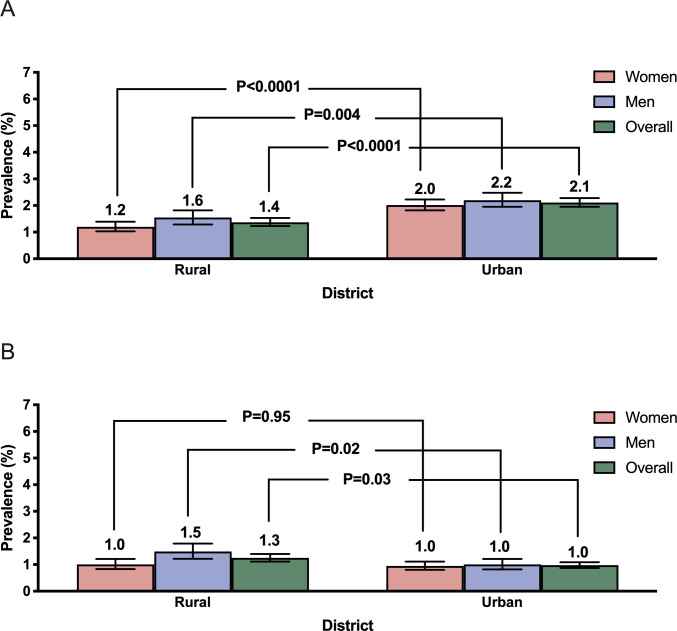
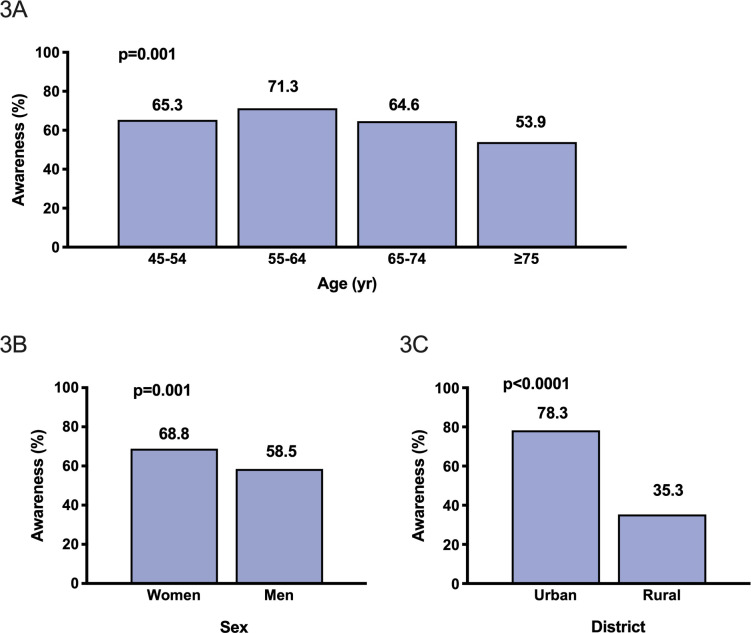
Results: The weighted AF prevalence was 1.8% (95% CI 1.7% to 1.9%), but varied from 0.9% to 2.4% across geographical regions and equates to being present in an estimated 7.9 (95% CI 7.4 to 8.4) million people in China. Among men and women, the AF prevalence increased from 0.8% and 0.6% in the age group 45-54 years to 5.4% and 4.9% in the age group ≥75 years, respectively. Proportions of people who were aware of having AF decreased overall from 65.3% in 45-54 year-olds to 53.9% in ≥75 year-olds and varied between sex (men 58.5%, women 68.8%) and residency status (urban 78.3%, rural 35.3%). Only 6.0% of patients with high-risk AF received anticoagulation therapy.
Conclusions: AF prevalence is higher than previously reported in China, with low awareness and large treatment gaps. Large-scale efforts are urgently needed to reduce AF adverse consequences.
Keywords: atrial fibrillation; epidemiology.
© Author(s) (or their employer(s)) 2021. Re-use permitted under CC BY-NC. No commercial re-use. See rights and permissions. Published by BMJ.
Conflict of interest statement
Competing interests: CM has received honoraria for presentations from AstraZeneca, Bayer Healthcare, Boehringer Ingelheim, Bristol-Myers Squibb, Johnson & Johnson and Pfizer. JDo has received honoraria for presentations from Johnson & Johnson. CA received grants from the National Health and Medical Research Council of Australia and Takeda and advisory board feeds from Amgen and Boehringer Ingelheim. HA received honoraria for presentations from Bayer, Daiichi Sankyo, MSD, Takeda, Teijin, and fees for consultancy from Kyowa Kirin. MH received grant from the World Heart Federation for the Emerging Leaders program, supported by grants from Boehringer Ingelheim and Novartis with previous support from AstraZeneca and Bupa. MH also received support from the American Heart Association, Verily and AstraZeneca and the American Medical Association for work unrelated to this project.
Figures
References
LinkOut - more resources
Full Text Sources
Other Literature Sources
Medical
