. 2021 Jan 12:11:613244.
doi: 10.3389/fpsyg.2020.613244. eCollection 2020.

Compulsive Internet Pornography Use and Mental Health: A Cross-Sectional Study in a Sample of University Students in the United States

Affiliations

Compulsive Internet Pornography Use and Mental Health: A Cross-Sectional Study in a Sample of University Students in the United States

Christina Camilleri et al. Front Psychol. .

Abstract

Background: The sustained rise in negative mental health reports among university students is a source of continued global concern, and investigation continues into potential contributors to this rise. This includes the increased prevalence of risky sexual behaviors. Related is the increased prevalence of pornography use. Our study sought to explore the potential relationship between compulsive use of pornography and mental health in university students.

Methods: Our sample consisted of university students (N = 1031; 34% male, 66% female) from Franciscan University of Steubenville, Steubenville, Ohio. An anonymous survey was sent to all students at the university over the age of 18. The survey was comprised of the following: (1) demographic questions, (2) questions on pornography use and perception, (3) a modified version of the Compulsive Internet Use Scale (mCIUS) assessing various factors associated with compulsive internet pornography use, (4) questions assessing emotional and sexual states relative to pornography use (EmSS), and (5) the 21-question version of the Depression, Anxiety and Stress Scale (DASS-21).

Results: Our results indicate that 56.6% of those surveyed reported lifetime pornography use, with a significantly higher proportion of males than females reporting such use. The majority of students reported accessing pornography through internet-related technologies. Additionally, 17.0, 20.4, and 13.5% of students reported severe or extremely severe levels of depression, anxiety and stress, respectively, with compulsive pornography use significantly affecting all three mental health parameters in both sexes. Exploratory Factor Analysis identified three factors suggesting emotional coping, dependence and preoccupation for the mCIUS items and three factors reflecting interoceptive, impotent, and extrinsic characteristics for the EmSS items. Regression analysis indicated that various demographics, items pertaining to reduced control and social impairment, and other variables pertaining to pornography use predicted mental health outcomes. Faith, morals and personal motivation were the primary variables reported to help reduce pornography use.

Conclusion: Our analyses indicate a significant relationship between mental health and pornography use, including behaviors reflecting behavioral addictions, highlighting the necessity for a better understanding and consideration of the potential contribution of internet pornography to negative mental health among university students.

Keywords: COVID-19; addictive behavior; anxiety; compulsivity; depression; mental health; pornography; stress.


Conflict of interest statement

The authors declare that the research was conducted in the absence of any commercial or financial relationships that could be construed as a potential conflict of interest.

Figures
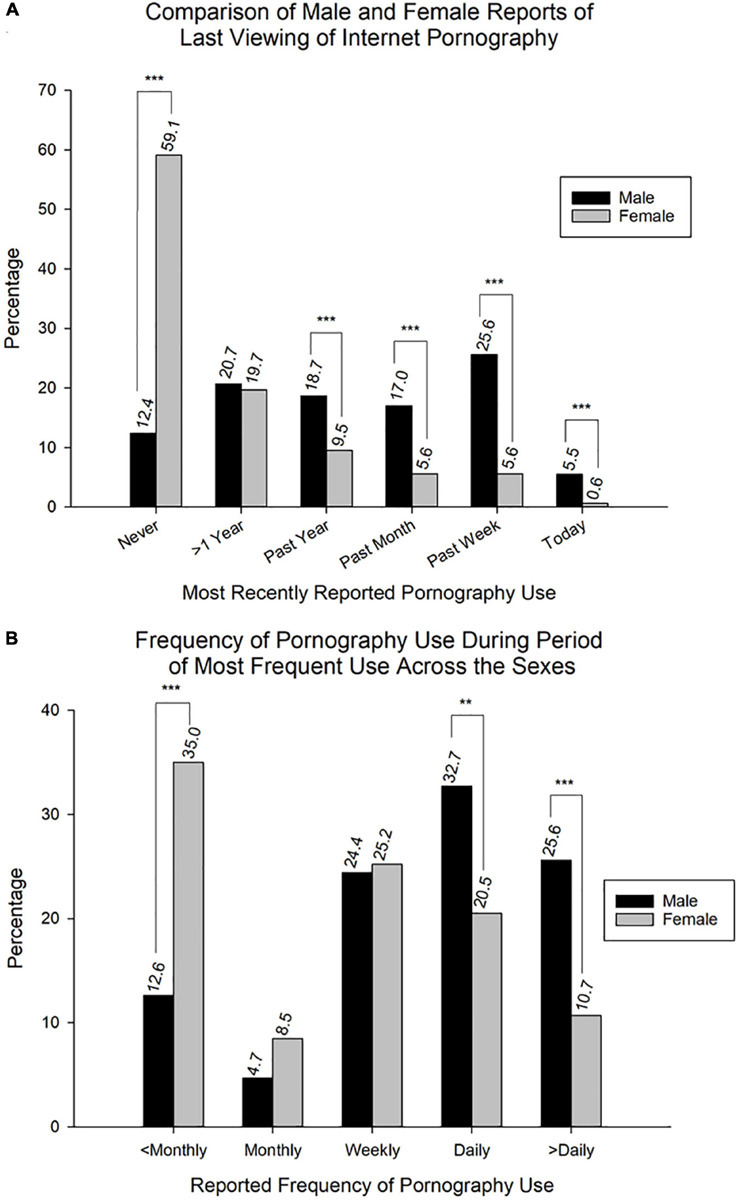
FIGURE 1
FIGURE 1
Reported pornography use across the sexes. (A) Comparison of last viewing of internet pornography reported across the sexes (N = 1031; Male: n = 347; Female: n = 684). Abbreviations for the last reported pornography use: Never, never having viewed pornography; >1 Year, more than a year ago; Past Year, within the past year; Past Month, within the past month; Past Week, within the past week; Today, today. (B) Reported frequency of pornography use during period of most frequent use in both males and females (N = 488; Male: n = 254; Female: n = 234). Abbreviations for reported frequency of pornography use: <Monthly, less than monthly; Monthly, monthly; Weekly, weekly; Daily, daily; >Daily, multiple times daily. Data is expressed as percentage of participants responding to specific options. **p < 0.01, ***p < 0.001.
FIGURE 2
FIGURE 2
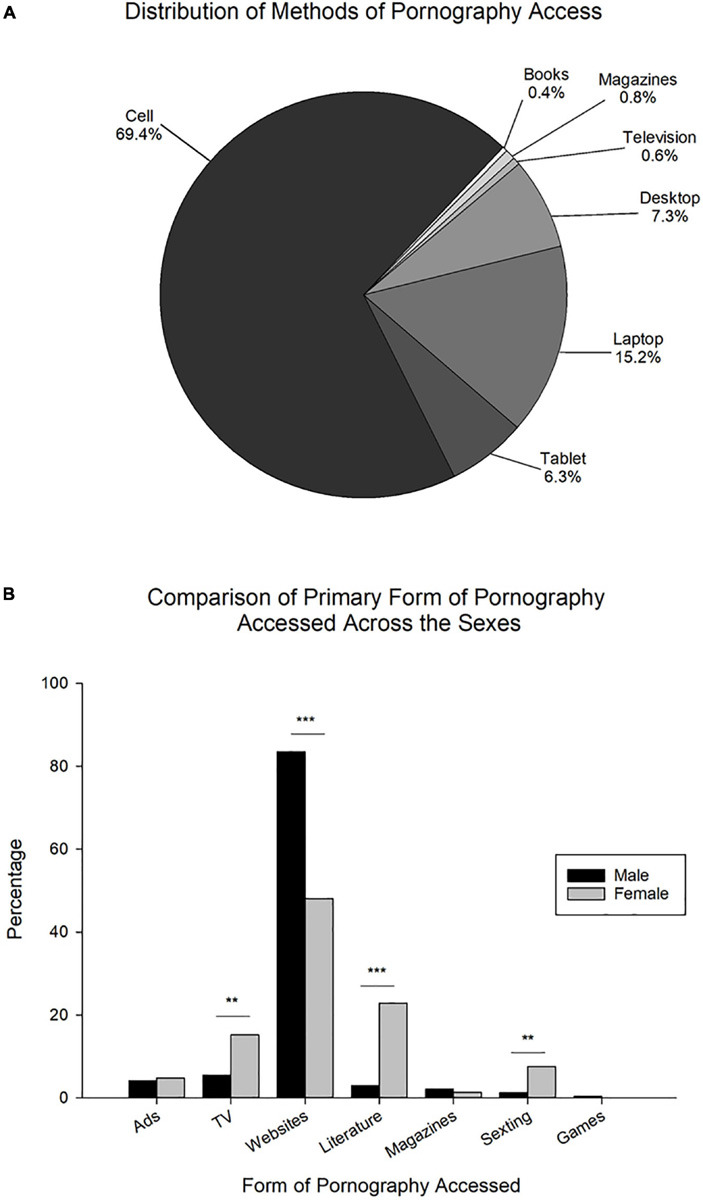
Details of pornography use during period of most frequent use. (A) Distribution of methods of pornography use. Given that no significant differences were observed between the sexes, data is shown as a percentage of males and females combined indicating specific method of access. Cell, cell phone; Books, physical (paper) books; Magazines, magazines; Television, television; Desktop, desktop computer; Laptop, laptop computer; Tablet, tablets (e.g., Kindle, iPad, etc.) (N = 488). (B) Comparison of the primary form of pornography accessed during period of most frequent use across the sexes (N = 488; Male: n = 254; Female: n = 234). Ads, advertisements on the internet; TV, TV/Movies; Websites, adult websites (e.g., pornography websites); Literature, Adult/Erotic literature; Magazines, pornographic magazines, Sexting, sexting/phone sex/hotlines/Snapchat, Games, adult video games. Data is expressed as percentage of participants responding to a specific answer choice. **p < 0.01, ***p < 0.001.
FIGURE 3
FIGURE 3
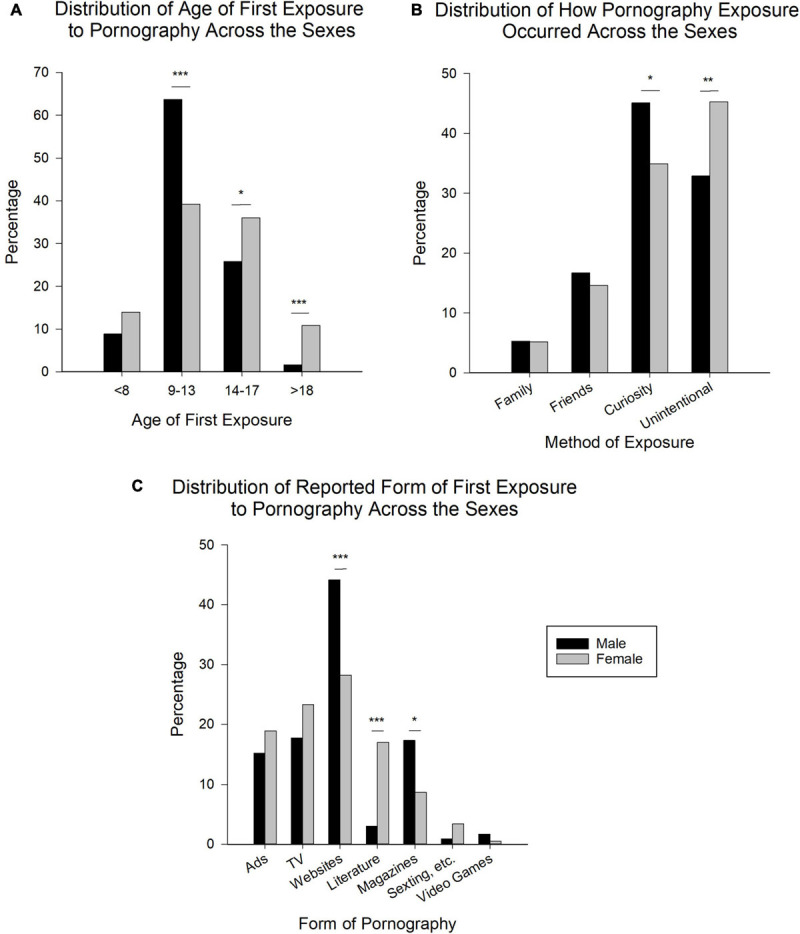
First exposure to pornography across the sexes. (A) Age of first exposure to pornography across the sexes. <8, 8 years or younger; 9–13, 9–13 years of age; 14–17, 14–17 years of age; >18, 18 years or older. (B) Distribution of how exposure to pornography occurred in males and females. Family, through family; Friends, through friends; Curiosity, personal curiosity; Unintentional, unintentional exposure. (C) Form of pornography to which first exposure occurred across the sexes. Ads, pop-ups/advertisements on the Internet; TV, television/movies; Websites, adult websites (e.g., pornography websites); Literature, adult/erotic literature; Magazines, pornography magazines; Sexting, etc., sexting/phone sex/hotlines/Snapchat; Video Games, adult video games. Data is expressed as percentage of respondents indicating specific answer choices (N = 470; Male: n = 248; Female: n = 222). *p < 0.05, **p < 0.01, ***p < 0.001.
FIGURE 4
FIGURE 4
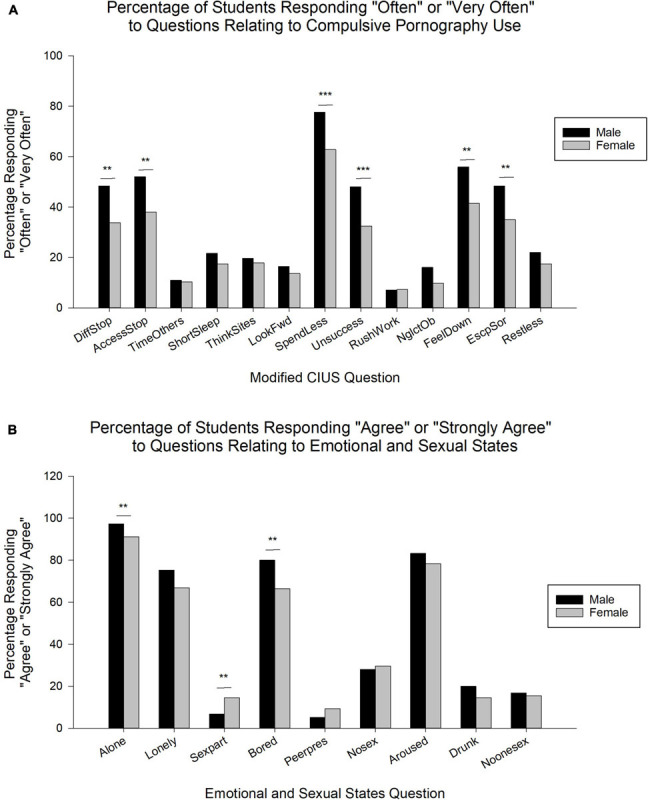
(A) Percentage of males and females responding “Often” or “Very Often” to items of the modified Compulsive Internet Use Scale related to pornography use. DiffStop, difficulty to stop accessing pornography websites; AccessStop, access despite intention to stop; TimeOthers, access pornography over spending time with others; ShortSleep, short of sleep due to pornography use; ThinkSites, think about websites when not online; LookFwd, look forward to next session of use; SpendLess, think it is necessary to spend less time; Unsuccess, unsuccessful at spending less time; RushWork, rush work to view pornography; NglctOb, neglect obligations due to pornography; FeelDown, use pornography when feeling down; EscpSor, use pornography to escape negative feelings; Restless, restless/frustrated/irritated when unable to view pornography. Data is expressed as percentage of respondents indicating “Often” or “Very Often” (N = 488; Male: n = 254; Female: n = 234). (B) Distribution of participants responding “Agree” or “Strongly Agree” to the items related to emotional and sexual states relative to pornography use across the sexes, indicating that they were more likely to view Internet pornography when by themselves (Alone), feeling lonely (Lonely), with a sexual partner (Sexpart), feeling bored (Bored), peer pressured (Peerpres), not having had sex in a while (Nosex), feeling sexually aroused (Aroused), drunk or under effects of drugs (Drunk), and unable to find someone to have sex with (Noonesex). Data is expressed as percentage of respondents indicating “Agree” or “Strongly Agree” (N = 476; Male: n = 250; Female: n = 226). **p < 0.01, ***p < 0.001.
FIGURE 5
FIGURE 5
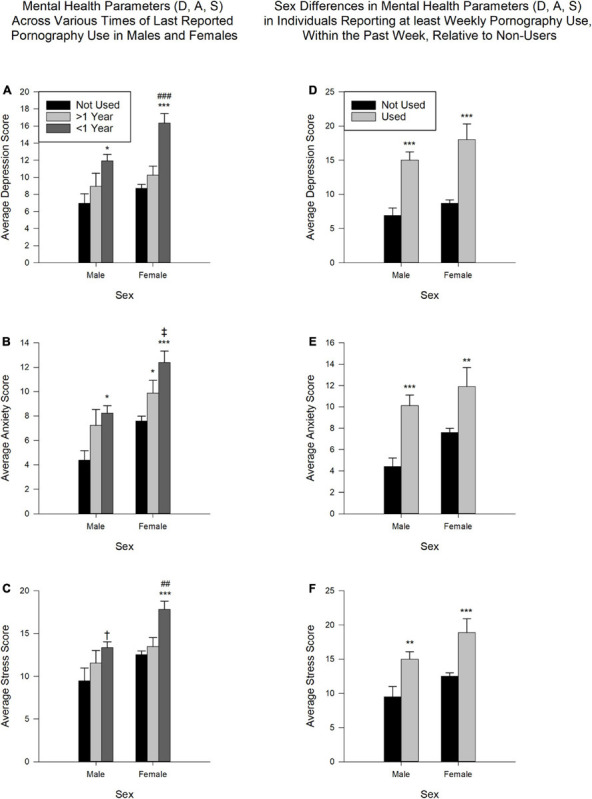
Mental health parameters in males and females relative to reported pornography use. (A–C) Depression (A), anxiety (B), and stress (C) scores across various times of last reported pornography use across the sexes (N = 872; Male: n = 278; Female: n = 594). Not Used, never having viewed pornography; >1 Year, more than a year ago; <1 Year, within the past year (i.e., Today, Within the past week, Within the past month, Within the past year). Relative to Not Used: *p < 0.05, ***p < 0.001, 0.05 < p < 0.1. Relative to >1 Year: ##p < 0.01, ###p < 0.001, 0.05 < p < 0.1. (D–F) Depression (D), anxiety (E), and stress (F) scores in participants reporting at least weekly pornography use, within the past week, relative to non-users (N = 531; Male: n = 124; Female: n = 407). Not Used, never having viewed pornography; Used, viewed pornography in the past week, at least weekly. Data is expressed as mean ± SEM. Relative to Not Used: **p < 0.01, ***p < 0.001.

References

    1. Agardh A., Cantor-Graae E., Ostergren P. O. (2012). Youth, sexual risk-taking behavior, and mental health: a study of university students in Uganda. Int. J. Behav. Med. 19 208–216. 10.1007/s12529-011-9159-4 - DOI - PMC - PubMed
    1. Algren M. H., Ekholm O., Nielsen L., Ersboll A. K., Bak C. K., Andersen P. T. (2020). Social isolation, loneliness, socioeconomic status, and health-risk behaviour in deprived neighbourhoods in Denmark: a cross-sectional study. Ssm-Population Health 10:100546 10.1016/j.ssmph.2020.100546 - DOI - PMC - PubMed
    1. Alhassan A. A., Alqadhib E. M., Taha N. W., Alahmari R. A., Salam M., Almutairi A. F. (2018). The relationship between addiction to smartphone usage and depression among adults: a cross sectional study. BMC Psychiatry 18:148. 10.1186/s12888-018-1745-4 - DOI - PMC - PubMed
    1. American Psychiatric Association (2013). Diagnostic and Statistical Manual of Mental Disorders, 5th Edn Washington, DC: American Psychiatric Association.
    1. Arnold A. J., Winkielman P., Dobkins K. (2019). Interoception and social connection. Front. Psychol. 10:2589. 10.3389/fpsyg.2019.02589 - DOI - PMC - PubMed

LinkOut - more resources