


Allergen skin test reactivity and asthma are inversely associated with ratios of IgG4/IgE and total IgE/allergen-specific IgE in Ugandan communities
- PMID: 33512036
- PMCID: PMC7610822
- DOI: 10.1111/cea.13834
Allergen skin test reactivity and asthma are inversely associated with ratios of IgG4/IgE and total IgE/allergen-specific IgE in Ugandan communities
Abstract
Background: Serum inhibition of allergen-specific IgE has been associated with competing IgG4 and non-specific polyclonal IgE. In allergen immunotherapy, beneficial responses have been associated with high IgG4/IgE ratios. Helminths potentiate antibody class switching to IgG4 and stimulate polyclonal IgE synthesis; therefore, we hypothesized a role for helminth-associated IgG4 and total IgE in protection against atopic sensitization and clinical allergy (asthma) in tropical low-income countries.
Methods: Among community residents of Ugandan rural Schistosoma mansoni (Sm)-endemic islands and a mainland urban setting with lower helminth exposure, and among urban asthmatic schoolchildren and non-asthmatic controls, we measured total, Schistosoma adult worm antigen (SWA)-specific, Schistosoma egg antigen (SEA)-specific and allergen (house dust mite [HDM] and German cockroach)-specific IgE and IgG4 by ImmunoCAP® and/or ELISA. We assessed associations between these antibody profiles and current Sm infection, the rural-urban environment, HDM and cockroach skin prick test (SPT) reactivity, and asthma.
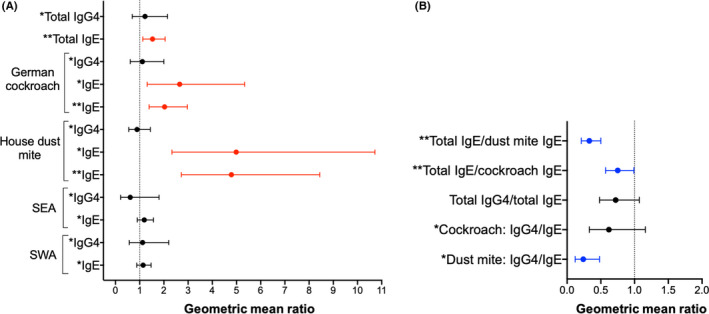
Results: Total IgE, total IgG4 and SWA-, SEA- and allergen-specific IgE and IgG4 levels were significantly higher in the rural, compared to the urban setting. In both community settings, both Sm infection and SPT reactivity were positively associated with allergen-specific and total IgE responses. SPT reactivity was inversely associated with Schistosoma-specific IgG4, allergen-specific IgG4/IgE ratios and total IgE/allergen-specific IgE ratios. Asthmatic schoolchildren, compared with non-asthmatic controls, had significantly higher levels of total and allergen-specific IgE, but lower ratios of allergen-specific IgG4/IgE and total IgE/allergen-specific IgE.
Conclusions and clinical relevance: Our immuno-epidemiological data support the hypothesis that the IgG4-IgE balance and the total IgE-allergen-specific IgE balance are more important than absolute total, helminth- or allergen-specific antibody levels in inhibition of allergies in the tropics.
Keywords: Schistosoma; IgE; IgG4; allergen; asthma; skin prick test.
© 2021 The Authors. Clinical & Experimental Allergy published by John Wiley & Sons Ltd.
Conflict of interest statement
The authors declare no conflict of interest.
Figures


References
-
- Leonardi‐Bee J, Pritchard D, Britton J. Asthma and current intestinal parasite infection: systematic review and meta‐analysis. Am J Respir Crit Care Med. 2006;174(5):514‐523. - PubMed
-
- Cooper PJ, Chico ME, Rodrigues LC, et al. Reduced risk of atopy among school‐age children infected with geohelminth parasites in a rural area of the tropics. J Allergy Clin Immunol. 2003;111(5):995‐1000. - PubMed
-
- Cooper PJ, Chico ME, Bland M, Griffin GE, Nutman TB. Allergic symptoms, atopy, and geohelminth infections in a rural area of Ecuador. Am J Respir Crit Care Med. 2003;168(3):313‐317. - PubMed
-
- van den Biggelaar AH, Lopuhaa C, van Ree R, et al. The prevalence of parasite infestation and house dust mite sensitization in Gabonese schoolchildren. Int Arch Allergy Immunol. 2001;126(3):231‐238. - PubMed
Publication types
MeSH terms
Substances
Grants and funding
- MC_UU_00027/5/MRC_/Medical Research Council/United Kingdom
- 102512/WT_/Wellcome Trust/United Kingdom
- Medical Research Council (MRC) and the UK Department for International Development (DFID) under the MRC/DFID Concordat agreement
- 095778/WT_/Wellcome Trust/United Kingdom
- 107743/WT_/Wellcome Trust/United Kingdom
LinkOut - more resources
Full Text Sources
Other Literature Sources
Medical
