


Activated protein C has a regulatory role in factor VIII function
- PMID: 33512448
- PMCID: PMC8109017
- DOI: 10.1182/blood.2020007562
Activated protein C has a regulatory role in factor VIII function
Abstract
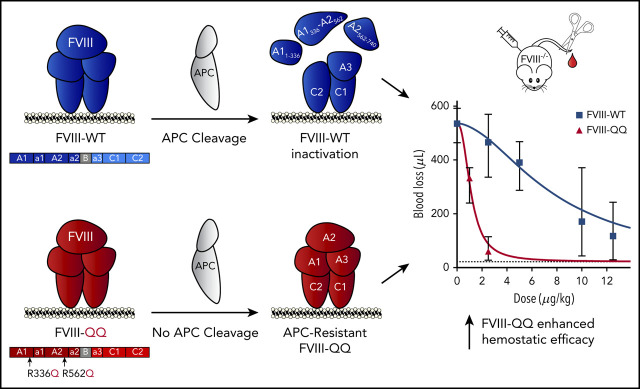
Mechanisms thought to regulate activated factor VIII (FVIIIa) cofactor function include A2-domain dissociation and activated protein C (APC) cleavage. Unlike A2-domain dissociation, there is no known phenotype associated with altered APC cleavage of FVIII, and biochemical studies have suggested APC plays a marginal role in FVIIIa regulation. However, the in vivo contribution of FVIIIa inactivation by APC is unexplored. Here we compared wild-type B-domainless FVIII (FVIII-WT) recombinant protein with an APC-resistant FVIII variant (FVIII-R336Q/R562Q; FVIII-QQ). FVIII-QQ demonstrated expected APC resistance without other changes in procoagulant function or A2-domain dissociation. In plasma-based studies, FVIII-WT/FVIIIa-WT demonstrated dose-dependent sensitivity to APC with or without protein S, whereas FVIII-QQ/FVIIIa-QQ did not. Importantly, FVIII-QQ demonstrated approximately fivefold increased procoagulant function relative to FVIII-WT in the tail clip and ferric chloride injury models in hemophilia A (HA) mice. To minimize the contribution of FV inactivation by APC in vivo, a tail clip assay was performed in homozygous HA/FV Leiden (FVL) mice infused with FVIII-QQ or FVIII-WT in the presence or absence of monoclonal antibody 1609, an antibody that blocks murine PC/APC hemostatic function. FVIII-QQ again demonstrated enhanced hemostatic function in HA/FVL mice; however, FVIII-QQ and FVIII-WT performed analogously in the presence of the PC/APC inhibitory antibody, indicating the increased hemostatic effect of FVIII-QQ was APC specific. Our data demonstrate APC contributes to the in vivo regulation of FVIIIa, which has the potential to be exploited to develop novel HA therapeutics.
© 2021 by The American Society of Hematology.
Conflict of interest statement
Conflict-of-interest disclosure: R.M.C. and L.A.G. hold intellectual property related to this work. The remaining authors declare no competing financial interests.
Figures


References
-
- Eaton D, Rodriguez H, Vehar GA. Proteolytic processing of human factor VIII. Correlation of specific cleavages by thrombin, factor Xa, and activated protein C with activation and inactivation of factor VIII coagulant activity. Biochemistry. 1986;25(2):505-512. - PubMed
-
- Vehar GA, Keyt B, Eaton D, et al. Structure of human factor VIII. Nature. 1984;312(5992):337-342. - PubMed
-
- Lollar P, Hill-Eubanks DC, Parker CG. Association of the factor VIII light chain with von Willebrand factor. J Biol Chem. 1988;263(21):10451-10455. - PubMed
-
- Fay PJ, Smudzin TM. Characterization of the interaction between the A2 subunit and A1/A3-C1-C2 dimer in human factor VIIIa. J Biol Chem. 1992;267(19):13246-13250. - PubMed
-
- Hill-Eubanks DC, Lollar P. von Willebrand factor is a cofactor for thrombin-catalyzed cleavage of the factor VIII light chain. J Biol Chem. 1990;265(29):17854-17858. - PubMed
Publication types
MeSH terms
Substances
Grants and funding
LinkOut - more resources
Full Text Sources
Other Literature Sources
Medical
Molecular Biology Databases
