Review
. 2021 Jan 29;23(2):12.
doi: 10.1007/s11926-020-00978-5.

T Cell Abnormalities in the Pathogenesis of Systemic Lupus Erythematosus: an Update

Affiliations
Review

T Cell Abnormalities in the Pathogenesis of Systemic Lupus Erythematosus: an Update

Ping-Min Chen et al. Curr Rheumatol Rep. .

Abstract

Purpose of review: Systemic lupus erythematosus is a complex disease with broad spectrum of clinical manifestations. In addition to abnormal B cell responsive leading to autoantibody production, various T cells also play different roles in promoting systemic autoimmunity and end organ damage. We aim to provide a review on recent developments in how abnormalities in different T cells subsets contribute to systemic lupus erythematosus pathogenesis and how they inform the consideration of new promising therapeutics.

Recent findings: Distinct subsets of T cells known as T follicular helper cells enable the production of pathogenic autoantibodies. Detailed understanding of the B cell helping T cell subsets should improve the performance of clinical trials targeting the cognate T:B cell interaction. CD8+ T cells play a role in peripheral tolerance and reversal of its exhausted phenotype could potentially alleviate both systemic autoimmunity and the risk of infection. Research on the abnormal lupus T cell signaling also leads to putative therapeutic targets able to restore interleukin-2 production and suppress the production of the pathogenic IL-17 cytokine. Recently, several studies have focused on dissecting T cell populations located in the damaged organs, aiming to target the pathogenic processes specific to each organ. Numerous T cell subsets play distinct roles in SLE pathogenesis and recent research in understanding abnormal signaling pathways, cellular metabolism, and environmental cues pave the way for the development of novel therapeutics.

Keywords: Lupus; SLE; T cells.


Conflict of interest statement

Conflict of Interest The authors declare that they have no conflicts of interest.

Figures

Fig. 1
Fig. 1
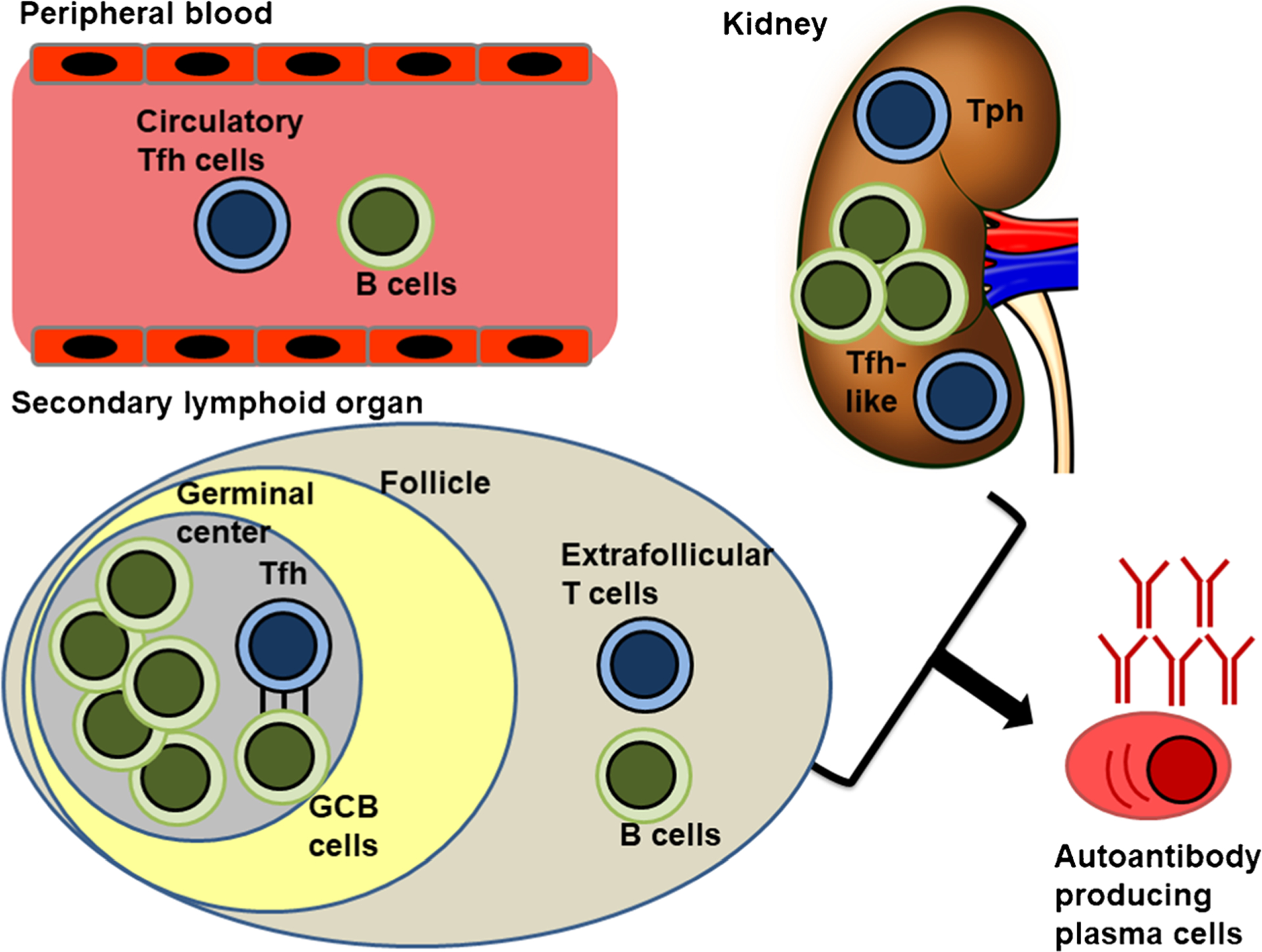
T cell subsets involved in promoting autoantibody-producing plasma cells through aberrant T-B interaction. T follicular helper (Tfh) promotes germinal center B cells (GCB) affinity maturation and class switch in a contact-dependent manner. Other non-canonical T cells subsets include extrafollicular T cells, circulatory Tfh cell, peripheral helper (Tph) cells, and Tfh-like cells residing in damaged organ
Fig. 2
Fig. 2
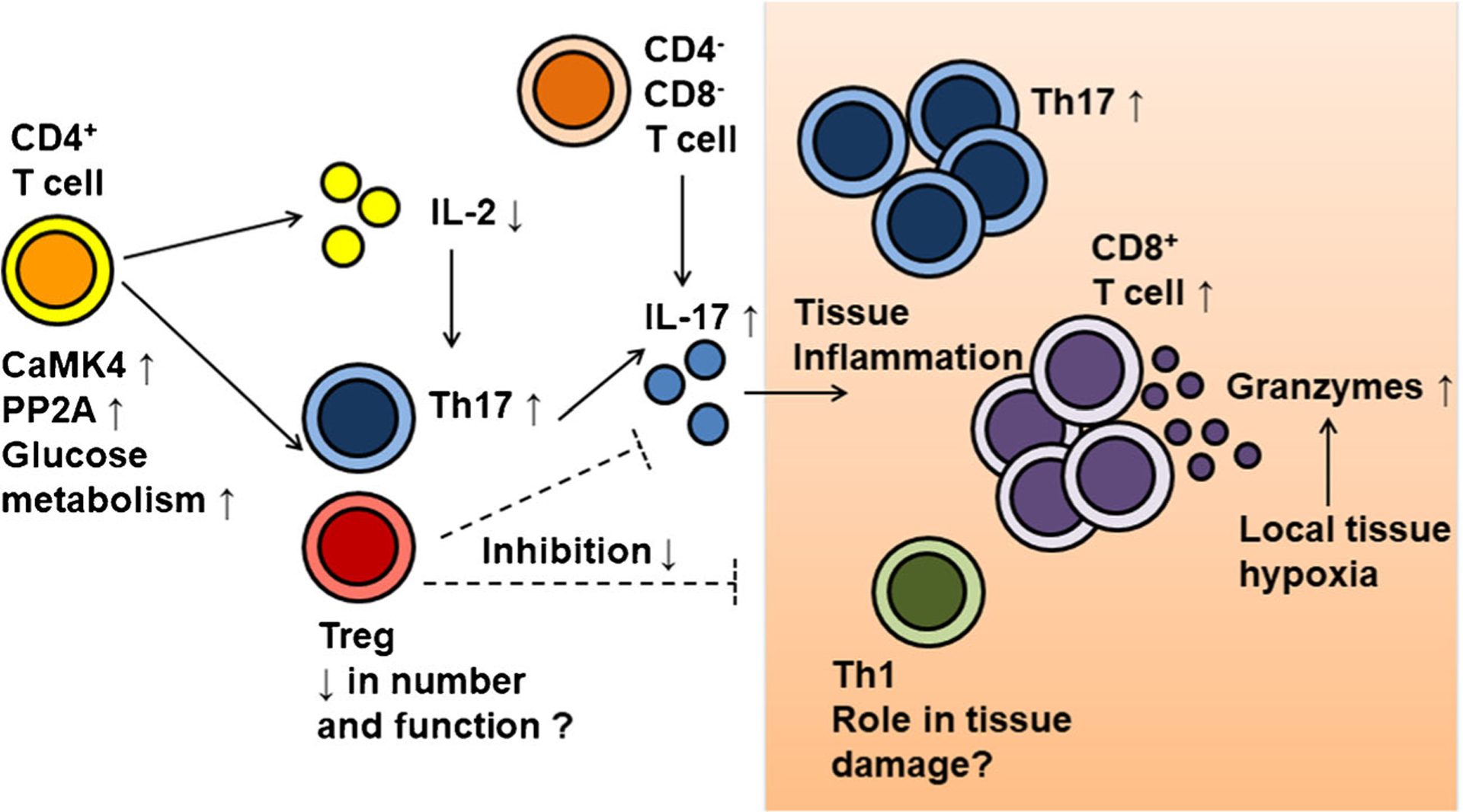
Dysregulated T cell subset distribution and function involved in driving lupus pathogenesis. Abnormality of CD4+ function and signaling, including increased calcium/calmodulin-dependent protein kinase IV (CaMK4), serine/threonine protein phosphatase 2A (PP2A), and glucose metabolism, cause reduction in IL-2 production and the imbalance of Th17/ regulatory T cells (Treg). Reduction of Treg numbers and function may partly play a role in lupus pathogenesis through inadequate suppression of systemic and tissue inflammation. Meanwhile, increased IL-17 production by Th17 and CD4 CD8 double-negative T cells contributes to tissue inflammation. Increased numbers of Th17 and CD8+ T cells indicate their pathogenic roles, and increased effector function of tissue-infiltrating T cells may be caused of local factors, such as hypoxia

References

    1. Olsen NJ, Karp DR. Autoantibodies and SLE: the threshold for disease. Nat Rev Rheumatol. 2014;10(3):181–6. 10.1038/nrrheum.2013.184. - DOI - PubMed
    1. Tsokos GC. Systemic lupus erythematosus. N Engl J Med. 2011;365(22):2110–21. 10.1056/NEJMra1100359. - DOI - PubMed
    1. Tsokos GC. Autoimmunity and organ damage in systemic lupus erythematosus. Nat Immunol. 2020;21(6):605–14. 10.1038/s41590-020-0677-6. - DOI - PMC - PubMed
    1. Seth A, Craft J. Spatial and functional heterogeneity of follicular helper T cells in autoimmunity. Curr Opin Immunol. 2019;61:1–9. 10.1016/j.coi.2019.06.005. - DOI - PMC - PubMed
    1. Apostolidis SA, Lieberman LA, Kis-Toth K, Crispín JC, Tsokos GC. The dysregulation of cytokine networks in systemic lupus erythematosus. J Interf Cytokine Res. 2011;31(10):769–79. 10.1089/jir.2011.0029. - DOI - PMC - PubMed